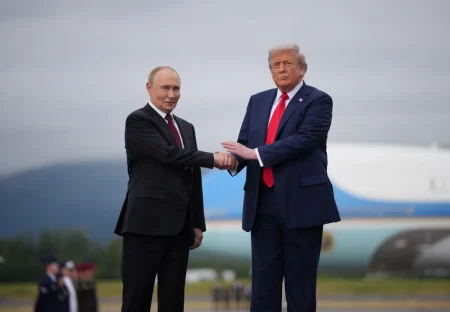




President Donald Trump has never been one to avoid a fight—but this time, the fight is coming from his own side. On a Friday evening in late September, with little fanfare, Trump signed an executive order that effectively paused key sanctions and tariffs on Russia, just weeks after signing a bill named for his late ally, Senator Lindsey Graham, that was designed to punish Moscow for its war in Ukraine. The move sent shockwaves through Washington, drawing sharp rebukes from Republicans and Democrats alike, and triggering an emotional response from Ukrainian President Volodymyr Zelensky, who saw it as a devastating blow at a moment when Russian missiles were pummeling his country’s energy grid. At the same time, a senior Russian official praised the decision as “historic.” The contrast could not have been starker: while American lawmakers accused the president of caving to a dictator, Moscow celebrated what it saw as a weakening of Western resolve. For many observers, the executive order felt like a sudden reversal—a policy shift that appeared to undermine the very law Trump had championed only weeks earlier, and one that raised painful questions about the future of U.S. leadership, the fate of Ukraine, and the murky intersection of energy politics and war.
The legislation at the center of the storm, formally known as the Lindsey O. Graham Sanctioning Russia and Iran Act, had been signed into law by Trump on September 18 after passing the Senate with a stunning 86–11 vote. It was crafted to squeeze Russia’s economy by targeting officials, banks, and the sprawling network of tankers that moves Russian oil and gas around the world. Perhaps most dramatically, the law authorized a 500 percent tariff on goods imported from Russia, and opened the door to 100 percent tariffs on goods from the five largest importers of Russian crude oil and natural gas if they purchased new supplies after October 18. Additional tariffs could hit countries that helped Russia evade sanctions. These measures were designed to ratchet up pressure on Moscow to end a war that has killed tens of thousands since February 2022. But Trump’s executive order brushed those provisions aside, at least for now. The order declared that the sanctions, restrictions, and duties in the Graham Act were waived in the national interest of the United States. What that meant in practical terms was immediate: the tariffs and sanctions that were set to take effect on Sunday would not be imposed, and the economic hammer the law promised would remain suspended. The White House did not offer a detailed public explanation at first, but the decision fit a broader pattern—Trump has repeatedly said he wants to lower energy prices for American consumers, and he has shown interest in engaging directly with Russian leader Vladimir Putin.
Republican lawmakers were among the first to express their fury, and their words carried a particular sting because they came from the president’s own party. Senator Thom Tillis of North Carolina, a Republican who had voted for the sanctions bill, called the waiver “beyond irresponsible.” In a pointed social media post, he asked, “What part of enforcing a law passed 86–11 by the Senate does the President and his advisors not understand?” Tillis went on to say it was “unconscionable” that the administration was “capitulating to a Russian dictator who illegally invaded Ukraine and butchers innocent civilians every single day.” Representative Don Bacon, a Republican from Nebraska, echoed that sentiment with a stark warning: “The President is prolonging the war, not ending it.” Senator John Cornyn of Texas, who had been a close ally of Lindsey Graham, wrote simply, “Lindsey would be appalled.” Even Republican Governor Kevin Stitt of Oklahoma, who had earlier voiced doubts about the approach, suggested that easing pressure on Russia would do little to lower fuel prices and could extend the suffering in Ukraine. But not all Republicans were opposed. Patrick Casale, a senior adviser to Nevada GOP chairman Michael McDonald, argued that Trump’s decision was part of a broader strategy to bring down diesel prices and push both sides toward the negotiating table. Casale dismissed the critics as Republicans who “will do anything in their power to hurt him,” and suggested that the waiver might finally “motivate Ukraine and Russia to sit down and end the war.” It was a revealing split—between those who saw the waiver as a betrayal of American values and allies, and those who saw it as a pragmatic, if controversial, step toward peace.
For Democrats and for Ukraine, the reaction was even more visceral. Senate Minority Leader Chuck Schumer delivered a biting one-liner, saying that Trump had given Putin “the best birthday gift he’ll get this year.” Schumer went on to accuse the president of putting the Russian economy on life support, adding, “There’s nothing America First about Trump caving in to Putin and exempting Russia from US sanctions.” Senator Richard Blumenthal, a Connecticut Democrat who helped draft the sanctions legislation, was blunter still. He described Trump as standing “on the side of a bloodthirsty thug and the enablers of Russia’s war machine,” and insisted that the waivers had nothing to do with national security and everything to do with “sucking up to Vladimir Putin.” Meanwhile, in Ukraine, President Zelensky addressed the decision with a sorrow that seemed to come from a place of deep exhaustion. He noted that Russia had just launched one of its largest attacks on Ukraine’s energy sector, striking more than 15 power facilities, killing at least four people, and wounding dozens more. And in that moment, he said, the United States had chosen to disregard the Lindsey Graham Act—the very law that was supposed to apply “truly effective pressure” on Russia to stop its aggression. The timing made the decision feel almost cruel to many Ukrainians, who have spent years pleading for stronger support only to watch the most powerful country in the world ease off at a critical moment. The waiver, combined with Trump’s recent outreach to Moscow, left Kyiv and its supporters grappling with a troubling sense that the United States might no longer be the reliable ally it once was.
The Russian reaction only deepened that unease. Kirill Dmitriev, a special envoy to President Putin, called the suspension of some provisions of the Graham Act “an important and truly historic moment.” It was a striking sign of how much the political landscape had shifted. Just a year earlier, the idea of the United States waiving sanctions on Russia would have seemed almost unthinkable; now, a senior Russian official was openly celebrating a decision by an American president. The waiver also did not exist in a vacuum. A week earlier, Trump had announced a deal with Putin to increase diesel supplies to U.S. and global markets, a move intended to ease rising energy prices that was immediately criticized by a bipartisan group of twelve senators. In an October 13 letter, they argued that allowing Moscow to sell Russian diesel freely in global markets would give Putin additional revenue to fund his war—“a gift to our adversary and a betrayal of our allies.” White House spokeswoman Taylor Rogers defended the approach, saying Trump had successfully negotiated a great deal to supply the global market with massive amounts of diesel and bring prices down, while also urging both sides to stop strikes against refineries. But critics saw a dangerous pattern: a president who talked about peace while undermining the very tools that could force Russia to negotiate in good faith. The executive order made no explicit mention of the diesel deal, and no direct link was established, but the sequence of events suggested a coherent strategy—one that prioritized American fuel prices and diplomatic outreach over the sanctions architecture that Congress had built.
In the end, the controversy over Trump’s waiver is about more than tariffs or diesel. It is a story about the meaning of leadership and the difficulty of balancing competing priorities. There is no question that high energy prices hurt American families, farmers, and truckers, and any president would want to address that. There is also no question that ending a war that kills thousands every month is a noble goal. But at what cost? By waiving the Graham Act, Trump signaled to Moscow that the United States was willing to soften its stance, and to Ukraine that its sacrifices might no longer be met with unwavering support. For lawmakers on both sides, that was a step too far—a decision that undermined the force of American law, strained alliances, and handed a propaganda victory to a man who has shown little interest in genuine peace. The coming months will reveal whether Trump’s gamble pays off: whether the waiver pushes Russia and Ukraine to the negotiating table, or whether it simply gives Putin breathing room to continue his assault. Each side sees a different truth. The president sees a path to lower prices and an end to the killing. His critics see capitulation to a dictator and a betrayal of the values that have defined U.S. foreign policy for generations. Either way, the decision has opened a new and troubling chapter in America’s relationship with the world—one in which the line between strength and surrender, between pragmatism and principle, has never appeared more blurred.