


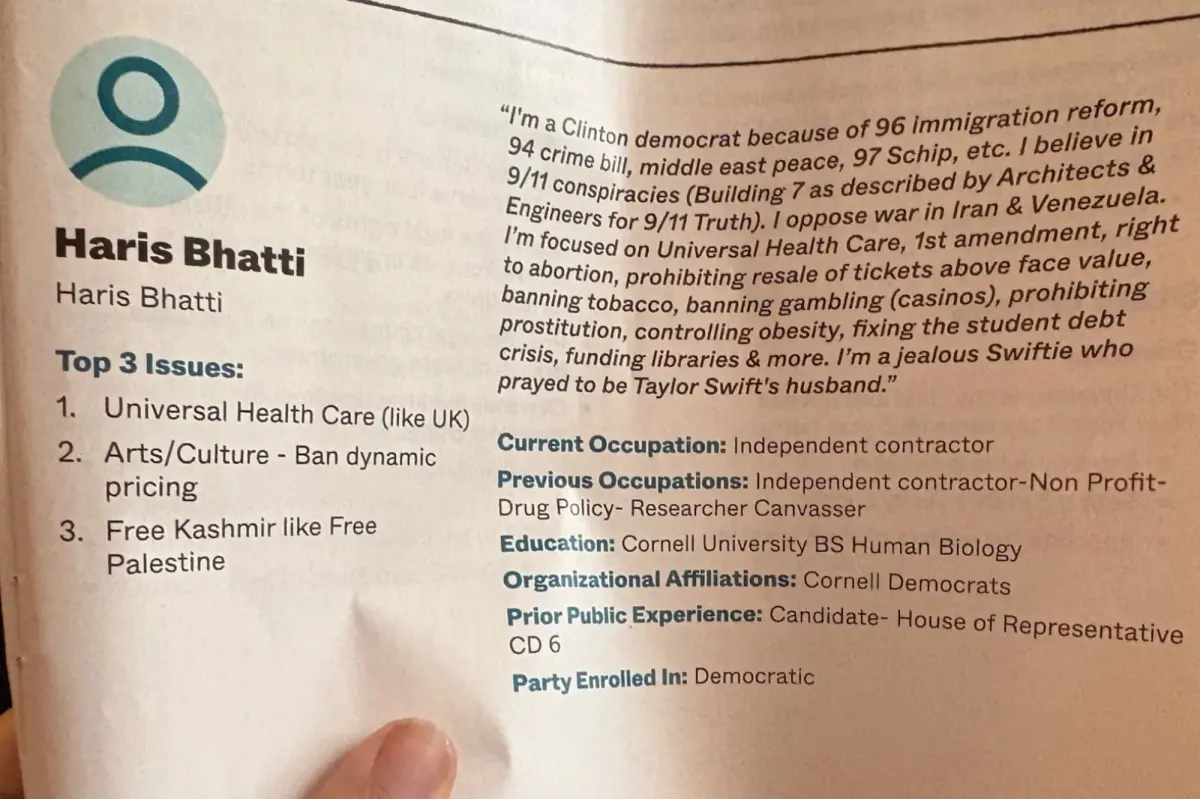
The fate of Ophelia is on this year’s ballot—or at least that is how the story opens for Manhattan voters who pulled the official NYC Voter Guide out of their mailboxes and found themselves not in a familiar political debate but in the middle of a strange, one-sided romance with Taylor Swift. In the weeks before the general election, thousands of residents in City Council District 3 on the West Side received a very official-looking pamphlet from NYC Votes, produced by the nonpartisan New York City Campaign Finance Board, and inside it was a candidate biography that did not sound like any political profile they had ever seen. The candidate, Haris Bhatti, described himself in his own words as “a jealous Swiftie who prayed to be Taylor Swift’s husband.” That line, printed just below his name and next to his policy goals, turned a routine election mailer into something closer to a fan confession or a comedy sketch. The race itself was notable for a different reason: it was the only City Council contest on the general election ballot, an off-year race where the incumbent Carl Wilson, who had won a special election earlier in the spring, was being challenged by the independent Bhatti. For many voters, the guide contained just those two names, which meant that the eccentric candidate was not a footnote but a major feature of their voting packet. Social media reacted quickly. One user posted a photo of the mailer and pleaded with everyone to “wake up and look at who they used as an example for the city council voting guide for the upcoming election because it’s insane.” Another joked that the combination of a Taylor Swift marriage fantasy and a ban on tobacco made the candidate seem impossible. But Bhatti was not a prank. He was a real person who had fought to get his name on the ballot, and he was using his one chance to speak to voters to tell them exactly who he was—including the parts that made no political sense.
Who is Haris Bhatti, really? He is the kind of candidate who makes people wonder whether they have wandered into an alternate timeline. A Cornell University graduate, he had run for Congress in 2016, which showed that he had at least some interest in public life long before Taylor Swift came to dominate his bio. But he did not have a typical political résumé, and his platform reflected a fiercely independent, sometimes contradictory worldview. On his campaign website, he listed no fewer than twenty-six platform points, beginning with calls to ban smoking, vaping, and gambling, all the way to “fixing the student debt crisis” and, more troublingly, promoting 9/11 conspiracy theories. For a district that sits in the shadow of the World Trade Center attack, that last point alone would have been enough to disqualify him in the eyes of many voters. Yet there he was on the official guide, with a campaign manager, a small fundraising total of just over $15,000, and a public position that was equal parts earnest ambition and bordering-on-parody behavior. His road to the ballot had not been easy. He had originally tried to challenge Wilson in the special election in April, but could not collect the required 450 signatures to qualify. Rather than give up, he kept going, gathered enough signatures for the general election, and won a spot on the independent line. When asked why he was running against a sitting councilman who had just been elected, Bhatti did not offer the usual grand pronouncements about saving the city. He said he was testing the waters, gaining political experience, and trying to figure out whether he belonged in this world at all. There was something almost refreshing about that honesty. He seemed to know, better than anyone, that his campaign was a long shot. “We know it’s a longshot,” he told reporters. The statement carried no arrogance, no delusion, just a strange kind of clarity that is rare in modern politics.
The obsession with Taylor Swift, however, was never presented as a joke. Bhatti admitted in an interview that the pop superstar was one of the reasons he decided to run in the first place. “First I was trying to get the attention of a female celebrity I admire. Second, there are issues I want to make more mainstream,” he said. That explanation may not make his candidacy seem more logical, but it does make it more human. There is a frankness in admitting that a dream about a celebrity marriage and a desire to ban cigarettes can share space in the same heart. The fact that Swift is famously in a relationship with Kansas City Chiefs tight end Travis Kelce made Bhatti’s “prayed to be her husband” line even more hopelessly romantic, in the most absurd sense. It was as if he had written his voter guide bio as a private diary entry and accidentally submitted it to the city. The public response ranged from mockery to disbelief. One X user wrote: “Yes, the Swiftie thing is hilarious, but banning tobacco?? Who is this person???? this must be a joke bc I literally think this collection of political preferences does not exist in a single person in the country.” The comment captured why the mailer felt so strange: no one expected a candidate to be a fan of one of the most famous women in the world, a critic of smoking, a conspiracy theorist, and a student debt activist all at once. But people are never simple, and Bhatti refused to reduce himself for the sake of appearing conventional. He wore his contradictions openly. In that way, he may have accidentally become the most authentic person on the ballot—not because his views were coherent, but because he did not hide any part of himself for political comfort.
The reaction to Bhatti’s candidacy also says something important about the machinery of New York City elections. The Voter Guide is not a place where candidates get to edit themselves into polished emptiness; it is a public document designed to include anyone who follows the rules and makes it onto the ballot. Aaron Ghitelman, the press secretary for the Campaign Finance Board, explained that all candidates who appear on the ballot are eligible to participate in the guide, regardless of how much money they have raised. The City Charter explicitly requires the print guide to include every city candidate and every citywide ballot proposal. This is a beautiful and messy commitment to democratic inclusion. The consequence is that sometimes the system produces a brochure with a jealous Swiftie next to an incumbent councilman, and the system is expected to treat them both with equal seriousness. Some voters posted online that because this was the only Council race in their packet, they had no other political contest to compare it with. “Received an NYC Voter Guide for the General Election. Because this is an off-year for City Council elections, these are the only 2 candidates in my packet,” one X user noted. “Seems like a pretty easy choice,” another replied. The easy joke was that the choice was obvious—vote for anyone other than the man who wanted to marry Taylor Swift. But the deeper point is that the guide worked the way it should. It gave voters a chance to see who was running, even when one of those people was exceptionally strange. In a political culture where candidates are often selected by committees, fundraisers, and pollsters, Bhatti’s presence on the official guide is a reminder that citizens can still force their way into the conversation. The ballot belongs to the people, not just to the credible or the powerful. That is uncomfortable, unpredictable, and somehow exactly what democracy promises.
For all the laughter, Bhatti built an actual campaign infrastructure. He raised more than $15,000, hired a campaign manager, and published a long list of policy ideas. He did not simply write one silly line and disappear. He was interviewed, he answered questions, and he explained himself without running away from the parts that were embarrassing. There was a strange dignity in that. He admitted that his political positions ranged from serious to deeply problematic, and he did not seem to understand why people found the mix amusing. But perhaps that is the real lesson of his candidacy: there is no such thing as a perfect political story. In a world where every move is calculated, Bhatti moved awkwardly but honestly. He may believe things that most New Yorkers reject, especially the 9/11 conspiracy theories, which should not be excused or treated as harmless. But the rest of his campaign—the student debt passion, the desire to ban nicotine and gambling, the dream of marrying Taylor Swift—presents a picture of a man who is not afraid to be fully seen. He wanted to test the waters, and he did. He wanted to gain experience, and he certainly got it. Whether he wins or loses, he has accomplished more than most people who dream about entering politics: he forced the public to pay attention. In an era when local elections are often ignored, Bhatti made District 3 the most talked-about Council race in the city. He did not do it through a famous endorsement or huge donations. He did it by being unforgettable.
In the end, the fate of Ophelia—whatever or whoever Ophelia may be—will be decided in the quiet act of voting. But so will the fate of Haris Bhatti, and of the dream he had when he looked at a city that did not know him and decided to run anyway. When voters enter the booth in November, they will face a choice between Wilson, a candidate who represents institutional stability and mainstream political expectations, and Bhatti, a longshot independent who loves Taylor Swift, wants to ban tobacco, and believes things that most people would rather not be printed on official city stationary. It is tempting to laugh at the whole affair, and many voters have done exactly that. Yet beneath the absurdity, there is something unexpectedly moving about a person who puts his heart on the line in public, with no realistic chance of victory, simply because he was tired of staying quiet. Bhatti’s campaign may not change the City Council, but it has already changed the way thousands of New Yorkers looked at their mail. It made them stop, reread, and wonder: who is this person, and why is he in my house? That moment of confusion is not a sign that democracy is broken. It is a sign that it is alive. The ballot is full of people who are complicated, contradictory, and sometimes even ridiculous. That is not a flaw. That is the human condition. And perhaps the true lesson of this strange little campaign is that no matter how much we try to make politics clean and professional, it will always be shaped by real people with real obsessions, real dreams, and real inability to keep those things hidden. So go vote. Vote for the candidate you trust, the candidate who makes sense, the candidate who will actually serve your neighborhood. But before you do, try to keep a little patience for the jealous Swiftie who had the courage to show himself fully, even if the only thing he ended up winning was our attention.