


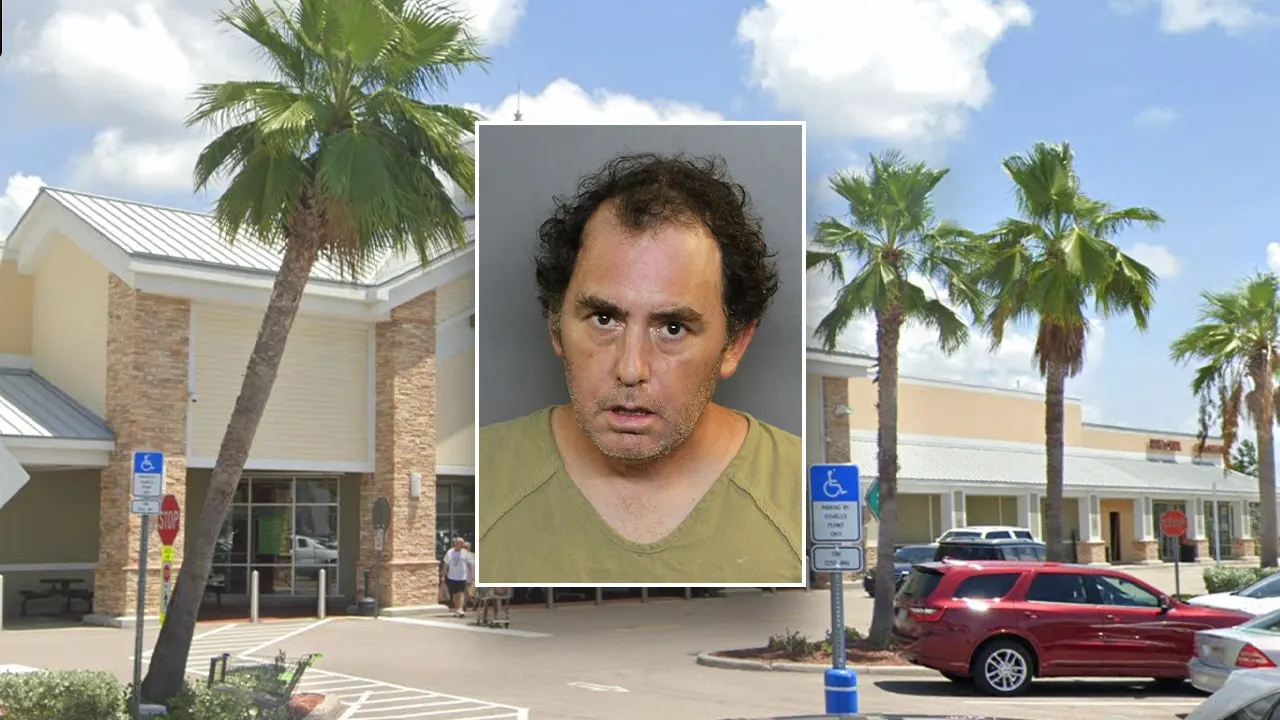
The afternoon sun slanted through the big glass windows of the Publix Super Market on Tamiami Trail in Punta Gorda, Florida, casting the kind of warm, golden light that makes an ordinary grocery run feel like a small, peaceful ritual. Carts rolled slowly down the aisles, shoppers studied labels, and the air smelled of fresh bread and citrus. David Terry, 70, was doing what millions of Americans do every day: reaching for items, checking a list, thinking about dinner. He had no reason to be afraid. Then, without warning, a hand came down hard from behind, a violent, slashing blow to his head and neck. Terry spun around in shock and confusion, his hand instinctively touching the wound. When he pulled it away, his fingers were slick with blood. Standing before him was a stranger — later identified as Ramsey Thomas Lyons, 47 — staring at him, holding a box cutter. Terry ran, his heart pounding, his blood staining his collar, the sudden brutality of the moment collapsing the ordinary world around him. He made it to the front of the store, where customers and employees stared in horror as he called for help. The cut ran four to six inches from his left cheek down his neck, a long, vicious gash that could easily have been fatal, along with a smaller laceration on his upper chest. In a matter of seconds, a quiet afternoon had become a nightmare.
Police arrived quickly, finding Lyons at the front of the store with his hands on his head, as if waiting. The box cutter was recovered in the aisle where the attack happened. Lyons waived his Miranda rights and gave officers an explanation that was almost too bizarre to process. He said he had a deep “dislike for the 1960s era,” and that he had walked into Publix that day planning to kill someone. He had chosen Terry for one reason only: because the older man “looked like he was from the 1960s.” Lyons told police he had spent two days planning the attack, and that he purposely dropped the weapon after the assault so responding officers would not use a Taser or shoot him. “I just pulled it out of my pocket and stuck it in his neck,” he said, according to the probable cause affidavit. He also told police he had mental health issues. But his actions were not those of a man in a sudden, uncontrollable crisis. He had planned, targeted, and executed the attack with a disturbing clarity. The randomness of the violence — the idea that a man could be slashed simply because his face or clothes reminded a stranger of a bygone decade — sent a chill through the community. If it could happen to Terry, it could happen to anyone. A Publix, with its fluorescent lights and familiar shelves, became just another place where a life could be overturned in an instant.
As shocking as the attack was, it was not the first time Lyons had exploded into violence. Just over three months earlier, in March 2025, he had assaulted a 16-year-old boy at a Wawa gas station in Port Charlotte. The teenager was holding the door open when Lyons sucker-punched him in the side of the face, an unprovoked attack that left the boy reeling and his family terrified. That assault should have been a warning. The mother of the teenager, Shawna Gentry, did everything she could to make sure the system took the threat seriously. She begged the state prosecutor to seek jail time, alcohol classes, and probation. She pleaded with judicial officials to understand that Lyons was not a misunderstood man having a bad day, but an active, volatile threat to the community. But instead of prison or even strict supervision, Lyons was placed into the 20th Judicial Circuit’s specialized Mental Health Court diversion program — a system designed to treat offenders with mental illness rather than simply punish them. It sounds compassionate in theory. In practice, for Gentry and her son, it felt like a betrayal. By July 6, the court terminated Lyons’ probation early, with no objection from the State Attorney’s Office. The court minutes included handwritten words: “Graduation! Congratulations!” alongside a hand-drawn smiley face. For Gentry, that smiley face was an insult, a symbol of a system that had celebrated a dangerous man’s freedom while her son still lived with the memory of being punched without reason.
Gentry’s anger is not just the anger of a mother whose child was hurt; it is the anger of someone who saw a catastrophe coming and was powerless to stop it. She told Fox News Digital that the way the court and the state attorney handled the case was deeply strange. They told her that Lyons would be sent to a mental health facility, but he never went to a secure place. Instead, he was put right back into the neighborhood on outpatient probation, and the family was cut completely out of the process. There were no tracking updates, no safety alerts, no transitional monitoring to warn previous victims that a man who had already shown he was dangerous was back on the streets. Gentry also challenged the idea that Lyons was suffering from a psychiatric break. She felt he was using mental health language as a calculated legal shield. When the sheriff arrived after the Wawa assault, she said, Lyons knew exactly what to say. “Well, I’ve got mental health issues,” he said quickly, almost on cue. To Gentry, it sounded rehearsed. She also noted that Lyons appeared visibly intoxicated during the 2025 assault. It was a pattern she recognized: a man who used the language of illness to avoid accountability, while the system that was supposed to protect the public accepted it. “He was so quick to use that word,” she said. For months afterward, she carried the fear that he would hurt someone else. She had been told the court would handle it. She had been told he would be treated. Instead, she was left to wait, and her worst fear came true.
The case has reignited a difficult conversation about mental health courts, which are meant to be a humane alternative to incarceration. There are hundreds of them across the country — according to the National Treatment Court Resource Center, there were 679 adult mental health courts at the end of 2024. Research suggests that, in many cases, mental health court participation can reduce repeat offending; a 2021 analysis of 30 evaluations linked it to 74% lower odds of recidivism. These courts are built on the idea that treatment, not jail, is the answer for people whose crimes stem from mental illness. But the case of Ramsey Lyons exposes the limits of that approach. Studies have also shown that recidivism among offenders with mental disorders depends more on criminal history than on diagnosis. A 2005 study published in the Journal of Interpersonal Violence found that the number of previous offenses was the strongest predictor of reoffending. In other words, a person with a history of violence remains dangerous regardless of whether they are mentally ill. The challenge is balancing compassion with public safety. Not everyone who commits a crime while struggling with mental health is a violent predator. But some are. And when the system focuses so heavily on treatment that it ignores the risk of future harm, the consequences can be devastating. The court may have believed it was giving Lyons a second chance. Instead, it may have given him a license to attack again. Terry, the 70-year-old victim, may have paid the price for the system’s blind faith.
In the days after the Publix attack, Gentry’s son was scrolling through TikTok when he saw the news. He came running to his mother, his face twisted with emotion, big tears welling up in his eyes. “Mom, the guy that hit me just stabbed an old man at Publix. You were right.” For Gentry, that moment was a terrible vindication. She had warned the sheriff back in 2025 that if Lyons had a gun or a knife, her son might not be alive today. And now an innocent senior citizen was in the hospital because, in her words, “the system refused to hold him accountable.” The irony was unbearable: she had begged for safety, and instead the court had given Lyons congratulations and a smiley face. Lyons now sits in the Charlotte County Jail, held without bond, facing a felony charge of aggravated battery on a person 65 years or older. His arraignment is scheduled for Nov. 16 at the Charlotte County Justice Center. Court records indicate that he has declined a public defender, and it is unclear whether he has hired a private attorney. But for Gentry, the legal details feel almost secondary. What matters is that a dangerous man walked free when he should have been watched, and another family is now living through the same nightmare she lived through. Terry will heal, hopefully, but the scar on his neck will remain a permanent reminder of a system that failed him. The question that hangs over Punta Gorda — over every community with a mental health court, over every prosecutor, judge, and treatment provider — is simple: how many more victims will be slashed before the courts learn that compassion without accountability is not compassion at all? It is a lesson written in blood on the floor of a grocery store, and it is one we cannot afford to ignore.