


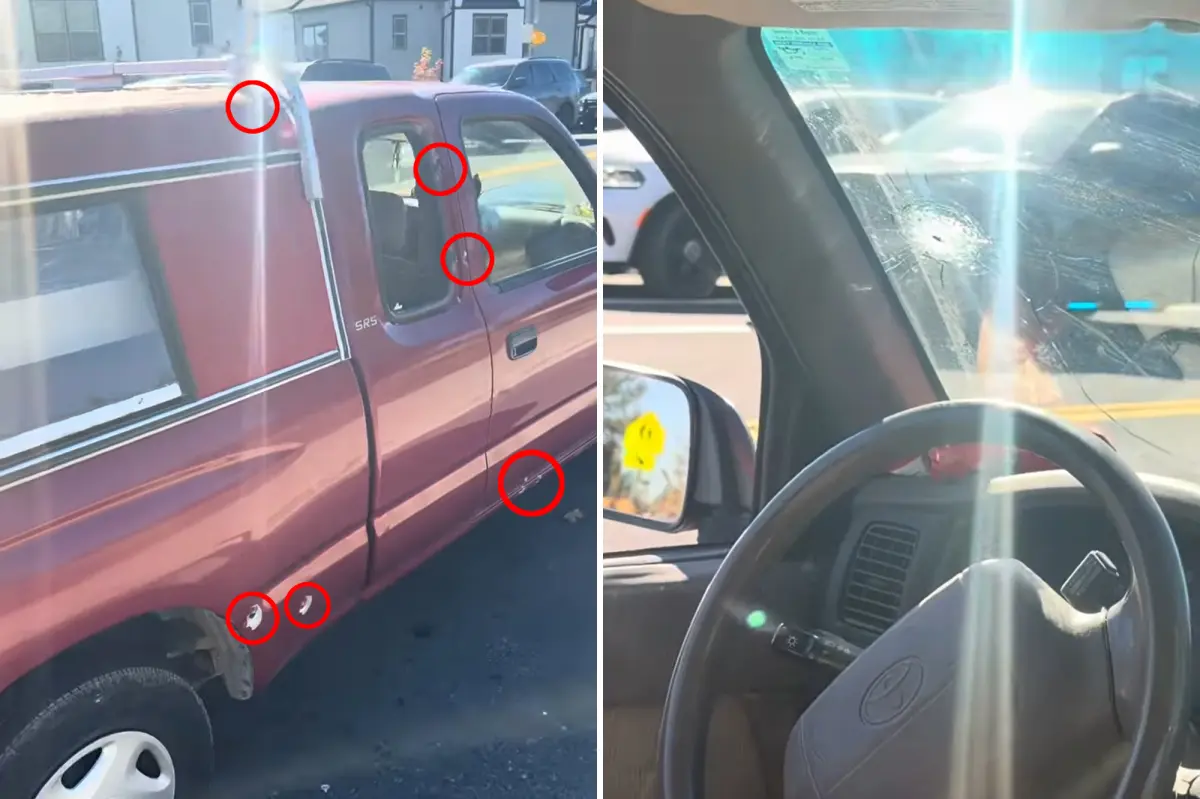
It was just after one o’clock on a seemingly ordinary Thursday afternoon when a red Toyota Tacoma rolled through the quiet streets of Bend, Oregon. The driver, a man whose name we still do not know, was likely running errands or heading home, his mind occupied with the mundane details of daily life. That all changed in an instant when he saw a figure armed with a long gun, and then heard the first deafening crack of gunfire. Bullets tore through the air, smashing into his truck with brutal force. In a heartbeat, his vehicle became a fortress under siege, the windshield and rear window exploding into a spiderweb of shattered glass. The driver, miraculously unharmed, felt the wind of a bullet pass above his head, close enough to leave him breathless. This anonymous citizen, thrust into the heart of a nightmare, became the first person to dial 911 that day, his call a desperate alarm that would set in motion a tragic, heroic, and heart-wrenching chain of events.
The man’s account, later captured in a video he shared, is raw and visceral. He pans the camera across his battered pickup, showing the aftermath of the volley of shots that had been fired at him. “Boom boom, through my canopy, shattered out the back window,” he says, his voice trembling with the residue of fear and adrenaline. “Shattered out that f–king window.” The expletive is not gratuitous; it is the authentic language of a man who has just stared into the abyss and somehow walked away. He moves the camera to the front, revealing the windshield with a bullet hole that looks like a gash in the glass. “The bullet went right through the f–king windshield. Right above my f–king head. Holy s–t.” At least six large bullet holes now pepper the red paint of his truck, each one a permanent reminder of the seconds when his life hung in the balance. He was not a soldier or a police officer; he was a civilian caught in the crosshairs of an evil that would soon claim the lives of children and a teacher at Silver Rail Elementary School.
Yet in that moment of terror, the driver did not simply flee or hide. His instinct was to call for help, to raise the alarm that would allow others to respond. He was the first to alert authorities, providing crucial information about the shooter’s location and weapon. His courageous 911 call, made while he was still under fire, is a testament to the quiet heroism that often emerges in moments of crisis. He did not know that minutes later, a bystander would rush into the school and confront the 16-year-old gunman, fatally shooting him and preventing further carnage. The driver’s actions, though less direct, were equally vital. By reporting what he saw, he gave police and emergency responders a head start in a situation where every second counted. He may have saved lives simply by being brave enough to speak up while bullets were still flying.
The tragedy that unfolded at Silver Rail Elementary School remains almost too painful to comprehend. Three young students—ages five, eight, and eleven—and a beloved teacher lost their lives in a senseless act of violence. Another student and another teacher were critically injured, their lives forever altered by the same few minutes of horror. The grief that has gripped Bend is palpable, a small community shattered by an unimaginable act. The shooter, a 16-year-old whose identity has not been released, was found dead by the time police stormed the building, killed by that heroic bystander. The questions that follow such an event—why, how, what could have been done—are left hanging in the air, unanswered and likely unanswerable. The only certainty is that a day that began with the promise of learning and laughter ended in unspeakable loss.
The driver, standing beside his bullet-riddled truck, is a living symbol of both survival and the fragility of life. His story, though brief in the retelling, speaks volumes about the randomness of violence and the bravery of ordinary people. He did not ask to be a first responder, yet he answered the call. His 911 call was the first thread in a web of response that included the bystander who charged into the school, the police who arrived too late to save the victims but in time to secure the scene, and the medical personnel who fought to save the wounded. Each of these individuals, driven by a common humanity, responded to an emergency that no one was trained for. The driver’s decision to share his experience, to show the world the damage to his truck, is a way of honoring what happened—not for attention, but to remind us that the echoes of that day are still ringing.
As the community of Bend mourns, it also clings to stories of heroism and hope. The driver’s narrow escape is one such story, a reminder that even in the darkest moments, there are those who act with courage. He will likely carry the trauma of that afternoon for the rest of his life, the memory of bullets whizzing past his head as vivid as the holes in his windshield. Yet he also carries the knowledge that his quick thinking helped mobilize a response. The teacher and students who died are not forgotten; they are honored in the vigils, the flowers, and the tears of a community that refuses to be broken. And the driver, standing in the sun with his damaged truck, embodies a simple truth: that life can change in an instant, but it is what we do in that instant that defines us. His story, and the stories of all those touched by this tragedy, will live on as a testament to the resilience of the human spirit and the fragile, precious nature of every single day.