


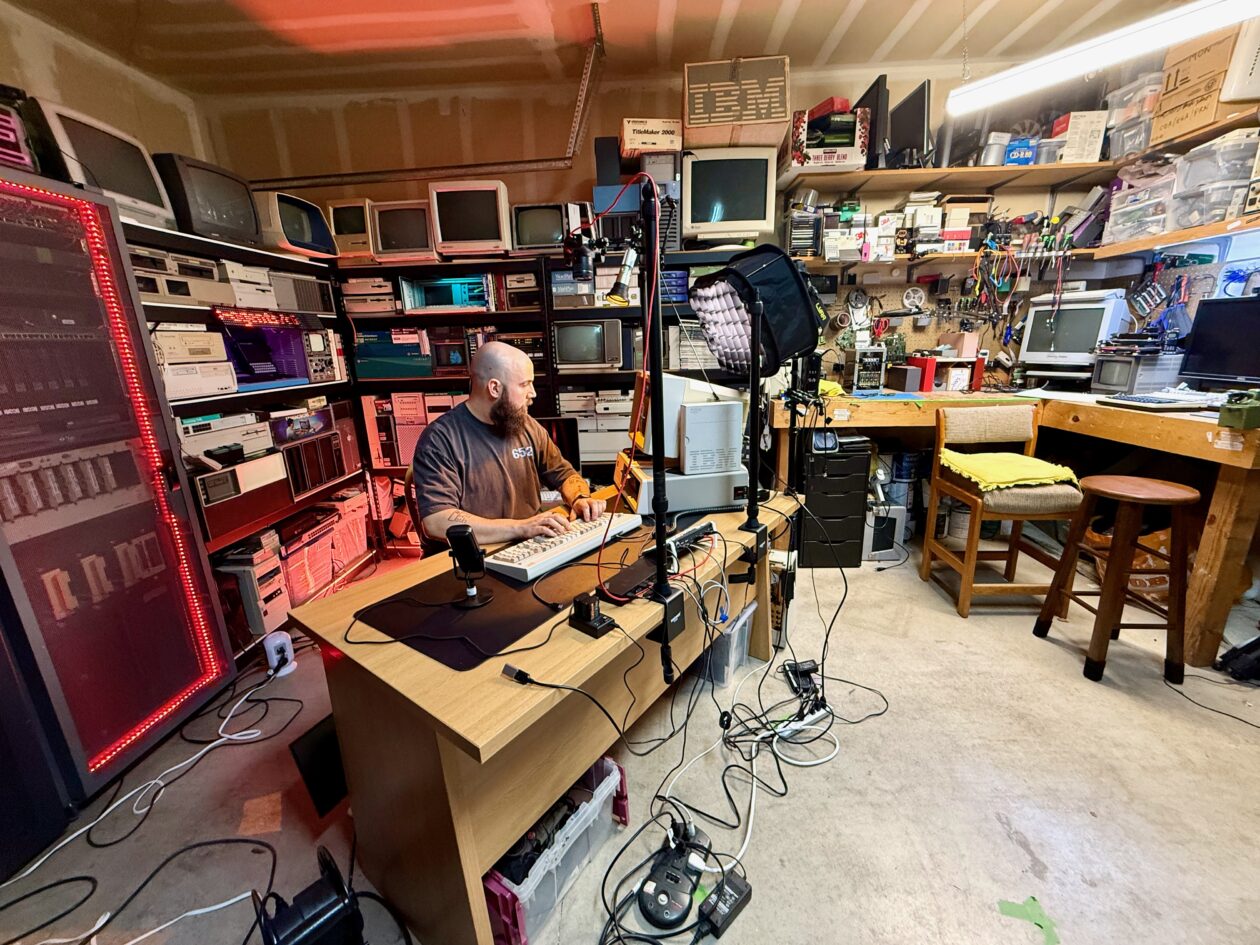
Darko Mesaros’s garage in Maple Valley, Washington, used to hold a car. Now it is wall-to-wall computers. A towering server rack glows with red LEDs—at about $1,000, it is the most expensive single piece in his collection—and CRT monitors are stacked beside vintage workstations. A workbench overflows with tools, cables, and half-repaired components. Mesaros, a distinguished developer advocate at Amazon Web Services, says he started getting stuff and then it “snowballed” to the point where he “legitimately don’t have space for it anymore.” The mythology of the suburban garage is built around founders tinkering their way to world-changing startups. Mesaros is not launching a startup. Instead, he is running a one-man living museum, a rescue mission for the discarded ghosts of computing history. He repairs broken machines, preserves forgotten software and peripherals, and, in an improbable twist, connects old hardware to modern artificial intelligence. The collection has spilled into an upstairs office and includes more than 100 full computers, from an early-1970s minicomputer to Silicon Graphics workstations from the 1990s and HP workstations from the 2000s. There are roughly 25 vintage video game consoles, rescued software, a leather-bound TRS-80 owner’s manual, and nearly a decade of 1980s Byte magazines. The total tops 1,000 items. Most arrive broken, and that is exactly the point. “Buying a mint old system is not fun,” he says. “Buying something that’s broken and then having that excitement of fixing it is just fantastic.” He finds gear at Goodwill, on Facebook Marketplace, and through Seattle’s large retro-computing community. When a man in Washington, D.C., was about to throw away a pallet of 1980s computers, Mesaros had a friend grab it and paid to ship the whole load to Seattle. At one point, he had seven Commodore 64s; he gives extras to other collectors and has never sold a single piece. “That’s been my little pride,” he says.
To understand why a 38-year-old cloud advocate fills his home with machines older than his career, you have to go back to Serbia in the 1990s. Growing up there, Mesaros faced an economic reality where cutting-edge technology was out of reach. From 1991 to 2003, his only computer was a Commodore 64, a machine released in 1982. While the rest of the computing world sped through the 1990s and early 2000s, Mesaros stayed on that 8-bit keyboard. “I feel like I missed that whole thing,” he says. “I missed the whole, you know, Sun workstation, Silicon Graphics, HP 9000, all of those things … and I just wanted to explore how that was.” So he bought a couple of Sun workstations to see what he had missed. Then he kept going. “It’s a hobby, but it’s also a problem,” he says with a laugh. If the garage caught fire, the one machine he would grab is a bright blue Silicon Graphics Indy, a 1990s workstation and the first SGI he ever owned. It showed him how an amazing workstation worked, and he still boots it up from time to time just to enjoy its IRIX operating system. Still on his wish list is a DEC VT520 terminal with an amber screen, but working units seem to only turn up on the East Coast, and he won’t risk shipping a fragile CRT across the country. Mesaros moved to the Seattle area around the start of the pandemic with a couple of workstations, a monitor, and a handful of laptops. He soon realized that vintage gear was far cheaper here than in Europe. He also narrowly missed the chance to visit Seattle’s beloved Living Computers: Museum + Labs before it permanently closed, but in his own home he has essentially built a private version of the late Microsoft co-founder Paul Allen’s former institution. Most of the machines around him are older than his entire tech career. “Most of these things are older than me. Especially older than my tech career,” he says. “However, again, I find it fascinating how computer history has evolved.”
Before joining Amazon nearly a decade ago, Mesaros held system administration and engineering roles at companies including AT&T and Tipico. Now at AWS, his day job is helping developers and customers adopt cloud services through blog posts, webinars, live streams, code, and technical advocacy. The garage doubles as his set; he records AWS videos and live streams there, surrounded by the history of computing. That history is also etched into his skin. He has a collection of retro tech tattoos on his arms: symmetrical DOS and Linux terminal prompts (C:WINDOWS> and root@localhost), a classic Windows 95 logo, MS-DOS branding, a shebang and a quit command that mark the start and end of a script, and detailed microprocessors like the Zilog Z80 and MOS 6502 paired with assembly code. He jokingly calls the chips his literal “ARM CPUs” and says he is still waiting on his check from Microsoft. “I only tattoo ancient technology on myself,” Mesaros says. People often stop him at airports to take pictures. “Old technology will stay with me … I feel like this is an investment in my career.” He has plans for more ink during his next trip home to Serbia. His tattoos are not just decoration; they are a public declaration of his values. In a field that constantly pushes toward the next new thing, he stays fluent in the forgotten languages of computing. That fluency makes him a bridge between generations, someone who can explain what modern developers can learn from old machines. It also gives him perspective: every shiny new framework will eventually become somebody’s vintage artifact. His job requires him to look to the future, but his garage and his skin keep him anchored to the foundations.
Collecting, for Mesaros, would be meaningless if the machines just sat silent on shelves. So he spends his free time wiring them to modern AI, often with gloriously absurd results. He has chatted with an AI coding agent from a Commodore 64, the same kind of computer he used in Serbia. He has deployed Kubernetes from a 1986 Tandy 102 portable computer. He wired a 1984 DEC DECwriter IV teletype to Amazon’s Kiro coding agent and wrote a blog post about how he talks to Kiro through the clacking machine, even deploying AWS infrastructure from it. “Should this be done? Probably not,” he says. “But is it fun? Absolutely.” During a GeekWire visit, the teletype clattered out the agent’s answer to “What is GeekWire?”: “Seattle-based tech news site covering Pacific Northwest startups, Amazon, Microsoft and the broader tech industry.” Not bad for a machine older than its operator. Mesaros also spent a weekend deliberately stuck in 1999, using a Windows 98 machine as his only computer and documenting the experiment on a VHS camcorder. “The only window into the future was Kiro,” he says. Another project involves a vintage military field phone from his native Serbia, which he is trying to connect to a large language model. These experiments may sound like elaborate practical jokes, but Mesaros sees them as serious exercises in attention. They force him to confront serial ports, baud rates, handshakes, and the physical constraints of machines that cannot be fixed by simply updating software. They also prove that old protocols and old hardware can still reach the most advanced cloud systems if someone is curious enough to build the bridge. In an era when developers can ask an AI to write code and walk away, he wants to keep the tactile, messy, joyful act of making old and new technology talk to each other.
Attention and curiosity are the threads that tie Mesaros’s hobby to his professional philosophy. He likes to point out that a 2017 Google paper titled “Attention Is All You Need” helped kick off today’s large-language-model boom. “Now in 2026, to be a really successful developer,” he says, “attention is all you need.” To him, those words are not just an architecture diagram; they describe the central challenge of modern engineering. “I think being curious and paying attention are the two most important skills for a developer these days because it is so easy not to do those things,” he says. “And if you want to be relevant, if you want to be good at your job, especially with AI, I think those are the two important things that are critical.” Old technology, in his view, trains those skills. It offers a slower pace, a time when computer manuals took months to produce because they would remain accurate for years. “Today, if you create a manual that’s printed, it’s going to be valid for a week,” he says. The garage is an antidote to the endless scroll, a place where glowing CRT screens and clacking keys demand physical presence and patience. He calls the hobby his “computer away from a computer.” “I spend my days in the email factory … and then in the afternoon, I just come here and tinker with something ancient that shouldn’t work anymore,” Mesaros says. He does not think screens will disappear just because AI agents are taking on more work. “We still have the need for control,” he says. “Being able to observe and see, visualize what’s happening is still important.” In a world built to scatter attention, his vintage machines are a deliberate way to focus it.
At home, Mesaros is not the only maker. His wife is a fashion designer who 3D prints clothing and purses on a farm of printers in an upstairs room. “She’s more creative than I am,” he says. “I get to tinker with old things that don’t want to work, and she uses technology to actually make new things.” The contrast defines their household: one side resurrects the past, the other fabricates the future. Mesaros’s analog instincts extend into daily life. An old Jeep TJ sits in the driveway because there is no room for a car in the garage. He wears a classic analog Timex watch. He bought Meta’s smart glasses when they launched and sold them within a month. “I don’t like the camera on my face,” he says. He does use a camera-free pair that displays real-time translated subtitles when he travels abroad, a practical compromise. A friend once gave him a Funko Pop! figurine in his likeness, and it now sits among the vintage hardware, a playful reminder that the neighborhood retro-computing obsessive also works for one of the world’s largest cloud providers. At 38, Mesaros has built a rare kind of career: one that looks firmly forward while staying rooted in the past. His garage is not a shrine or a hoard; it is a living workshop where neglected machines are given new life and new purpose. It is also a reminder that progress is not a clean break from what came before. The cloud is built on ideas and conventions established by early computers, and the people who understand those foundations are often the ones best equipped to push into the future. As the red LEDs glow and the teletype waits for its next question, Mesaros keeps doing what he loves: rescuing digital ghosts and daring them to run modern artificial intelligence. “Should this be done? Probably not,” he might say, with a grin. “But is it fun? Absolutely.”