



Bitcoin and Ether Retreat From 2025 Peaks, but XRP’s Stalled Rally Exposes the Hidden Force in Crypto Markets
A Market of Two Speeds
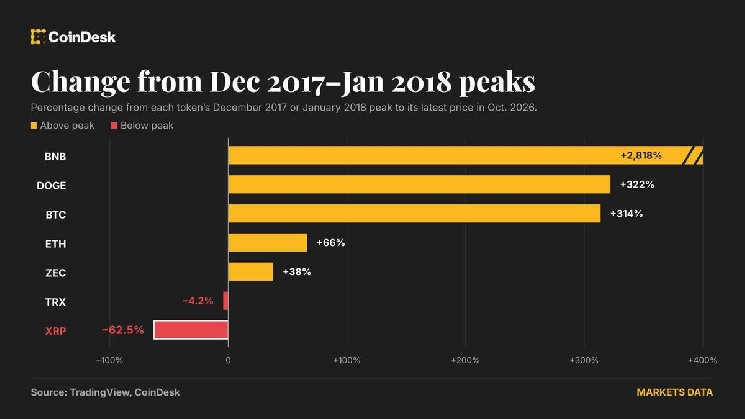
The cryptocurrency market has spent 2025 swinging between euphoria and caution. After a scorching rally that carried Bitcoin and Ether to new yearly highs, digital asset prices have pulled back sharply in recent weeks, leaving traders to wonder whether the bull market is taking a breather or something more serious is underway. Yet even after that cooling-off period, Bitcoin and Ether remain far above the all-time peaks they reached in 2017, a powerful reminder of how much the industry has matured over the past eight years. The same, however, cannot be said for every token. XRP, one of the most closely watched cryptocurrencies in the world, has been a notable exception. It has rallied, corrected, and attracted headlines alongside the rest of the market, but it has not reclaimed the same rarefied heights relative to its own history. That disconnect has puzzled many retail investors, who look at XRP’s price and wonder why it has not kept pace with other digital assets. The answer, according to analysts, lies not in the price chart itself but in the mechanics of supply, demand, and the rapidly evolving structure of institutional investment. To understand why XRP has lagged, it is necessary to look at more than just market sentiment; the real story is buried in the numbers.
The Supply Problem Behind XRP’s Underperformance
When analysts are asked why XRP has struggled to recapture its former glory, the first thing they point to is supply. Circulating supply—the number of coins actually available on the open market—has grown at a staggering pace since XRP first captured mainstream attention. Nicolai Sondergaard, senior research analyst at the analytics firm Nansen, spelled this out in a recent interview with CoinDesk. “Circulating supply grew 63%, from 38.7B in 2017 to 63.1B,” Sondergaard said. “While XRP’s total market value fell only about 3%.” That may sound like a dry statistic, but it is the single most important detail in XRP’s recent history. A cryptocurrency’s price is not set in a vacuum; it is derived from the total value of the network divided by the number of coins in circulation. When the supply of coins grows faster than demand, the value of each individual coin tends to shrink, even if the network as a whole is retaining its value. In XRP’s case, there are now dramatically more tokens in circulation than there were during the 2017-era peak. That means each XRP token represents a smaller share of roughly the same total value. The fundamental principle is straightforward: more coins in circulation means each coin owns a smaller slice of the pie. If the total pie stays approximately the same size, the price of each slice has to come down.
Why Market Capitalization Tells a Different Story
This is why some market observers argue that XRP looks far healthier when measured by total value rather than spot price. Oliver Carding, head of marketing at Tesseract Group, is one of those voices. “On value, XRP recovered,” Carding said. “About 63% more XRP is in circulation than at that peak, so the same circulating market capitalization would mean a price roughly 39% lower.” Tesseract, an institutional digital asset management firm with more than $500 million in assets under management, sees this dynamic as a common source of confusion for retail investors. A falling price can easily look like failure, especially when compared to Bitcoin or Ether, which have both managed to hold far above their 2017 levels. But when viewed through the lens of market capitalization, XRP’s story is very different. The network has retained nearly all of its total value from the 2017-era peak, but that value is now spread across many more coins. One way to think about it is a pizza: if the same pizza is cut into more slices, each slice is smaller, but the pizza itself has not shrunk. For XRP, the price per coin may be lower, but the total market value of the network has held up remarkably well. In other words, the lower price is not necessarily a rejection of XRP’s fundamentals. It is simply a reflection of a larger supply pool.
Institutional Demand Has Not Shown Up for XRP the Way It Did for Bitcoin and Ether
The second major factor in XRP’s price story is demand, particularly from institutional investors. The arrival of U.S.-listed exchange-traded funds, or ETFs, was one of the most significant turning points in the history of digital assets. These regulated investment vehicles gave institutional investors a way to gain exposure to cryptocurrencies through traditional brokerage accounts, without needing to manage private keys, navigate crypto exchanges, or worry about custody. For Bitcoin and Ether, the result has been transformational. ETFs tied to the two largest cryptocurrencies have pulled in billions of dollars in net flows, creating a powerful, steady source of buying pressure that has helped support their prices through volatile cycles. XRP, so far, has not enjoyed the same wave of enthusiasm. “ETF uptake has also been muted relative to BTC and ETH,” said Paul Howard, senior director at market-making firm Wincent. That distinction matters for reasons that go beyond simple fund flows. ETF adoption is not just another trading signal; it represents a structural shift in how capital enters the cryptocurrency market. When institutions buy Bitcoin or Ether ETFs, they are often making long-term allocation decisions, not short-term speculative bets. The relatively tepid interest in XRP products suggests that many institutional allocators have not yet been convinced that XRP deserves a similar place in their portfolios. It is not that XRP lacks institutional attention entirely—several asset managers have explored XRP-related products—but the level of demand has been far quieter. And quiet demand, in any market, means less upward pressure on price.
The Supply-and-Demand Lesson at the Heart of the Crypto Market
Taken together, the forces shaping XRP’s price offer a valuable lesson for anyone trying to make sense of the cryptocurrency market. It is tempting to compare prices across different cycles and conclude that a coin has either succeeded or failed. But the reality is far more nuanced. Price, at its most basic level, is the point where supply and demand meet. If the number of coins in circulation expands, the price must adjust unless demand grows just as quickly. If demand remains flat, even a fundamentally sound project can see its price stagnate. This is why analysts consistently emphasize metrics like circulating supply and market capitalization when evaluating digital assets. A coin with a large supply and a modest price can still represent a substantial network by total value. Conversely, a coin with a low price and skyrocketing supply may not actually be cheap in any meaningful sense. For XRP, this market cycle has been defined by two forces pulling in opposite directions: greater supply, which has diluted the value of each token, and relatively weaker demand, especially from institutional investors, which has prevented the price from catching up to its 2017-era peak. The same dynamics could easily shape the next phase of the crypto market, regardless of whether that phase brings another rally, a deeper correction, or a prolonged period of sideways trading. The underlying math does not change with market sentiment.
What Comes Next for XRP and the Broader Digital Asset Market
As the market moves beyond its 2025 peak and into an uncertain new phase, the questions surrounding XRP are unlikely to disappear. Can the project find meaningful ways to absorb its growing supply into real-world use? Will institutional products eventually gain traction and bring the same kind of inflows that have supported Bitcoin and Ether? And will the broader cryptocurrency market continue its long-term climb, lifting even the laggards along with it? No one can say for certain. But one thing is clear: the era of judging a cryptocurrency by price alone is over. Bitcoin and Ether have demonstrated that they can hold far above their 2017 highs because they have attracted enormous institutional demand and cemented their positions as the cornerstones of the digital asset market. XRP, by contrast, remains a project in transition—a cryptocurrency whose total value has largely recovered, but whose price has been held back by a larger supply base and a stubborn shortage of new institutional money. For investors, the lesson is simple but essential: look at the full picture. Track circulating supply. Watch ETF flows. Measure market capitalization. Because in the cryptocurrency market, price is only the surface. The real story, as XRP continues to show, lies underneath.