


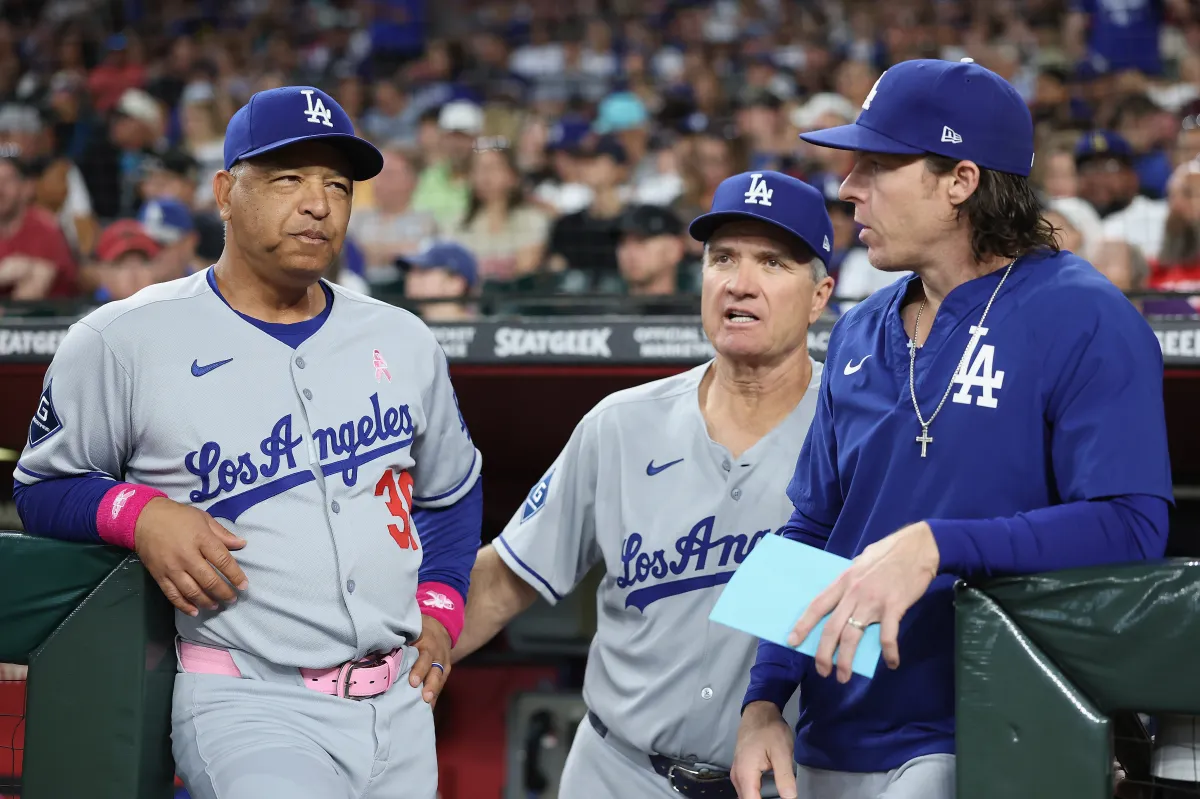
The Los Angeles Dodgers woke up Thursday, Oct. 15, to a feeling they had not known for a long time: fear. The Milwaukee Brewers were in town with a 3-0 lead in the best-of-seven National League Championship Series, and one more loss would end the Dodgers’ season in the most brutal way possible. For a franchise that had spent years treating October like its own personal playground, the shock of being on the brink was almost impossible to process. The Dodgers were the two-time defending World Series champions. They had the stars, the payroll, the pedigree, and the confident swagger of a team that expected to be on top of the baseball world every single fall. But the Brewers did not seem to care. They came into Los Angeles with a clear plan, a relentless attack, and the kind of fearless energy that usually makes October so special. Now the Dodgers were facing not just elimination, but the possibility of a humbling collapse. The clubhouse had to be tense. Every batting practice swing, every meeting, every quiet conversation carried an extra weight. The fans were nervous, the players were feeling the pressure, and the coaching staff was searching for the right words to keep everybody calm. Baseball is a game built on routine and repetition, but when your season is about to end, nothing feels routine. The Dodgers needed a miracle, or at least a sudden burst of resilience, and they needed it fast. And yet, in the middle of all that chaos, another storyline was quietly taking shape. It involved the man standing next to manager Dave Roberts, the bench coach who had helped guide the Dodgers through so many high-pressure moments. Danny Lehmann was suddenly being mentioned as a potential manager elsewhere, and the timing could not have been more surreal.
The Houston Astros had let go of manager Joe Espada on Wednesday, a decision that sent ripples across the sport. Houston is a franchise that expects to win, and it does not tolerate long stretches of mediocrity. Espada’s dismissal opened the door for a new voice, and within hours, multiple reports out of Houston identified Lehmann as a top candidate for the job. It was not the first time his name had surfaced in managerial searches. A year earlier, he had been a candidate to replace Brian Snitker as the Atlanta Braves’ manager, before the position went to Walt Weiss. That earlier opportunity had given Lehmann a glimpse of how close he was to landing a top job, but it had also taught him that these things can slip away quickly. Now, with the Astros looking for a leader to carry them into the next chapter, Lehmann’s name was at the front of the line. The irony was hard to ignore. Here he was, deep in the middle of a playoff war with the Dodgers, his full attention supposedly locked on the Brewers and the immediate challenge of avoiding elimination. But baseball is a business as much as it is a game, and the business never stops. While he was trying to help Los Angeles find a way to stave off disaster, the outside world was already imagining him in a different uniform, standing in a different dugout, speaking to a different group of players. The rumor mill can be a strange companion. It gives you a peek at your future while you are still trying to survive the present.
Lehmann’s story is not the typical story of a major league manager. He never spent a decade paying his dues as a minor league skipper. He never worked his way up the traditional baseball ladder in the way people once expected. Instead, his career took a different route, one that reflects how much the sport has changed. After his own minor league playing days ended, Lehmann joined the Dodgers’ video scouting staff in 2015. That was not a flashy job. It involved long hours, close attention to detail, and a willingness to stay behind the scenes. But it was the perfect foundation for someone who wanted to understand the modern game from the inside out. Video scouting is all about noticing the things other people miss, the subtle shifts, the tiny tendencies, the hidden patterns that can become the difference between a win and a loss. Lehmann clearly had a gift for that kind of work. He climbed the ranks, gaining trust and respect at every level, until he became one of Dave Roberts’ most important voices in the dugout. By the time he was named bench coach before the 2023 season, he had already contributed to three Dodgers World Series titles from 2020 through 2025. That kind of résumé is hard to ignore. It tells you that Lehmann knows what it takes to win, even if he did not get there by the most conventional route. It also tells you that he has something to offer beyond baseball strategy. He has the ability to connect with people, to communicate clearly, to earn the trust of stars and role players alike. Those are the qualities that front offices are looking for in a modern manager.
The Houston connection, of course, makes this possibility even more interesting. Lehmann went to high school in the Houston area and later played college baseball at Rice University, one of the most respected programs in the country. That means he knows the city, he knows the culture, and he understands what it means to be an Astro in a deep Texas baseball market. Local roots do not guarantee success in the dugout, but they can make a transition smoother. He would not be walking into a completely unfamiliar environment. He would know the high school fields where so many local kids dream of the big leagues. He would know the humidity, the fans, the expectations, the way a summer in Houston can test a team’s endurance. When a franchise hires a manager, it is not only hiring a strategist; it is hiring a representative of its identity. Lehmann’s connection to Houston gives him an edge that other candidates might not have. He could step in and immediately understand the pulse of the city. He could talk to players about what it meant to play baseball in that part of Texas. He could relate to the pride that comes from wearing the Astros’ uniform. Even so, the Dodgers were not simply going to hand him over without a fight. He was a valuable piece of one of the most successful organizations in baseball, and Dave Roberts trusted him deeply. Losing him in the middle of the offseason would hurt, especially if Los Angeles still had championship ambitions. But the opportunity to manage at the highest level is rare, and when it comes, people listen.
Lehmann’s only taste of managerial duty came in 2023, when Roberts left the team for a day to attend his son’s college graduation. With the manager away, Lehmann took over in San Diego, stepping into the dugout and making decisions in a big league game for the first time in his life. It was a small, quiet moment in the long season, but it meant everything to him. It was his first time managing at any level of professional baseball, and he handled it with the same calm he had shown throughout his career. Afterward, he spoke about the changing nature of the job. “How managers are picked today is very different than 10, 15, 20 years ago,” he said. “There was a progression in the past, where it was kind of like you managed whatever league in the minors, and you progress, or became a base coach. It’s just very different. I think now it’s a little bit more specific in how you want to run your team, and I think that makes a lot of sense.” Those words reveal a lot about Lehmann’s baseball mind. He does not believe in cookie-cutter paths or old-school formulas. He believes that every organization is different and that every team needs a leader who fits its particular set of problems and strengths. That kind of adaptability is becoming more and more valuable in a sport that is always evolving. The days of simply mailing in a lineup card are gone. Today’s managers need to be partners in the front office, teachers in the clubhouse, and decision-makers in the most tense moments of a game. Lehmann seems to understand that better than most, even without a long resume of managerial stops. He has learned by watching, by studying, by doing the unglamorous work that prepares a person for the spotlight.
Of course, Lehmann is not the only name on the list. The Astros are exploring several possibilities, and the speculation has been wide-ranging. Brad Ausmus, a former catcher with a long history in Houston, has been mentioned. David Ross, who managed the Chicago Cubs through a turbulent and emotional period, is also in the conversation. Morgan Ensberg, a former Astros infielder who still knows the organization well, has been named by MLB.com and the Houston Chronicle as a potential candidate. Each of those men brings something different. Ausmus has experience, Ross has a championship pedigree, and Ensberg has deep ties to the franchise’s proud past. But right now, it is Lehmann whose name seems to be generating the most buzz. Perhaps that is because of his success with the Dodgers. Perhaps it is because of his modern, forward-thinking approach. Perhaps it is simply because he represents the kind of fresh start that Houston seems to be looking for. Whatever the reason, his future is suddenly full of possibility. The Dodgers were still fighting to keep their season alive, and Lehmann had to keep his focus on the task at hand while his phone buzzed with texts and calls from agents, reporters, and old friends. He had to be in two places at once, emotionally and professionally. But that is the nature of baseball. The game is always moving, always changing, always offering new opportunities to those who are ready. Lehmann’s turn may be coming sooner than anyone expected, whether it is in Houston or somewhere else. And if the Dodgers somehow manage to escape their 3-0 hole, they will be doing it with a bench coach who might be leading another team before the next season arrives.