


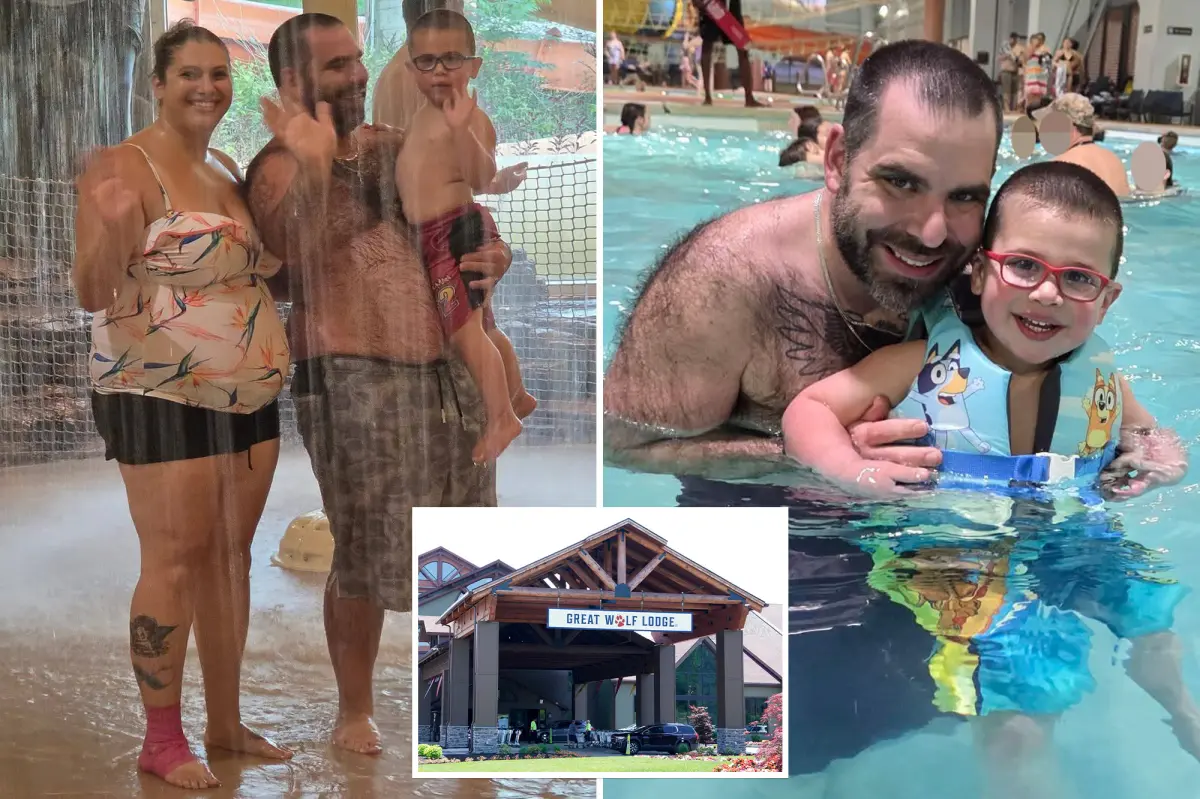
It was supposed to be a simple family getaway, the kind of trip that fills a phone with smiling photos and leaves a three-year-old talking about water slides for weeks. A mother, a father, and their little boy had checked into the Great Wolf Lodge in the Poconos, a sprawling indoor water park resort where parents trade work emails for swim diapers and the biggest decision of the day is whether to go down the green tube slide or the yellow one. For Metallica Rose Harrison, 27, her husband Chris, and their son Tristan, it was meant to be a few days of joy. Tristan, according to his family, was an “amazing” and “very happy” little boy who adored water parks, so an extended stay at this particular resort felt like a dream come true. The family sent regular photos back home, proof that they were making memories, loving every minute. Nobody could have imagined that those same posted pictures would become the last cheerful evidence of a life that would soon shatter. By the time police were called to the resort, the scene inside the family’s suite was not one of vacation joy, but of blood and horror. Police said the young mother had stabbed her husband and her three-year-old son, and then tried to slit her own wrists and neck. The little boy and his father were found dead. Metallica survived, and the family she left behind—her stepmother, father, siblings, and everyone who thought they knew her—was left standing in the wreckage of a story they never saw coming.
Metallica’s stepmother, April Thetga, has spent the days since the tragedy replaying every conversation, every text, every laugh. She spoke to The Post with the raw bewilderment of a woman who loved the accused and cannot reconcile the person she knew with the person police describe. Thetga said that just hours before the killings, on that very Sunday, she and Metallica had exchanged a video call. It was ordinary in every way. They chatted, they caught up, and then Metallica said she loved them very much, the same way she always did. “It wasn’t an odd conversation,” Thetga said. “She didn’t give us any indication that anything was ever going to happen.” That sentence is perhaps the most haunting part of the entire tragedy. How many families, after a sudden act of violence, search through the last message they received, looking for a clue they somehow missed? Thetga found none. The call was warm, normal, filled with affection. There were no tears, no goodbyes, no hint that young woman was about to bring a knife into a bathroom and end the lives of the two people she was supposed to protect. “We’re just as shocked as everybody else,” Thetga said. “It was a loving family.” That phrase—”it was a loving family”—now carries the weight of a eulogy. In the absence of any explanation, they cling to it as both truth and question.
Part of what makes the case so impossible to process is how ordinary and happy the days leading up to the tragedy appeared to be. The family’s extended stay at Great Wolf Lodge had struck the stepmother as a little odd at first. It seemed like a long time for a young family to spend at a water park. But they quickly explained it away: Tristan loved the water, loved the slides, loved the chaos and splashing and joy of the enormous indoor playland. If the trip was longer than usual, it was only because they wanted to give their little boy one more day of pure childhood happiness. They sent photos to relatives, showing off their fun, proving that the vacation was everything they had hoped. It is almost too painful to imagine those photos now. A mother holding her son in the pool, his little face lit up with delight. A father, smiling, maybe wearing a life vest, waving at the camera. These snapshots are not just memories; they are evidence of a reality that now feels like a cruel illusion. The family didn’t think twice about the extended stay, because they believed they knew Metallica. She was a mother who loved her son, a wife who seemed happy with her husband. The resort was not a place to fear. It was a place where nothing bad could happen, a bubble of floating foam noodles and chlorinated water and the high-pitched shrieks of children having the time of their lives. And somewhere inside that bubble, something went horribly, unfathomably wrong.
The most chilling discovery, and the one that transformed this from an inexplicable tragedy into something darker, was the knife. Police found a butcher knife on the bathroom floor and a smaller knife in the bathroom sink. But it was not the type of weapon that changed everything—it was where it came from. Thetga said she was told the knives were from Metallica’s home. They were not hotel utensils or a random kitchen tool. They were knives that Metallica had brought with her to the resort. “Her house. So to me, it was planned,” Thetga said. That single fact bore into the heart of every assumption the family had. If the knives came from home, then the violence was not a sudden snap at the height of a vacation argument. It meant that at some point before packing the car, before checking in, before sending those photos of Tristan splashing in the water park, Metallica had placed a butcher knife in her luggage. It meant that while she was chatting warmly on a video call saying I love you, the weapon was somewhere in that suite. It meant that for hours, perhaps days, the plan had existed in her mind even as she smiled, even as her son hugged her, even as she watched him run toward the water slides. The stepmother’s word, “planned,” is not an accusation born out of anger. It is a terrified attempt to make sense of the senseless. Because if it was not planned, then it was an impulse so sudden and so overwhelming that a woman could go from loving mother to killer in minutes. And if it was planned, then she had been suffering, or hiding, or slowly breaking in a way no one saw. Both possibilities are unbearable.
Then there is the harrowing detail of the 911 call. After the attack, Metallica herself called the emergency line. But she did not call to confess, and she did not call to save anyone. According to police, she called to ask for help on how to kill herself, after reporting the slayings. That surreal request captures the almost impossible contradiction at the center of the case. She had already tried to cut her own wrists and neck and failed. Now, she was on the phone with someone whose job is to save lives, asking for instructions to end her own. In that moment, she was no longer the cheerful mother from the video call, no longer the woman who kissed her three-year-old goodnight. She was someone who had crossed a line so absolute that there was no coming back. It is tempting to imagine her in that bathroom, surrounded by blood, holding a phone to her ear, her voice steady or shaking, asking a stranger for the final escape. The contents of that call are not public, and perhaps they reveal nothing at all. But for the family, the image is seared into their brains. How do you mourn a son and a grandson while sitting with the knowledge that the person who took them asked for help to follow them into death? How do you love the woman you knew and hate the action she committed, all at the same time? The stepmother has no answers, only the same question the rest of the world is asking: why?
There is, at the moment, no motive. April Thetga says the family does not have one. “That’s the thing. I don’t have one. We’re just as shocked as everybody else. … We want answers,” she said. This confession of complete disbelief is perhaps the most honest statement anyone can make about a case like this. There is no neat psychological explanation, no clear history of mental illness that would have warned them. Metallica had never shown signs of instability. There was no abuse, no money trouble, no terrible fight, no note explaining a descent into darkness. The family sees only a young woman who seemed happy, a marriage that seemed strong, and a little boy who was the center of his parents’ world. “It was a loving family. This is devastating.” That is what they are left with. A devastating ending to a story that began with love. They want answers, but answers may never come. Perhaps the answer died with Chris and Tristan in that resort bathroom. Perhaps it lives only in Metallica’s shattered mind, and she may not be able or willing to put it into words. For those who loved them, the future is now a strange and terrible thing. Every photo of Tristan, every memory of Chris, every memory of Metallica before she became a name in a police report—all of it is now mixed with grief, confusion, and rage. The family has lost four people that day, even though only two bodies were counted. They lost the husband, the son, and the woman they thought they knew. They are left with a pile of questions and a box of knives from home, packed by a mother who took them with her on a trip meant to bring joy to a three-year-old. In the end, there is only the terrible silence where a loving family used to be, and the image of a little boy in a water park, blissfully unaware that the mother holding his hand had already, perhaps, decided how the story would end.