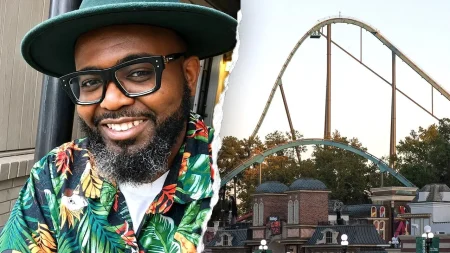


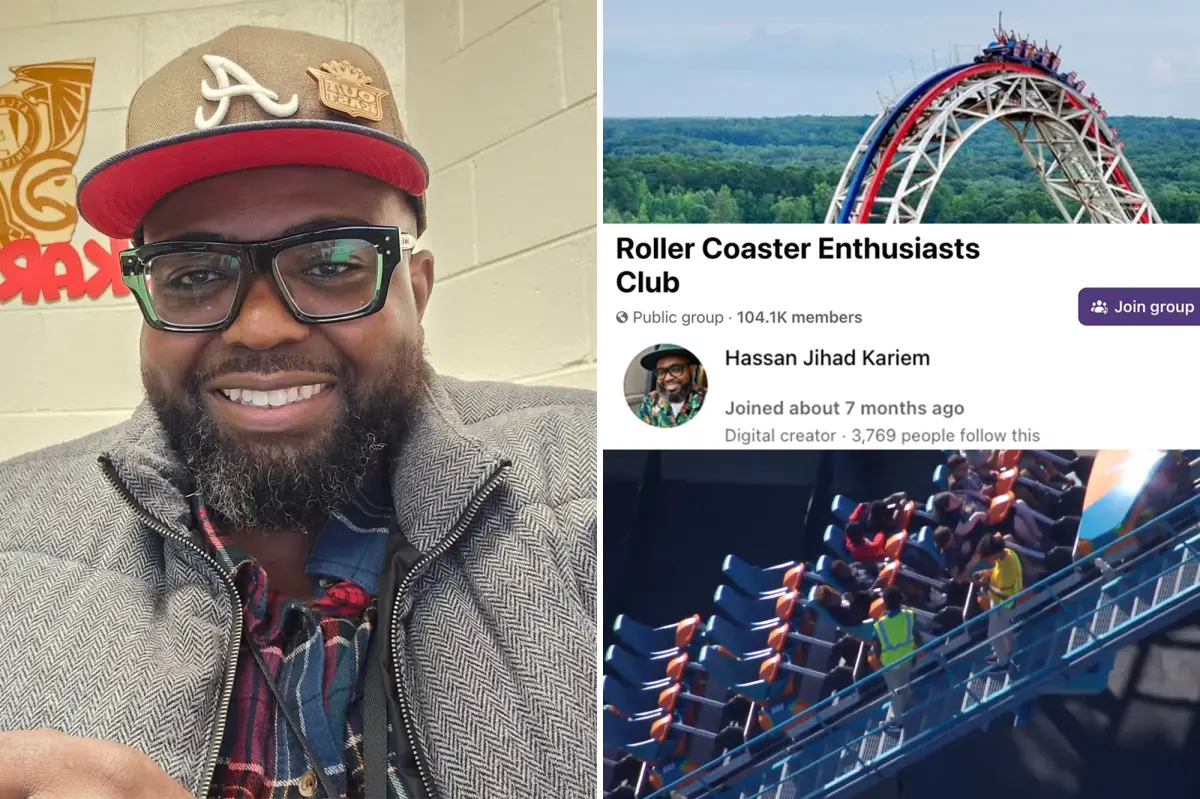
Some people live their lives in a way that makes the world feel smaller and kinder, and Hassan Kariem appears to have been one of those people. At forty-two, he had already overcome a battle with cancer, an experience that gave him a particular appreciation for life and for the people in it. Professionally, he was the IT manager at Wesley International Academy, an Atlanta charter school, but his job title only hinted at what he meant to the school. He taught technology, coached robotics, and formed bonds with generations of students. On a day meant for leisure and family, Kariem went with his niece to Six Flags Over Georgia. What should have been minutes of laughter and adrenaline turned into an unthinkable nightmare. Kariem was riding Goliath, the tallest roller coaster in Georgia, when he was thrown from the ride and killed. Photo souvenirs from the ride captured the immediate chaos, and fellow riders were left injured, traumatized, and splattered with blood. As an investigation into the accident begins, the park has closed the coaster indefinitely, but for those who knew Kariem, the question is not simply when the ride will reopen. It is how to make sense of the loss of a man who had already survived so much only to be taken in a sudden, violent moment of entertainment.
Grief has a way of erasing ordinariness, and the ordinary details of Kariem’s life now shine with meaning. He was the kind of person who might spend a Saturday teaching a child to build a robot, or who might quietly manage the technology so that everyone else’s work could proceed without friction. He was also a thrill-seeker, someone who found joy in the rush of speed and height, and he had found a community that shared that passion. That same community is now mourning him as one of its own. The investigation into the accident promises to be lengthy, and the park has given no date for reopening Goliath, leaving many riders and employees in a strange fog of sorrow and uncertainty. But before any of the official findings come, there is the human reality: a beloved family man is gone, and the world he inhabited—classrooms, homes, enthusiast forums, and the parks where he chased joy—is struggling to move forward.
Among the many spaces where Kariem’s absence is being felt is a Facebook group called Roller Coaster Enthusiasts Club. The group, created fifteen years ago, is a vast online gathering place of more than 104,000 members who share ride reviews, visit theme parks together, and celebrate the strange, joyful subculture of roller coasters. Kariem joined the public group on March 15, seven months before his death. To many outside the community, it might seem like a niche interest, but to its members, it is a family of kindred spirits. In the wake of the tragedy, the group’s feed has been flooded with messages for a man most members had never met. Strangers describe him as “one of our own” and “a brother,” recognizing that the love of roller coasters bound him to them in an intimate way. The tributes are striking not because they come from people who knew Kariem, but because they come from people who did not. They mourn him because he belonged to the same tribe; they understand that a person who rides a roller coaster for fun is entrusting their life to the engineering, the operators, and the laws of physics, and that this trust is communal. The group has become a place where riders can share their grief, their memories of Kariem, and their questions about how a day at a theme park could end so tragically. In a way, the outpouring reveals the underlying humanity of a hobby that is often reduced to screams and loops. For enthusiasts, a roller coaster is not just an adrenaline rush; it is a moment of weightlessness and surrender, and when that trust is broken, the entire community feels the fracture.
Many members likely rode Goliath themselves; they knew its signature drop, its turns, the final stretch where Kariem was ejected. They cannot separate their own memories of joy from the image of his body bouncing against the cart, and so they post heartfelt, helpless messages. They also share practical concerns about safety, about seat restraints, about what could possibly cause a rider to come free. But beneath the mechanics is the ache of a shared identity. The Roller Coaster Enthusiasts Club was supposed to be a place for celebrating the very best of amusement parks, not for writing eulogies. That its members have turned it into a memorial is a measure of how deeply they felt Kariem was one of them. His death has become a reminder that even in a community built around fun, there is room for sorrow, and that the bonds formed over shared experiences can be as real as any other family tie.
Kariem’s death has also left Wesley International Academy in a state of mourning. A spokesperson for the school described the staff and students as “devastated,” and in a statement, colleagues recalled the many roles Kariem played in the school community: IT manager, technology teacher, and robotics coach. “His love for Wesley, dedication to our students, and commitment to our school community were evident in everything he did,” the statement said. “Mr. Kariem was deeply loved and respected, and his absence will be felt throughout our school community.” Those words carry the weight of an institution that has lost a cornerstone. In a school, the IT manager is often a behind-the-scenes figure, but Kariem’s impact was direct. He taught children to see technology not as a screen to be consumed but as a tool to create, to solve problems, and to dream. As a robotics coach, he spent hours after school with students who were learning to build machines, test their limits, and work as a team. For many of those students, Kariem was the person who introduced them to the idea that they could build something from nothing, and who taught them, through patience and encouragement, to keep trying when something did not work. His colleagues remember his warmth, his availability, and his dedication. He did not just fix computers; he strengthened the human connections that made the school function. The grief of his colleagues is not only for a fellow teacher but for a friend whose presence made work feel like community. For the students, losing a teacher and coach in this sudden, violent way is an especially harsh lesson in mortality, one that no classroom can prepare them for. The school is now tasked with supporting its community through an impossible week, helping students process a loss that defies comprehension. The statement from Wesley International Academy speaks for many: Kariem left a lasting impact on generations, and that impact will not fade just because he is gone. Having survived cancer, he knew the fragility of life in a way that made his everyday generosity all the more poignant.
The details of the accident itself are harrowing. Goliath is not just any ride; it is Georgia’s tallest roller coaster, a hypercoaster that carries riders through a three-and-a-half-minute journey of steep drops and high-speed turns. Kariem rode it with his niece, sharing what should have been an exhilarating experience. According to witnesses, on the final turn of the ride, Kariem began to come out of his seat. Nick Mendenhall, who had just ridden Goliath with his son, said Kariem fell headfirst back into the coaster, was tossed upward, and was then ejected from the ride on its last turn. Parkgoer Logan Conner, riding with his fiancé, described seeing Kariem “levitating in the air sideways” as he tumbled. The image is almost unbearable: a body rising out of a train, riders screaming, the frantic attempt of other passengers to comprehend what they were seeing. Disturbing souvenir pictures shared on social media appear to show Kariem flailing upside down as the ride continued. A woman who was on the ride told local station 11 Alive that Kariem “didn’t fall directly onto us” but instead fell onto a girl in front of her row, striking the cart three different times. “He was in our pictures,” she added, a detail that turns the normal rite of a theme-park souvenir into something impossible to look at without remembering. By the time the ride came to a stop, many riders were covered in his blood, and four other people were injured in the chaos. The medical details have not been released, but the testimony of survivors paints a scene of transfixed horror. The human mind is not built to process this kind of violence in a place built for fun; the collision of amusement and mortality leaves witnesses stunned, crying, and unable to find the words. For those who saw it, the final seconds of the ride were a terrible blur of wind, motion, and the sound of people screaming. For his niece, the ride that should have been a memory of joy has become an unfathomable nightmare. The park has not said how long Goliath will remain closed, but the ride’s silence on the skyline is a grim reminder of what happened.
Among the riders and bystanders who witnessed the accident, the trauma is still raw. Summer Bates, a mother who had ridden Goliath earlier that same Monday, watched the fall happen and later confessed that the sound of Kariem’s body coming down would stay with her and her family. “One thing I think that will stick with us is the sound of his body coming down,” she said. It is a sentence that evokes the almost unbearable sensory memory of the tragedy. Nick Mendenhall, who was nearby with his son, described the moment as feeling like slow motion even though it happened in an instant. “I was just praying in those moments,” he said. “I was praying, God, please let him stay in that car.” The prayer was not answered. Mendenhall’s words capture the helplessness that so many felt: the instinct to cling to hope even as the worst is unfolding, the desperate wish to rewind time. The survivors are not just witnesses to a fatal accident; they are people who now carry images and sounds that will resurface in quiet moments, in the dark, in the sudden flash of a souvenir photograph. The theme park, which is supposed to be a place of laughter, has become a scene of grief. Counseling services have been offered to those who were on the ride or in the area, but the psychological aftermath of such an event cannot be erased by a single debriefing. People who barely knew Kariem were covered in his blood; they will live with the physical and emotional traces of his death for years. Even those who only heard about it from a distance are struggling to reconcile the pleasure of amusement parks with the cruelty of what happened. The ride itself was designed to give people a taste of danger in a controlled, safe environment, and when that safety collapsed, the riders became part of an accident that no one had ever imagined. Their stories, told through tears and trembling voices, reveal how thin the line is between a wonderful memory and a lifelong scar.
In the official aftermath, there are more questions than answers. The cause of Kariem’s death has not been made public, and investigators are still working to understand how a man could be thrown from a moving roller coaster. Six Flags Over Georgia has temporarily closed Goliath, and the park president, Richard Pretlow, said, “We do not have an anticipated reopening date at this time.” That uncertainty is itself painful: every day without an explanation leaves family, friends, and witnesses waiting for closure. The investigation will examine the ride’s mechanics, the restraint systems, the maintenance records, the train’s operations, and every possible human factor. But no explanation will bring back a man who had already defeated cancer and who was enjoying an ordinary afternoon with his niece. In the end, Kariem’s death is more than a case study in roller coaster safety; it is a story about the fragility of life and the unexpected ways it can end. He was a 42-year-old IT manager, a teacher, a robotics coach, a cancer survivor, a family man, and a member of a global community of people who love the feeling of being lifted up and turned around and pushed to the edge. That community has lost one of its own, and his school has lost a beloved mentor. His family has lost someone irreplaceable. As the tributes continue to accumulate on Facebook and in the hearts of those who knew him, the most human response is also the simplest: to remember him not as a victim but as a person who lived fully, loved his family, gave himself to his students, and found joy in something as pure as a roller coaster ride. In the days to come, the park will investigate, engineers will inspect, and perhaps lessons will be learned. But for now, all that remains is grief, and the hope that Kariem’s loved ones can find strength in the warmth of the memories he left behind. May he rest in peace, and may the ride that took him never be remembered without the reminder that life, like every roller coaster, is fragile and precious.