

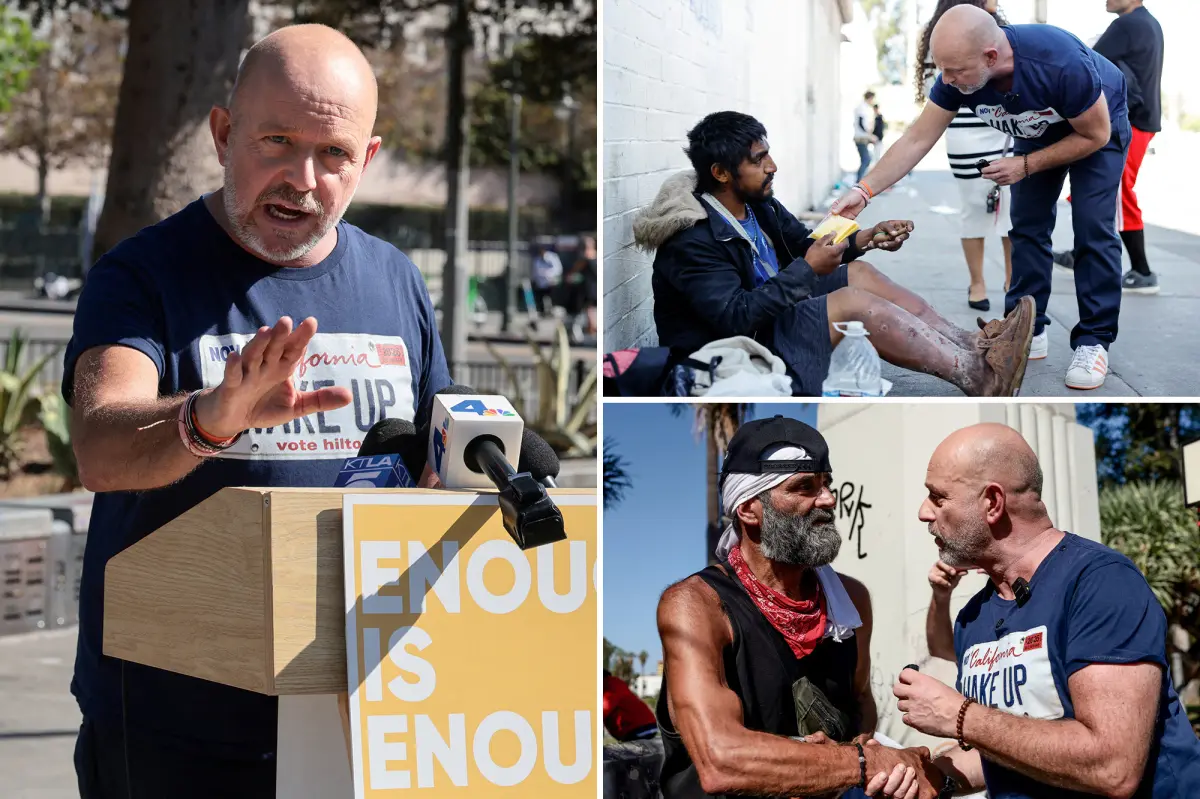
In the middle of a cloudless Los Angeles afternoon, MacArthur Park should have been a postcard of city life—emerald water, arched bridges, children’s laughter drifting across the lawn. Instead, the picture that greeted Republican gubernatorial contender Steve Hilton was a different kind of portrait, one carved by neglect and desperation. The park’s edges were littered with discarded needles, torn bags, and the scattered remnants of a crisis that has come to define California’s largest city. Hilton walked through the park and its adjoining alleys on Tuesday, not as a detached politician peering through a car window, but as a candidate trying to make a visceral point about the human cost of public policy. Every step brought him closer to the raw, unvarnished reality of homelessness and drug addiction that many Angelenos see daily but many policymakers fail to acknowledge with honesty. The trip was part of his campaign’s larger argument that the state’s approach to addiction has gone catastrophically wrong, and that the programs designed to soften the edges of drug use are, in fact, making the wounds deeper.
As Hilton moved through the neighborhood, the scene was almost unbearably intimate. He passed a woman sleeping in a narrow alley, her body folded against a dirty wall, her belongings scattered around her like a fragile shield. Just outside the park gate, another person lay on the sidewalk, motionless, while Hilton spoke to reporters about the conditions. Later, one of the most talked-about moments came when a homeless man wandered across the camera frame with his pants around his knees, oblivious to the political theater unfolding around him. It was a startling image, the kind that can be difficult to watch, but Hilton used it to underscore his core message: this is not abstract policy; this is a street-level catastrophe, and it has been allowed to persist. In his telling, the crisis is not merely the result of poverty or mental illness, though those play a role—it is the product of a system that has actively subsidized the destruction. He pointed to taxpayer-funded nonprofits that distribute free crack pipes and clean needles under the banner of harm reduction. “This is your tax money at work,” he told reporters, his voice carrying equal parts anger and incredulity. “Free crack pipes and needles being handed out to drug addicts. CEOs of these so-called nonprofits making millions a year. The smell, the squalor, the inhumanity. All of it is funded by you.”
For Hilton, the term “harm reduction” is not a compassionate compromise but a cynical acceptance of defeat. He argued that handing out clean supplies does not save lives in any meaningful way; it only makes it easier for people to continue using, to remain trapped in a cycle that rarely ends in recovery. “They call it harm reduction, but all it does is keep people addicted,” he said. “I’ll end this madness.” Those words resonated with residents who have long complained that their neighborhoods have become open-air drug markets, where sidewalks are blocked by tents, trash piles grow faster than city crews can remove them, and parents are forced to explain to their children why a person is slumped over a fence with a pipe still in hand. But Hilton’s language was also a flashpoint for critics, who see harm-reduction programs as one of the few pragmatic tools left to prevent overdoses and the spread of disease. Public health experts warn that cutting off clean syringe access can lead to more HIV outbreaks and more overdose deaths. That is the hard pull of the debate—a clash between the moral urgency of ending addiction and the clinical reality of keeping people alive long enough to seek help. Yet on that sidewalk, surrounded by lingering fumes and human waste, the theoretical arguments felt distant. Hilton’s message was blunt, and for many who live near MacArthur Park, it landed with the force of a long-ignored truth.
The political backdrop of this moment was heavy. Los Angeles, a city of nearly four million people, has a City Council with fifteen seats and not one identified Republican member. The city has not elected a Republican mayor since Richard Riordan won in 1993, and California’s last Republican governor, Arnold Schwarzenegger, left office in January 2011. Hilton’s campaign is, in many ways, an uphill battle against a deeply blue political culture, but he is betting that the crisis in places like MacArthur Park crosses party lines. He is betting that voters, regardless of registration, are tired of walking past human beings lying on the pavement, tired of watching the city’s resources poured into programs that seem to produce endless repeat visits rather than lasting change. During his tour, Hilton did not just talk in generalities. He pointed to trash piles, to human feces smeared on the ground, to the evidence of a neighborhood left behind. He called it a moral failure and a taxpayer-funded drug market. Each phrase was chosen to place responsibility not on the addicts themselves, but on the leaders and organizations who, in his view, have profited from the status quo. It was a populist appeal dressed in the language of conscience, aimed at a state that has become a national symbol of both progressive ambition and progressive breakdown.
There is something deeply human about the moment that Hilton tried to capture, and that is why his visit drew attention beyond the usual political news cycle. The image of a man sleeping just feet away from a press conference, the woman in the alley, the needle lying in the gutter—these are not statistics. They are lives, often marked by trauma, untreated illness, and economic collapse. Hilton’s words were hard, but they were also animated by a kind of horror, the horror of a society that has become accustomed to the unacceptable. He spoke of seeing “crack pipes, injection drug use, and people folded over on fentanyl in the middle of a sunny day,” and his description did not sound like someone seeking political gain so much as someone unspooling a nightmare he could not shake. The challenge is that the solutions he proposes remain far less developed than the emotions he conjures. Ending harm reduction programs, shutting down the nonprofits, stopping the flow of free paraphernalia—these are clear first steps, but what comes next is murkier. Where are the treatment beds? Where is the housing? Where is the mental health care that would make recovery possible? Hilton would likely say that none of those things can work as long as addiction is enabled, but the people lying in the alleys are not waiting for an ideological debate; they are waiting for a reason to believe that tomorrow will be different.
In the end, the election on November 3 will ask Californians to choose between Hilton and Democrat Xavier Becerra in a contest that will be shaped by moments like this one. Will voters see Hilton’s tour as a necessary confrontation with an uncomfortable truth, or as exploitation of suffering for political advantage? The answer will depend on how much they trust the messenger and how much they are willing to confront the conditions that Hilton documented. MacArthur Park is not just a park; it is a mirror reflecting the failures of a city and a state that have allowed the most vulnerable among us to fall through every safety net. The needles, the trash, the sleeping figures—they are the aftermath of a thousand small decisions, a budget cut here, a housing policy with no teeth, a treatment program with too few beds. Hilton’s language of moral renewal may appeal to those who are sickened by the sight of human dignity stripped away, but the road to recovery, both for the people on the street and for the communities that house them, will require more than outrage. It will require the hard, patient work of building a system that actually helps people say yes to life again. Until then, the alleys around MacArthur Park will remain crowded with stories that no political slogan can capture, waiting for someone, anyone, to see them not as symbols but as neighbors.