



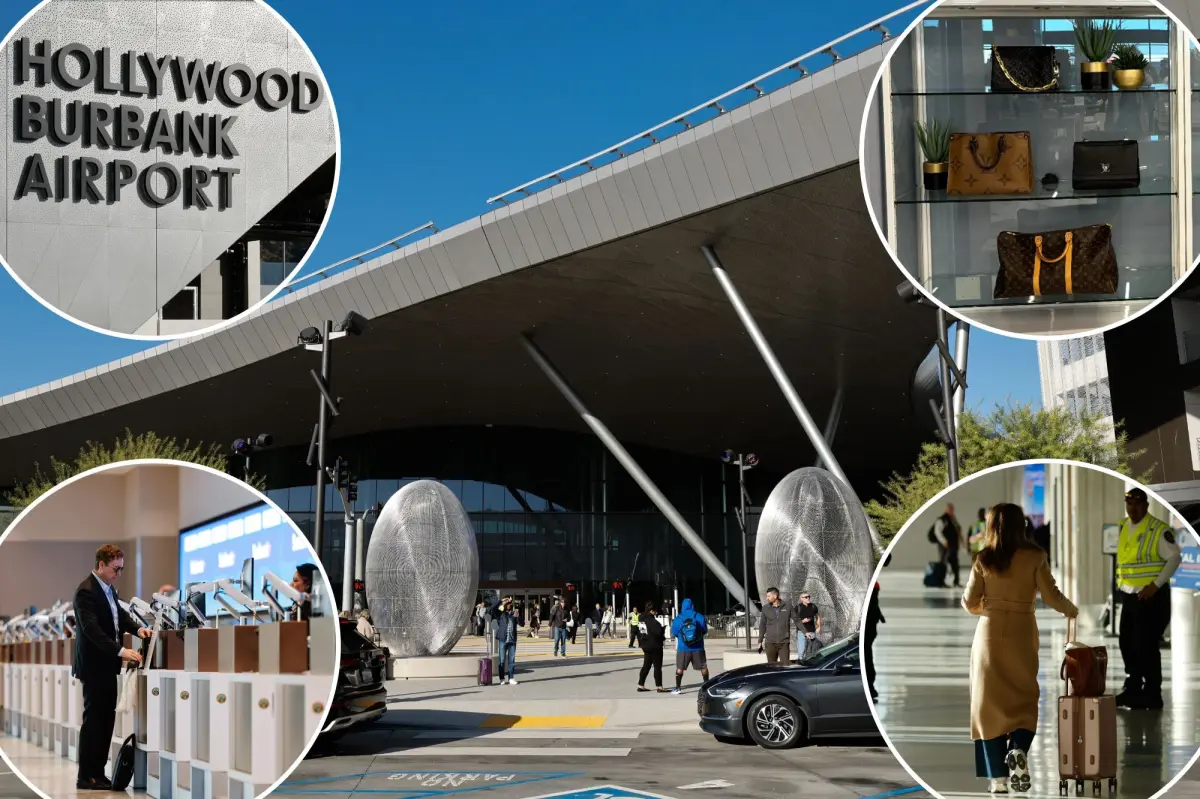
The little airport has reached a higher elevation, and it shows the moment you step past security. Burbank’s shiny new terminal opened Tuesday morning with a surprise that no one expected: a glass display of Gucci handbags near Gate 7, with prices ranging from $1,500 to $4,000. There they sat, gleaming under the terminal lights, while curious early-morning travelers stopped to stare and wonder if they were in the right place. This was, after all, the same airport where the big hope used to be finding a decent cup of coffee. The new terminal looks a little more like Beverly Hills now, and that’s a strange thing for a place that has always been proudly modest. Andy Orbeck, a traveler flying to Bend, Oregon, summed it up beautifully. “I never thought I’d see Gucci in the Burbank Airport,” she said. “You used to just hope for a decent cup of coffee. I’m not in the market for Gucci, but if I ever am it’s good to know it’s an option.” That mix of humor, skepticism, and quiet delight seemed to be the mood of the morning. The contrast between old and new was jarring, but also kind of lovely. It felt like a small airport trying on a fancy outfit and waiting to see whether it fit. The billion-dollar terminal has a polish the old building never attempted, but the real question was whether it could keep the soul that made Burbank the best-kept secret in Los Angeles air travel. That question was on my mind as I walked through the doors with my boarding pass in hand.
I flew out on one of the first flights from the new terminal Tuesday morning, and I will admit I was expecting the worst. Like many Angelenos, I had a deep attachment to the old terminal, weirdly enough. It smelled like 1950s grandma’s carpet, and its low ceilings made you feel like you were walking through someone’s attic. But it had so much going for it. Parking was close. Boarding and deplaning happened through doors on both sides of the plane, which made the whole process feel quicker and more personal. The TSA experience was relaxed, with no mobs, no chaos, and no sense that you were about to lose hours of your life to someone else’s schedule. It was a far cry from LAX, and that was exactly the point. The old terminal lived to almost a hundred years old, and it earned its reputation as a miracle of convenience. So the idea of replacing it with something shiny and expensive felt like a loss. Would the old charm survive? Would the new building blow up Burbank’s status as a quiet alternative to the big, stressful airports? Would the crowds suddenly discover it? I pulled into the new parking structure at 6:30 a.m. for an 8 a.m. boarding time, bracing myself for the worst. Instead, I found plenty of spaces, at $49 a day, and I was standing at my gate by 6:50 a.m. That’s not just acceptable; that’s remarkable. Security was quick, too. I zipped through TSA PreCheck in less than five minutes, with plenty of officers on hand and walk-through metal detectors keeping the line moving. The old airport’s greatest promise, convenience, was still alive.
Inside, the terminal feels like an entirely different world. There are high ceilings, wide hallways, and a sense of light and space that the old building never had. You no longer have to squeeze past fellow passengers or duck under low beams. The design is open and calm, and it makes the whole experience of waiting for a flight feel less punishing. I walked around for a while just to take it all in, and I could see that there will be plenty of places to eat, at least eventually. I spotted a Poquito Mas, a place called Spring Chicken, and a Boarder Grill. The names sound promising, and I imagined the breakfast burritos that would one day save hungry travelers from the sad airport world of packaged sandwiches and overpriced snacks. But on opening day, none of these restaurants were actually open. Some were still under construction, with workers moving around behind counters and equipment waiting to be unpacked. If you had been hoping to grab a quick bite before your flight, you were out of luck. There was also no lounge, at least not yet. No VIP hideaway with complimentary food and drinks, no quiet corner to escape the bustle. The old terminal could have desperately used a lounge, and the new one doesn’t have one yet either. It was a small disappointment, but not a deal breaker. The bones are good. The atmosphere is comfortable. The details, like restaurants and lounges, are probably coming. It just means that opening day was a little rougher than the polished terminal would suggest.
The morning’s biggest problems, though, were not about food. They were about information. The terminal features fancy digital arrival and departure screens, but a lot of them did not seem to work. I watched Southwest Airlines ground crew members spend a good portion of the morning trying to help confused passengers figure out where they actually needed to be. The screens insisted that certain gates were correct for flights to Phoenix, Oakland, and Las Vegas, but the employees knew better. People had to be redirected, sometimes more than once. One frustrated employee finally told passengers, “Sorry, they aren’t working right, please refer to the Southwest App.” It was the kind of glitch that opening days are supposed to avoid, but somehow always manage to have. My own flight to Oakland was delayed, too, because the flight crew showed up late and had trouble locating the plane. It wasn’t a catastrophic delay, just the sort of thing that makes you roll your eyes and think about how the old terminal, with all its flaws, never had to deal with this kind of high-tech breakdown. At least the airport was prepared with a small comfort: greeters handing out free coffee to passengers wandering around with their luggage, trying to figure out where they were supposed to go. I took my cup and walked back past the Gucci display, which now seemed less like a luxury statement and more like an odd little symbol of everything this transition represents. The high end is trying to sit alongside the practical, and for now, they’re figuring each other out.
When they finally called my flight and I walked outside to board the plane, I was still carrying my free coffee and a somewhat skeptical attitude. I settled into my middle seat, looked out the window, and waited for the doors to close. The plane left the runway, and as we climbed above the neighborhoods of Los Angeles, I looked down at Universal Studios and Sherman Oaks and felt something shift in my chest. I smiled. The new terminal had hiccups, yes. The restaurant situation was disappointing. The screens were unreliable. My flight was delayed. But the things that made the old terminal great were still there, underneath all the new paint and polished floors. Easy access. Quick security. A relatively painless trip from the car to the sky. The new building has expanded the space and added comfort, but it hasn’t destroyed the convenience that made Burbank so special. It hasn’t turned into LAX. It hasn’t become a maze of anxiety and traffic. It’s still a small airport, even if it’s now a small airport with Gucci bags behind glass and ceilings tall enough to make you forget you’re in a building built for planes. There was something reassuring about that, a sense that even as the airport changes, its personality remains intact. The kinks will get worked out. The screens will get fixed. The crew will learn the new layout. But the heart of Burbank, the part that makes flying feel less like an ordeal, was beating just fine.
As the plane continued to climb and Los Angeles got smaller below me, I thought about what this airport has always meant to the people who use it. In a city defined by traffic and distance and endless waiting, Burbank is a quiet miracle. It’s a place that lets you in, lets you fly, and lets you go without making you feel like you’ve run a marathon. The new terminal is different, no question. It’s bigger, brighter, and fancier. There is a billion-dollar shine to it now, and the Gucci handbags are a sign that the airport is trying to appeal to a different kind of traveler. But it still feels like the same secret. It still has that friendly, manageable, no-drama quality that Angelenos have relied on for years. I looked out at the clouds and thought about how many mornings I had walked through the old terminal with its strange smell, hurried onto a plane, and made it to my destination with ease. The new terminal, for all its first-day problems, is already delivering something similar. The restaurants will open. The screens will work. The flights will run on time. And the little airport will keep doing what it has always done: getting you where you need to go without the usual airport nightmares. So if you’re looking for a better way to fly in Los Angeles, come to Burbank. Enjoy the light, the space, the easy parking, and maybe even the unexpected sight of luxury handbags near Gate 7. But do me a favor. Please, just don’t tell anyone.