


For nearly nine decades, the disappearance of Amelia Earhart has remained one of the most haunting unsolved mysteries in modern history. A pioneering aviator who refused to accept limits, Earhart vanished over the Pacific Ocean in July 1937 while attempting to become the first woman to fly around the world. She and her navigator, Fred Noonan, were last heard from somewhere near Howland Island, a tiny speck of land in the middle of an immense ocean. Earhart reported that they were running low on fuel, and then the radio went silent. In all that time, dozens of searches have crisscrossed Pacific waters and islands, studied grainy photographs, chased scattered metal debris, and offered countless theories. Yet no trace of the Lockheed Electra 10E was ever confirmed. Now, a new expedition from Purdue University and the Archaeological Legacy Institute believes the world may have been looking in the wrong place all along. A 17-member team has made its way to Nikumaroro, a remote South Pacific atoll, to investigate a tantalizing submerged object near the shoreline. The voyage marks the 20th organized search for Earhart’s plane, and this time the researchers are armed with modern satellite imagery, historical photographs, and a strong theory that Earhart and Noonan actually landed on Nikumaroro rather than Howland Island, which lies some 350 miles to the north. After years of dead ends and false leads, this small team believes the answer may finally be within reach.
The island itself is no tropical paradise, at least not for the faint of heart. Nikumaroro is a heavily overgrown coral atoll, isolated and difficult to reach, but it is perhaps best known for something far more unsettling than its remoteness: an enormous population of coconut crabs. These creatures are the largest crustaceans in the world that spend their entire adult lives on land. They can grow up to three feet across, and their massive claws are powerful enough to crack coconuts, break bones, and cause serious injury to anything careless enough to get too close. Locals and researchers alike have long described them as aggressive night foragers, creeping out of their burrows after dark to seize unsuspecting prey. For anyone stranded on the island, the crabs would have been a constant threat. More than that, they have fueled grim speculation about what happened to Earhart and Noonan after their supposed landing. Coconut crabs are natural scavengers, and they are known to carry away anything organic, including bone fragments, to their underground burrows. Some researchers believe that if the aviators died on Nikumaroro, their remains could have been scattered by these creatures long before anyone arrived to search. That possibility is one of the many reasons the Purdue and ALI team is taking no chances: they sleep safely aboard their vessel each night rather than camping ashore, wary of the crabs’ silent and powerful presence.
The theory that Earhart and Noonan landed on Nikumaroro is not new, but it has gained real traction in recent years. Historians have long suspected that a navigational error may have caused the pair to miss Howland Island entirely. Flying low on fuel and exhausted after a long and grueling flight, they may have spotted Nikumaroro, then known as Gardner Island, and attempted a landing on its reef. Radio operators at the time picked up a series of distress calls in the hours and days after Earhart’s last official transmission, and many of those signals seemed to come from the island. The calls were faint and often garbled, but they suggested that someone was alive and trying to communicate. Later discoveries on Nikumaroro added weight to the theory. In 1940, British colonial officials found the remains of human bones on the island, though the bones were lost after being shipped to Fiji. Decades later, in 2018, a fresh analysis of measurements and photographs of those bones concluded that they were consistent with a woman of Earhart’s height and build. Even more tantalizing, searchers found remnants of a woman’s shoe dating to the 1930s and a small glass jar of freckle cream, a cosmetic product that Earhart was known to use. These fragments, though small, painted a heartbreaking picture: two castaways, stranded on an unforgiving island, trying desperately to survive before the sea eventually took their aircraft and, perhaps, their lives.
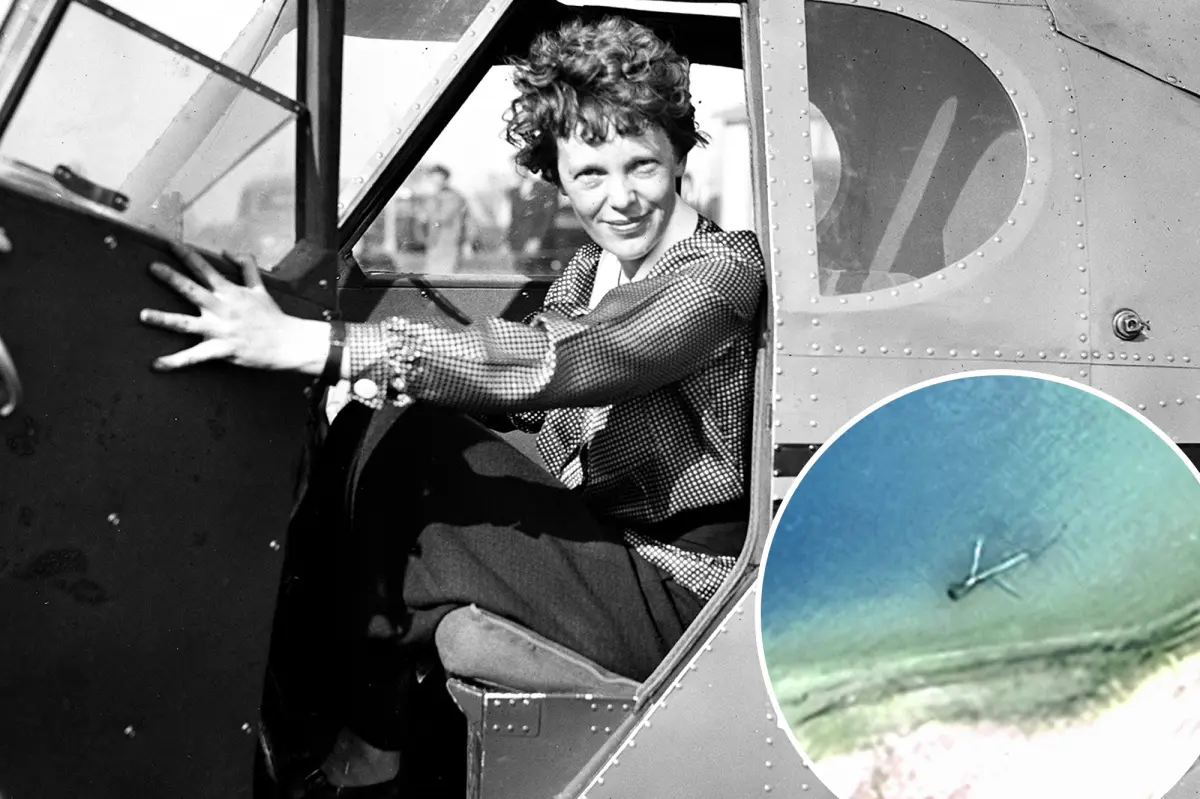
Now, the search has moved underwater. The expedition is focused on what researchers call the “Taraia Object,” a submerged shape near the western shoreline of Nikumaroro. The object was first identified in satellite imagery in 2020, but historical photographs suggest it may have been resting in the lagoon since as early as 1938, just a year after Earhart vanished. To the trained eye of the archaeologists leading this mission, the object seems too structured and too consistent to be a natural rock formation. They believe it could be the tail and fuselage of a Lockheed Electra 10E, the very plane Earhart flew on her ill-fated journey. To find out, the team arrived on the island’s western edge on October 12 and has deployed a floating hydraulic dredge, a special machine that removes layers of underwater sediment from around the object. The goal is to expose enough of the silhouette to see whether it is metal, and above all, to look for aluminum skin panels and telltale patterns of rivets that would positively identify the wreck. If the object turns out to be an airplane wing or the curved body of a fuselage, the team will have finally cracked the case that has eluded aviation experts for generations. They only have a five-day operational window, a narrow stretch of time dictated by weather, tides, and the limits of their expedition, so every hour of dredging matters.
The search, of course, has had many false starts before. Over the decades, explorers have scoured islands, hauled sonar equipment across ocean floors, and chased wreckage that turned out to be coral, rock, or abandoned military equipment. Some of the most promising objects spotted in underwater scans were later identified as natural formations, leaving researchers frustrated and empty-handed. But those earlier failures have made the current mission more focused. The team is not relying on a single clue; instead, they are combining modern remote sensing, historical records, and physical artifacts that point directly to Nikumaroro. If they do locate the Electra, the next step will be to carefully map the site and document everything before returning next year for a full recovery. That would be a massive undertaking. Purdue University is already in negotiations with the government of Kiribati, the Pacific nation that controls the islands in the region, to bring the wreckage back to the United States for conservation, study, and eventual museum display. The diplomatic and logistical challenges are considerable, but the historical importance is immense. For many people, finding Earhart’s plane is not just about solving an old puzzle; it is about giving a final resting place to one of history’s most inspiring and mysterious figures.
The stakes could not be higher for those who continue to care about her story. Earhart was more than a pilot; she was a symbol of courage, independence, and possibility. She broke barriers at a time when women were largely discouraged from pursuing careers in aviation. She was the first person to fly solo and nonstop across the United States, the first woman to fly solo across the Atlantic, and the second person in history to do so. She became a role model to millions, a woman who seemed to embody the audacious spirit of the twentieth century. Before her final voyage, she served as a career counselor for women at Purdue University and as an advisor to its Department of Aeronautics, and it is fitting that a Purdue-led team is now at the center of the search. For those who have spent years sifting through archives, satellite images, and fragments of bones, this is not an exercise in obsession. It is a search for closure, for answers, and for a meaningful end to a story that has lingered in the human imagination for almost ninety years. Whether the Taraia Object turns out to be her beloved plane or another piece of the island’s long history, the effort itself speaks to something deep in all of us: a refusal to let great lives simply dissolve into mystery, and a determination to bring lost stories home. On a remote, crab-infested island in the middle of the Pacific, that hope is being tested for the twentieth time.