



Paragraph 1
On a routine morning at Phoenix Sky Harbor International Airport, the steady rhythm of the security checkpoint was broken by a single, curious image on an X-ray monitor. A passenger, whose name would never be released to the public, had placed a carry-on bag onto the conveyor belt, likely expecting nothing more than a few minutes of standard screening before heading to a gate. But the TSA officer watching the screen noticed something odd inside that bag—a dense, unusual shape and a tangle of wiring hiding within what appeared to be an Apple Mac mini desktop computer. At first glance, the machine looked like any other compact desktop unit that travelers often bring for work or entertainment. Yet the internal structure looked wrong. The mass was too concentrated, the wiring too deliberate, and the placement too suspicious to be a normal factory configuration. That moment of visual recognition set off a chain of events that would end with a passenger in police custody and a cache of dangerous drugs seized from inside the computer. The screening officer, Logan Stortz, was the first to sound the alarm. He had been scanning baggage for hours, his eyes trained to pick out anomalies amidst the endless stream of clothes, electronics, and toiletries. But this particular image did not fit any familiar pattern. It was not a battery, a hard drive, or a power supply. It was something secret—something hidden with intention. Stortz would later describe his initial reaction with remarkable honesty, noting that he first suspected the object might be part of a deliberate test, one of the many internal exercises the TSA runs to keep officers alert and procedures sharp. That assumption made sense: agencies frequently plant dummy items to measure performance. But as the bag was pulled aside and the computer examined more closely, the truth became far more alarming than any simulated training scenario.
Paragraph 2
When the bag was flagged, Officer Stortz called over Isaiah Martinez Jr., another TSA officer working the checkpoint. Martinez was tasked with conducting a physical search of the carry-on. The two men stood together, peering at the Mac mini, noticing subtle signs of tampering—seams that did not quite align, screws that showed scratches, the type of wear that suggests someone had opened the device and closed it again without the precision of a manufacturer. “I was in shock,” Martinez later recounted. “I noticed something was awry and immediately notified a supervisor.” What struck him most wasn’t the discovery itself, but the audacity of the concealment. Travelers often attempt to hide contraband in commonplace items, but inserting drugs into a functional computer requires time, tools, and a certain level of technical know-how. It wasn’t a simple slip of a baggie into a pocket; this was a deliberate dismantling of a machine, the removal of its internal components, the placement of illegal substances into a hollowed-out compartment, and then the careful reassembly of the device so it would still appear normal to casual inspection. The officers could see that the computer was not just an ordinary piece of electronics. It had been transformed into a carrying case for something forbidden. At that point, they understood the situation required more than routine screening. They paused all searches and elevated the alarm, knowing that hidden compartments can sometimes conceal not only drugs, but more dangerous items like weapons or explosives. The checkpoint became a focused scene, with other passengers continuing their journeys unaware of the drama unfolding a few feet away. The initial suspicion of an internal test faded quickly as the reality of real-world contraband set in. Both officers felt a mix of surprise and gravity, reminding them that every single bag, every single scan, could hold a story far darker than a forgotten water bottle or an oversized shampoo.
Paragraph 3
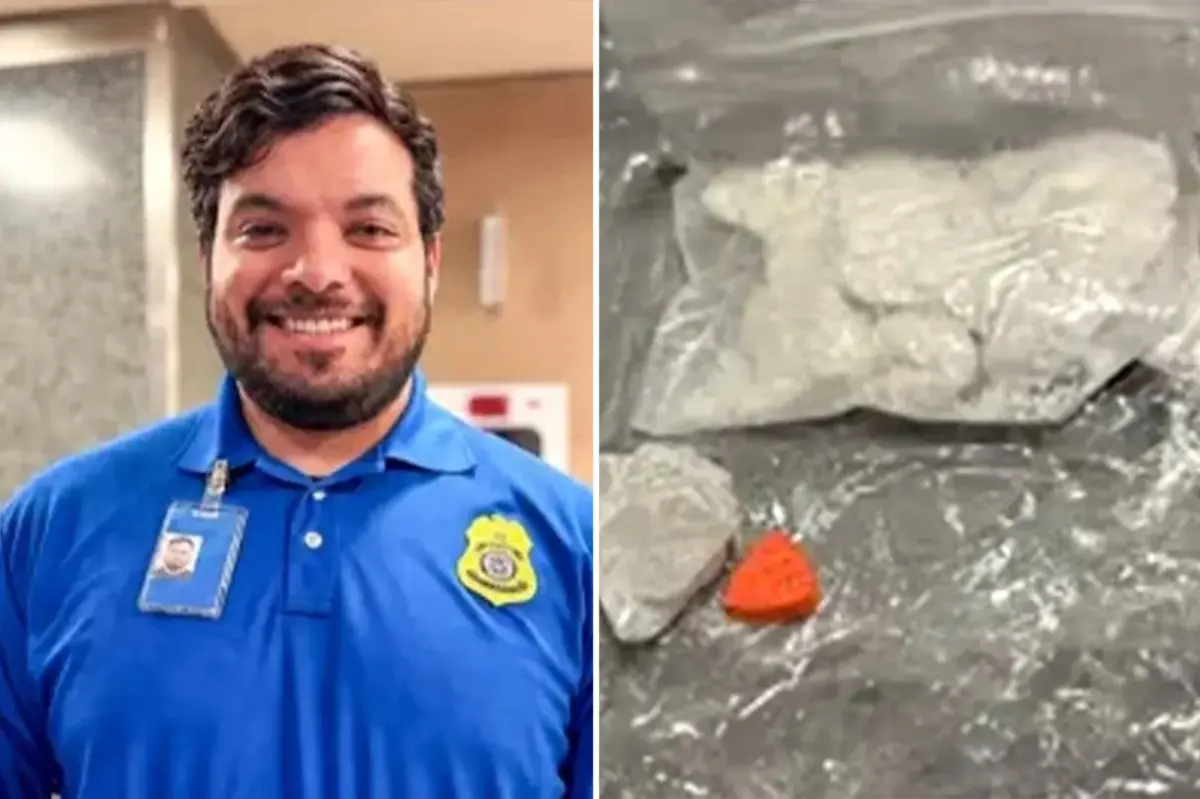
The next phase of the inspection was even more intense. The TSA team moved the suspicious computer to a secondary screening area, away from the flow of travelers. There, they ran it through another X-ray examination, this time with greater attention and from different angles. The images confirmed their worst suspicions: beneath a visibly concealed area of the computer’s casing was a solid mass, and detailed signs of tampering were unmistakable. The wiring did not match any standard Apple design, and the internal layout had clearly been altered. Because hidden compartments can sometimes be booby-trapped or contain hazardous materials, the TSA called in a specialist trained in explosives detection—Robert Rosas Perez II, whose job was to determine whether the object posed a danger to officers and the public. Perez approached the computer with extreme caution, following strict protocols designed to minimize risk. He examined the exterior, felt for any irregularities, and then carefully opened the altered casing. Inside, he discovered plastic-wrapped packages nestled within the machine’s former processing unit. The packages contained a crystallized substance and an orange pill-like item, both later suspected to be dangerous drugs. Perez wasted no time. “I stopped all procedures at that point,” he said. His role was not to identify the drugs himself, but to ensure that the discovery was made safely and securely. By pausing, he allowed law enforcement to take over the evidence handling, maintaining the integrity of the confiscated materials and preserving the chain of custody. The meticulous process—from the first X-ray anomaly to the careful opening of the computer—demonstrated how a single inconsistency at a security checkpoint can escalate into a full-scale law enforcement operation in a matter of minutes.
Paragraph 4
With the plastic-wrapped materials now exposed, the checkpoint team contacted the Phoenix Police Department. Officers arrived and conducted preliminary field tests on the substances. The results were sobering: the crystallized material was suspected to be methamphetamine, the powder showed signs of fentanyl, and the orange pill-like item was believed to be ketamine. Fentanyl is a synthetic opioid that has become a leading cause of overdose deaths across the United States; even a minuscule amount can be lethal. Methamphetamine is a highly addictive stimulant that devastates communities. Ketamine, while used medically as an anesthetic, is also abused as a club drug. Together, these substances represented not only a legal violation but a serious public health threat. The passenger was arrested at the scene, though the TSA did not release their identity or mention any charges beyond the arrest. Supervisory TSA Officer Emily Price later reflected on the incident, calling the concealment method “unusual.” She had seen many attempts to sneak prohibited items through security, but hiding a cocktail of dangerous drugs inside a desktop computer was a creative and troubling tactic. The discovery illustrated the lengths to which individuals will go to evade detection, and the equally determined efforts of security personnel who train to spot hidden anomalies. For the officers involved, the moment was both a professional success and a reminder of the unpredictability of their work. A routine morning had turned into a major drug bust, and they had played an essential role in keeping those substances off an airplane and out of the broader community.
Paragraph 5
Perhaps the most striking insight from the incident came from Robert Rosas Perez II, the explosives specialist who uncovered the drugs. Even after making such a notable discovery, he was surprisingly candid about the frequency of such events. “This is probably not as uncommon as the public might think,” he said. “Every day, passengers attempt to bring illicit, illegal, prohibited or suspected illegal items through security checkpoints.” His words offer a window into the real world of airport security, where the visible checkpoint experience—the lines, the bins, the beeping metal detectors—only hints at the constant vigilance required behind the scenes. TSA officers are trained to stop any item that threatens aviation security, with weapons and explosives as their primary focus. The enforcement of drug laws is not their main mission, and they are not law enforcement officers in the traditional sense. However, when they encounter suspected illegal substances during routine screening, they are obligated to notify law enforcement, as they did in this case. This distinction matters: TSA’s role is to protect passengers and aircraft from immediate physical threats, not to act as narcotics detectives. Yet the reality is that drug smuggling and aviation security often intersect. Passengers attempting to transport large quantities of illegal drugs through checkpoints pose potential risks not only because of the contraband itself, but because such individuals are often willing to take other dangerous actions to avoid detection. The line between catching explosives and catching drugs can be razor-thin, and a computer cleverly altered to hide fentanyl might just as easily have hidden a detonator. The officers’ discovery was therefore a dual victory: it removed dangerous drugs from the streets and prevented a potential security breach on an aircraft.
Paragraph 6
In the aftermath of the discovery, the checkpoints at Phoenix Sky Harbor continued to hum with its usual flow of travelers, most of them unaware of the drama that had just unfolded. For the TSA officers involved, the experience would linger as a vivid example of why their jobs matter. Logan Stortz did not start his shift expecting to find drugs. Isaiah Martinez did not plan to help foil a smuggling attempt. Robert Rosas Perez did not anticipate opening a computer and finding crystal meth and fentanyl. Yet their training, observation, and reaction aligned seamlessly to turn a suspicious image into an arrest. This incident is a reminder that airport security is not merely about enforcing rules or inconveniencing passengers; it is about preventing harm at multiple levels. The discovery of illicit drugs inside a Mac mini also highlights the evolving creativity of those who attempt to bypass security. As authorities improve their screening methods, travelers with criminal intent adapt, using new hiding spots and technical tricks. But as this case shows, the human eye, augmented by X-ray technology and sharp instincts, often catches what is meant to be hidden. The anonymous passenger’s trip ended not at a destination, but in police custody, while the officers returned to their posts, ready to scan the next bag. For travelers passing through security, the story serves as a quiet reassurance: there are trained professionals who are not just looking for water bottles and laptops, but who are ready to spot the strange, the hidden, and the dangerous. And for the officers themselves, it is a proud but sobering memory of a day when the ordinary concealed the extraordinary, and they answered the call.