


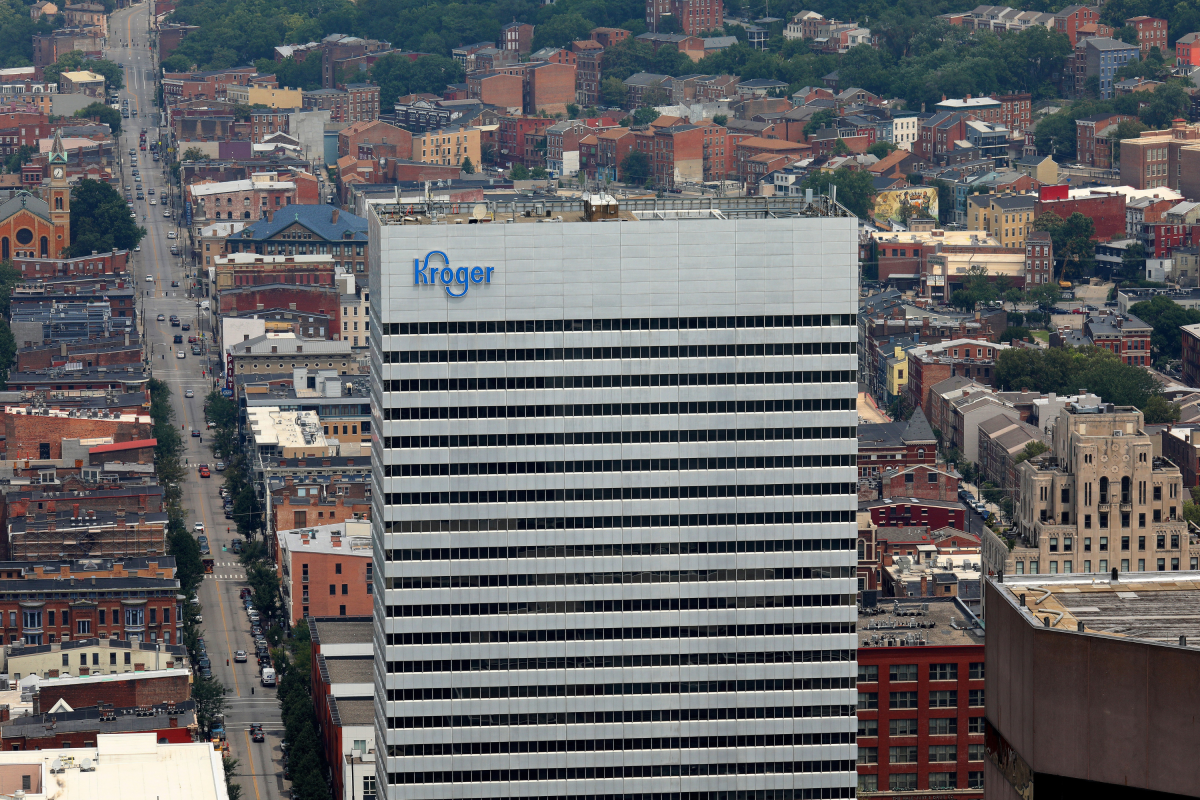
The news arrived not as a single dramatic announcement but as a quiet, internal memo, and for thousands of corporate employees at Kroger, it carried the weight of a seismic shift. The supermarket giant, based in Cincinnati, Ohio, has confirmed plans to lay off roughly 3,000 corporate workers over the next three years, a reduction that represents approximately 37 percent of its 8,200-person corporate workforce. According to reports from Reuters, Bloomberg, and The Cincinnati Business Courier, the cuts will not be limited to the company’s headquarters in Cincinnati, but that city will almost certainly feel the impact deeply. Kroger is the largest company in Greater Cincinnati, a regional economic anchor reporting $148 billion in revenue, and its corporate offices have long been seen as a source of white-collar stability in a state that has watched manufacturing jobs disappear for decades. The memo laying out the job cuts also signaled a broader transformation. CEO Greg Foran has made clear his desire to further integrate artificial intelligence into Kroger’s operations, and for many workers, that phrase is ominous. It conjures images of algorithms replacing judgment, spreadsheets replacing relationships, and software quietly absorbing the tasks that once belonged to people. The company has not specified how many of the eliminated positions will be in Ohio, but the announcement landed at a particularly charged political moment. The midterm elections in Ohio are now dominated by economic anxiety, and the loss of thousands of corporate jobs may become more than a headline. For the families affected, it is an immediate and personal disruption. For the broader community, it is another sign that the future of work is uncertain, and the promise of a career with a beloved institution may no longer hold.
Ohio, meanwhile, has once again become the center of the political world, and the timing of Kroger’s layoff announcement has made the economy an unavoidable topic in the final weeks of the campaign. The state once stood as the premier bellwether of American politics, voting for Barack Obama in 2008 and 2012 before shifting decisively to Donald Trump in 2016, 2020, and 2024—the last time by a double-digit margin. That history makes the current moment feel both familiar and strange. Ohio has drifted to the right in recent years, but Democrats argue that this year is different. With President Trump’s approval rating underwater nationally, the party believes that Ohio’s statewide races are winnable, and the polling so far has backed that optimism. The Senate race in particular has implications far beyond the Buckeye State. Republicans currently hold a 53-47 majority, but control of the upper chamber is considered increasingly at risk. Democrats need to flip four seats to take the majority, and while Vice President Vance would serve as the tiebreaker in a 50-50 Senate, the party’s path runs directly through Ohio. In fact, Democrats need to flip two seats in states that Trump won by double digits in 2024, and Ohio is widely viewed as one of their best opportunities. The candidates reflect the state’s new political reality: on the Republican side, Senator Jon Husted, who previously served as lieutenant governor and secretary of state, is seeking to hold onto the seat. On the Democratic side, former Senator Sherrod Brown, who represented Ohio in the Senate from 2007 to 2025 and remains a powerful figure in the state’s working-class politics, is trying to win his way back. Their race is rated a toss-up by the Cook Political Report and Sabato’s Crystal Ball, and the outcome could determine which party controls the Senate for the next two years.
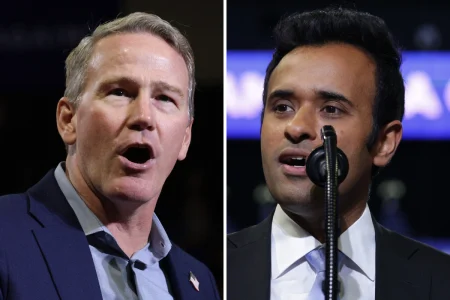
The governor’s race has turned into an equally fierce battle, and it is unlike any Ohio contest in recent memory. For the Democrats, Amy Acton, a former director of the Ohio Department of Health who became a household name during the early days of the pandemic, is running as a first-time candidate. For the Republicans, Vivek Ramaswamy, a wealthy entrepreneur who gained national prominence during his 2024 presidential campaign, is seeking to translate his outsider energy into executive power. What makes the race so unusual is that neither candidate has ever held elected office. The lack of traditional political experience has made the campaign less predictable and more personal, with both candidates leaning heavily on stories of economic hardship and promises of renewal. Acton has emphasized public health, community, and the idea that every Ohioan deserves a fair shot, while Ramaswamy has presented himself as a disruptor who will slash government and unleash entrepreneurship. In a state that once defined the American manufacturing economy, the contest has become a referendum on who can better navigate the transition to a new economy. The polls reflect a deeply divided electorate. A CNN poll of 760 likely voters taken from September 29 to October 5 showed Acton with a commanding 8-point lead, 50 percent to 42 percent. But a co/efficient poll conducted on October 5 and 6 found Ramaswamy ahead by 2 points, 45 percent to 43 percent. A New York Times/Siena College poll put Acton up by 4 points, 49 percent to 45 percent. The reality, three weeks before the midterm, is that either candidate could win, and the race is living up to its toss-up billing.
Beyond the daily drama of the campaigns, the deeper story in Ohio is one of economic transformation and persistent fear. For much of the twentieth century, Ohio was a powerhouse of American industry. Its cities turned out steel, iron, automobiles, and machinery for the entire country, and working-class families could rely on unionized factories to provide stable, dignified paychecks. But the decades since have been brutal for many communities. Factories closed, moved overseas, or became automated, and the jobs that once supported entire neighborhoods vanished. Manufacturing remains an important part of Ohio’s economy, but the transition away from it has left deep scars. The Kroger layoffs will almost certainly be seen through that longer history. Voters are not just reacting to a single announcement; they are responding to a lifetime of watching institutions shrink, corporations consolidate, and familiar names disappear. A recent New York Times and Siena University poll of 616 Ohio voters, conducted from September 22 to October 1, found that only 31 percent described the state’s economy as good or excellent. Forty-four percent rated the economy as fair, and 25 percent called conditions poor. The poll had a margin of error of plus or minus 4.5 percentage points, but the overall picture was unmistakable. Economic anxiety is not a niche concern in Ohio; it is the defining emotion of the election. Both Democrats and Republicans have tried to speak directly to that anxiety, with candidates from each party promising to lower the cost of living and bring down prices. National issues such as tariffs, the lingering effects of inflation, and high gas prices, intensified by the conflict with Iran, have filtered into local conversations. But at the kitchen tables of Ohio, the question is often simpler: can my family get ahead, or are we slipping backward?
The personal financial data from recent polls paints an even starker picture. A Bowling Green State University and YouGov survey of 1,000 likely voters, conducted from September 1 to September 10, found that only 17 percent of Ohioans believe their economic situation has improved. Thirty-nine percent said things were the same, and 44 percent said their circumstances had worsened. The same poll found that only 17 percent believe the national economy is getting better, while 65 percent believe it is getting worse. These numbers suggest a mood of deep discouragement, one that cuts across party lines and affects how voters interpret events like the Kroger layoffs. The introduction of artificial intelligence into corporate operations adds another layer of unease. Even when companies frame AI as a way to increase efficiency and reduce tedious tasks, workers tend to hear something else: replacement. Kroger’s decision to lean further into AI at the same time it cuts thousands of jobs is, to many observers, a powerful symbol of the future that workers fear. It is also a reminder that the economy is always changing, and not all change is kind. The Senate race polls illustrate just how tight and volatile the state has become. In the CNN poll, Brown led Husted by 6 points, with the Democrat at 49 percent and the Republican at 43 percent. The co/efficient poll, by contrast, showed Husted with a narrow 1-point edge, 44 percent to 43 percent. And the Times poll had Brown ahead by 3 points. These shifting numbers, with different methodologies and voter universes, confirm that Ohio is not a safe seat for anyone this year. Both campaigns are spending heavily and scrambling to mobilize their bases, while undecided voters are being pulled in different directions by the same issues: jobs, prices, and the future of work.
As the midterm approaches, the biggest unanswered question is whether the Kroger layoff announcement will change the trajectory of the race. Layoffs of this scale are rarely absorbed into the political system without consequence, especially in a state where the economy is already the dominant issue. But the cuts are scheduled to take place over three years, and many workers will not lose their jobs immediately. That slow, grinding process may have a corrosive effect on morale long before it shows up in the employment figures. Early voting is already underway in Ohio, according to the office of the secretary of state, and several thousand residents have cast their ballots. But the rest of the state is still watching, reading headlines, and trying to decide which candidate offers the most believable path forward. The Kroger announcement adds a concrete, emotional touchstone to the abstract debates about artificial intelligence, inflation, and the cost of living. It is one thing to hear that the economy is uncertain; it is another to know that a major employer in your city is shrinking by more than a third of its corporate workforce. For the people of Cincinnati, and for Ohioans across the state, the question is no longer just about polls or political strategy. It is about whether the institutions that have anchored their communities for decades can still offer the security they once did. The final weeks of this election will be shaped less by attack ads than by that deeply human fear, and the outcome may hinge on which candidate can convince voters that they understand it, share it, and have a realistic plan to address it. In the end, Ohio’s midterm is not merely a referendum on two parties or two politicians. It is a test of whether the state can find its footing in a changing economy, and whether the people who have been left behind can believe in the promise of a better tomorrow.