


Portugal has long been the kind of place that wraps itself around you before you have even noticed. It is not only the golden light, the blue-tiled facades, or the smell of freshly baked bread drifting through a narrow street. It is the people. Travelers return home from Portugal with stories they cannot stop telling—about a shopkeeper who walked them halfway across town, a neighbor who waved them into a local feast, a waiter who brought out an extra plate of sardines simply because they liked your smile. These stories are repeated so often that they have helped shape the country’s global reputation. Year after year, international studies and surveys place the Portuguese at the top of tourist favorites, and almost no one is surprised. The latest confirmation comes from Condé Nast Traveller, whose readers have named Porto Europe’s friendliest city in the Readers’ Choice Awards 2026, with Lisbon right behind it in second place. This particular honor carries extra weight because it is the result of real votes from seasoned travelers, not a certificate handed out by tourism boards. These are people who have walked through countless airports, checked into countless hotels, and learned to recognize the difference between rehearsed hospitality and something more sincere. In Porto, they found something special. The magazine explains that the distinction aims to identify cities where hospitality is at its warmest and locals are eager to help, whether you are trying to make sense of a neighborhood restaurant’s menu or standing on the metro with a confused look. That kind of everyday attentiveness is difficult to fake, and it is exactly the reason so many visitors leave Portugal with not just photographs but genuine memories.
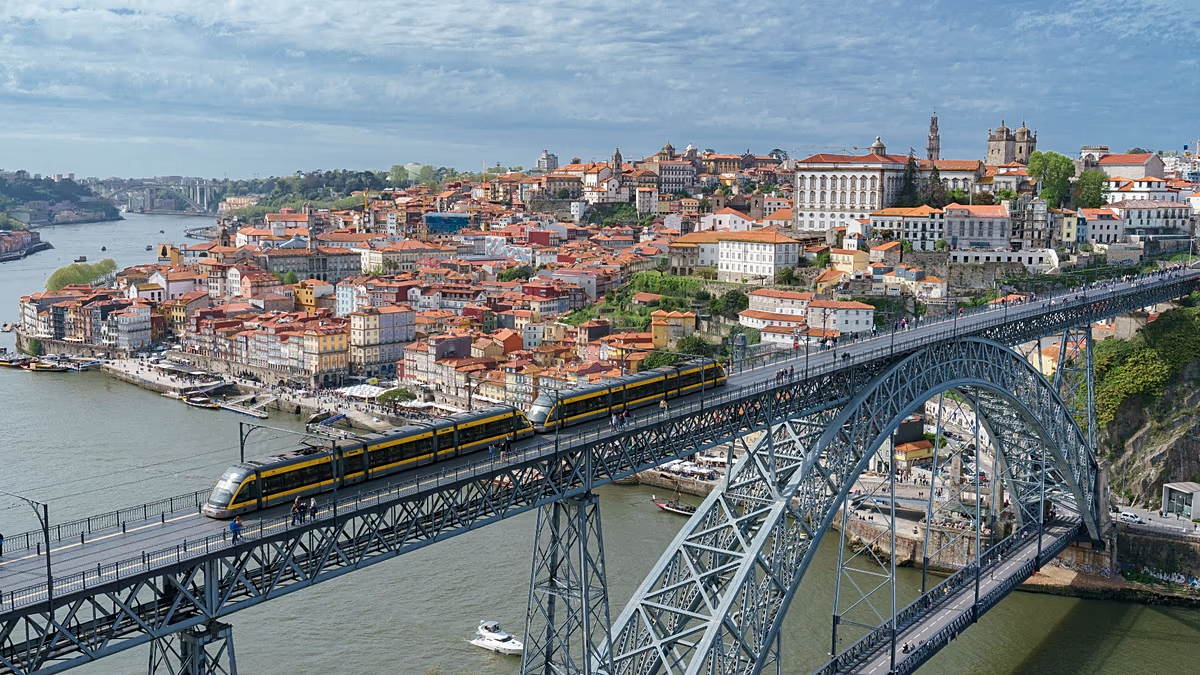
Porto, known affectionately as the Invicta—the unconquered city—has been winning hearts quietly for years. The Condé Nast editors note that the recognition now given to the city reflects a significant rise in Porto’s popularity as the ideal city-break refuge, especially for lovers of good food and culture enthusiasts. There is perhaps no better place to combine those two passions. The city is a living museum of faded elegance, a place where you can turn a corner and find yourself facing an entire building covered in centuries-old azulejo tiles. But the magazine also highlights authenticity and a relaxed atmosphere as key parts of Porto’s appeal, and that sense of authenticity runs through everything the city does. In the morning, the bakery owner behind the counter asks if you want your coffee “like a local,” short and strong, with no fuss. In the midday heat, market vendors smile as you fumble through Portuguese and help you choose the best fruit. In the evening, the air over the Douro River turns pink, and the stone streets fill with people simply walking, talking, laughing, not rushing anywhere. Friendliness in Porto is not a performance designed for tourists; it is simply the way people have always behaved. Walking into a restaurant can feel like being welcomed into someone’s kitchen. You are not expected to hurry through your meal or to impress anyone; you are expected to enjoy yourself and to share a little of your story. That is why the title of Europe’s friendliest city feels like an accurate reflection of everyday life, not a promotional slogan.
The magazine paints a vivid picture of what visitors will find when they arrive. It encourages travelers to unwind in a stunning square lined with azulejo tiles or to share petiscos—small portions of local delicacies—with residents in a neighborhood restaurant. “And you will quickly realize how generous hospitality has made Porto a destination many of us end up returning to time and time again,” the publication says. That phrase, “generous hospitality,” says a lot. It suggests a warmth that gives freely without expecting anything in return. Imagine a waiter who notices you eyeing the plate at the next table, then appears at your side with a small spoonful so you can taste it before deciding. Imagine an elderly man at the market who walks you through his stall, wrapping each of your purchases in paper and handing them to you with both hands, as if he were giving you a gift. Imagine an evening spent on a terrace where the owner pours you a glass of a local fortified wine, tells you the story of the grape, and refuses to let you pay for it. These are not unusual experiences in Porto. They are the moments that bring the city to life in the minds of travelers. The city’s food culture is deeply social. Petiscos are meant to be shared, dishes are pushed from one side of the table to the other, and conversation spills out onto the sidewalk. Even if you are traveling alone, someone will probably ask where you are from, whether you like Porto, what you have eaten so far. The question is not an intrusion. It is an invitation. This is why people return again and again, often with friends in tow, eager to share the city they love and the people who made it unforgettable.
Lisbon appears in second place, separated from Porto by only a slim margin in the rankings, and for good reason. The magazine notes that few European cities are as picturesque as the sun-drenched Portuguese capital, famous for being built on the seven hills that punctuate the banks of the River Tagus. It describes Lisbon as a wonderful city of winding alleys, soulful fado, and creamy pastéis de nata. The imagery alone is enough to make anyone book a flight, but what truly ties it all together, the publication continues, is the people. There is a youthful, inclusive atmosphere that pulses through the city’s steep neighborhoods, and there are plenty of opportunities for travelers to get involved too. You can climb up to the old quarter of Alfama and watch the light turn the walls to gold; you can ride the famous tram through streets so narrow that the brakes seem to whine in protest; or you can sit at a pastelaria and watch the rhythm of life pass by over your morning coffee. The magazine recommends experiencing the vibrant café culture, where groups gather to savor their ritual morning espressos, and visiting during the Festival of Saint Anthony, when the cobbled streets fill with open-air parties and the whole city celebrates with grilled sardines, music, and dancing. The friendliness of Lisbon is perhaps more polyphonic than Porto’s. It has a youthful energy, a cosmopolitan openness that welcomes all identities, and at the same time a deep, traditional soul. You hear it in fado, the melancholic music that seems to carry the memory of every traveler, every sailor, every lover. You taste it in the pastel de nata, warm and dusted with cinnamon, served with a smile. The people of Lisbon make room for you. They do not treat strangers as threats or inconveniences. They treat them as temporary neighbors, as people who need to be fed, guided, and made to feel at home.
While Portugal dominates this year’s list, the European top five is completed by Amsterdam in the Netherlands, Stockholm in Sweden, and Valletta in Malta. It is a fascinating mix of different cultures and styles of welcome. Amsterdam has long been known for its laid-back tolerance, a city where everyone is invited to be themselves and where bicycles and canals seem to encourage a slower, gentler rhythm. Stockholm offers a subtler kindness, one found in orderly, respectful spaces and a strong sense of social care; its friendliness may not be loud, but it is genuine. Valletta, meanwhile, is a small, graceful capital where the atmosphere remains intimate and neighborly, and where walking through the streets feels like joining a community rather than passing through a stage set. Each of these cities has its own form of hospitality. Yet seeing Porto and Lisbon together at the top of the list suggests something distinct about Portugal’s character. The country has a long history of exploration and emigration; its people have known what it means to be strangers in a distant land. That knowledge seems to have planted an empathic thread in Portuguese culture: the recognition that every visitor is someone’s son or daughter, someone far from home, someone in need of a little care. It may also be why the Portuguese remain warm even in crowded streets, why a simple question in English is often answered with a few words of Portuguese, some hand gestures, and a laugh. Formal training alone cannot produce that. It comes from somewhere deeper, from a cultural instinct to welcome.
At its simplest, an award like this is an invitation. It asks us to look beyond the glossy photographs and remember that the places we love most are the ones that make us feel human. In Porto, that happens in remarkable ways: at the riverside stalls where vendors call you over as if they have been waiting for you all day; in the steep, narrow lanes where strangers greet you with a quiet “bom dia”; in the moment you ask for directions and someone decides to walk with you, even if it means going out of their way. In Lisbon, it appears in the patience of a tram conductor, in the laughter of friends at a street party, in the warmth of a barista who wants to get your order just right. The readers of Condé Nast Traveller have made their choice, but the title will only deepen over time as more visitors fly to Portugal and discover it for themselves. Perhaps the great beauty of this recognition is that it is not about monuments or famous sights at all. It is about how a city makes a person feel. And if you have ever stood in a square lined with azulejo tiles, shared petiscos with a newfound group of friends, listened to fado in a candlelit room, or been led through a labyrinth of streets by a local who absolutely refuses to let you get lost, you already know why Porto was chosen. You have already been caught by the warmth. You have already started planning your return.