


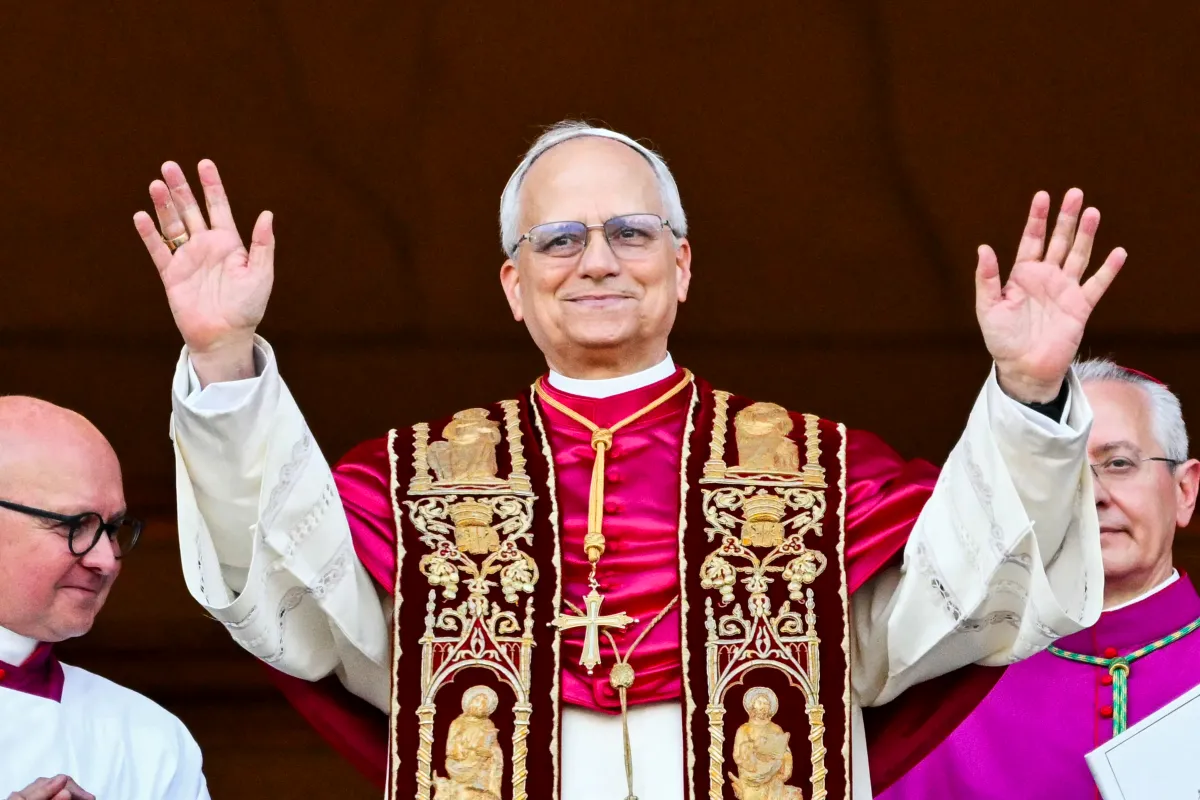
At noon on Sunday, the great square before St. Peter’s Basilica was filled with pilgrims who had come from every corner of the world. They stood with umbrellas, cameras, and children on shoulders, waiting for the familiar figure of Pope Leo XIV to appear at the window of the Apostolic Palace for the Sunday Angelus. His voice, usually warm and strong, carried across the square with the customary greeting and blessing. But then he paused. In that pause, something shifted. The Pope told the crowd that recent medical examinations had revealed something he had not expected: a localized nodule on his lung. He spoke calmly, without drama, but the weight of the words was unmistakable. “Dear friends,” he said, “during some recent medical examinations, doctors found a localized nodule in my lung. It was detected at a very early stage and is well localized. The doctors believe surgery is appropriate. Following their advice, I have therefore decided to undergo an operation to remove it.” The square fell silent. There was no need for explanations, no call for alarm. The Pope’s voice did not waver, but the news settled into the hearts of everyone listening like a stone dropped into still water. It was a moment of extraordinary human vulnerability, a reminder that even the most spiritually elevated leader on earth carries a body that can fail. The announcement was not delivered as a tragedy but as a simple statement of a decision made with trust, prudence, and faith. In that moment, the Holy Father was not only a shepherd or a monarch of a sovereign state; he was a patient, a man facing the uncertainty of surgery, and a person choosing to share his vulnerability with the world.
To understand what this announcement means, it helps to know what a lung nodule actually is. According to the Mayo Clinic and other medical sources, lung nodules are small clumps of cells that form in the lungs. They are often detected by accident during imaging tests for other conditions, such as chest X-rays or CT scans. The vast majority of these nodules are non-cancerous. Some are simply scar tissue left behind by a past lung infection, while others may be the result of inflammation, old fungal infections, or other benign processes. In many cases, they cause no symptoms and never become dangerous. Doctors monitor them over time, and often they remain unchanged for years. But sometimes a nodule requires a closer look. The fact that Pope Leo XIV’s doctors recommend surgery suggests that they believe the nodule, while localized and caught at an early stage, carries enough risk that removing it is the safest course of action. The word “localized” is reassuring in this context: it means the nodule has not spread, that it is contained in a specific area of the lung, and that surgery can target it directly rather than having to treat a widespread disease. Still, in human terms, a shadow on a scan is never just a clinical detail. For the Pope, the discovery must have landed like a sudden pause in a life spent in movement, prayer, and service. It is one thing to speak of the fragility of human life from a pulpit; it is another to hold that fragility in your own body. The Pope’s decision to go ahead with surgery, and to announce it so openly, reflects a kind of honesty that does not come easily to public figures. It also reveals his trust in medical expertise, his willingness to accept help, and his belief that the body is a sacred gift that deserves care.
The response to the announcement came quickly, and it crossed political lines in a way that is rare in Italian public life. Italy’s Prime Minister, Giorgia Meloni, issued a message of support that was both formal and deeply personal. “I wish to express to the Holy Father my personal closeness and that of the Italian Government for the trial he is called to face in the coming days,” she said. “The serenity and tranquility with which he spoke of it in today’s Angelus reassure us. I am certain that the Italian people too will not fail to offer their support and affection.” The prime minister’s words were striking because they emphasized the Pope’s own state of mind: serenity and tranquility. Those are not words we often associate with a cancer scare, even a mild one. They speak to a man who has made peace with his mortality, who has lived long enough and prayed deeply enough to understand that worry does not change the outcome. They also reflect something about the relationship between a nation and its spiritual father. Italy is a country where the Church and the state have their own separate institutions, but the Pope is still, for many Italians, a beloved presence who has shared their joys and sorrows, blessed their cities, and prayed for their dead. When he faces surgery, it is not a matter of ballot boxes or budgets; it is a matter of the heart. Meloni’s message, with its use of the word “trial,” also frames the surgery as more than a medical procedure. It is a test of faith, patience, and hope. The prime minister assured the Holy Father of the government’s closeness, but perhaps more importantly, she reminded him that he is not alone. That message of support will echo far beyond Rome, from the faithful in Latin America to Catholic communities in Africa, Asia, and across the world.
The Pope’s health has always been something of a public matter, because the Pope is a figure whose life is intertwined with millions of believers. When he travels, celebrates Mass, or appears at the window, it is a sign of continuity and vitality. A sudden announcement like this one changes the rhythm. It makes the world pause and remember that the leader of the Catholic Church is not an abstraction but a living, breathing human being. The phrase “breaking story” appeared in news reports almost immediately after the announcement, because every detail matters. When will the surgery take place? Who will perform it? How long will recovery take? Will he be able to resume his normal schedule? These are the questions that reporters will chase, and they are the same questions that anyone would ask when a beloved family member faces an operation. The Vatican has not released many details, and that is understandable. The Pope is entitled to privacy, even in the glare of global attention. But the fact that he chose to announce the surgery himself, in his own words, during a moment of prayer with the faithful, suggests that he understands the importance of transparency. He did not hide his illness; he brought it into the light, just as he has brought so many other difficult topics into the light during his ministry. There is something ancient about this gesture. For centuries, the health of the Pope has been a matter of public interest, and the Vatican has often struggled to balance secrecy with openness. By speaking directly, Pope Leo XIV has avoided speculation and fear, and instead invited the world to accompany him with prayer and goodwill.
There is also a deeper spiritual dimension to the Pope’s decision to speak openly about his illness. In a world that often denies death and tries to hide every sign of weakness, the image of a pope saying, “I have a nodule in my lung, and I am going to have surgery,” is a powerful testimony. It says that illness is not a punishment or a shameful thing. It says that even shepherds of great churches become sheep in the hands of doctors. It says that human beings are made of flesh and breath, and that the breath can falter. The Pope’s calm acceptance of his situation is almost a sermon in itself. He is not angry at God; he is not pretending that nothing is wrong; he is not clinging to power or control. He is simply doing what medical professionals recommend, and he is doing it with a kind of obedient humility that mirrors the obedience he encourages in others. For the faithful, this may be a moment to pray not for a miracle but for a recovery that is smooth and safe. It may also be a moment to reflect on the idea of solidarity. Every person who has ever sat in a hospital waiting room, or held the hand of a loved one before anesthesia, or heard the beeping of a heart monitor, knows that illness is the great leveler. It does not matter whether you are a pope or a street sweeper; your body will remind you of your mortality. The Pope’s announcement invites everyone to share in that common human experience. It also invites the Catholic world to turn its gaze toward him in the coming days, not as tourists gathering to see a celebrity, but as members of a family waiting to hear that their father has come through surgery safely.
As the days before the surgery unfold, the world will wait for updates. There will be official statements, medical bulletins, perhaps photographs of well-wishers outside the hospital. But beneath all of the news coverage, there is a simpler story. A man in his golden years, carrying the heavy burden of leadership, is about to place his body in the hands of surgeons. He will be put to sleep, a tube will guide his breathing, and a delicate operation will remove the small shadow that has appeared on his lung. He will wake up in a hospital bed, perhaps in pain, perhaps confused, perhaps reaching for the hand of a nurse. And around the world, people who have never met him will light candles, whisper prayers, and refresh their phones looking for good news. The Pope’s own words, spoken from an open window on a sunny Sunday, were simple and direct. He did not ask for pity. He did not dramatize his suffering. He told the truth, with the serenity of a man who understands that some events are beyond human control. That serenity, as the prime minister pointed out, is a gift in itself. In a time of fear, it reassures. In a time of uncertainty, it grounds. And in a time of illness, it reminds us that the human heart can remain calm even when the body is fragile. The story is still breaking, and there will be more details in the coming days, but the central fact is already clear: Pope Leo XIV has shown the world how to face a medical test with courage, faith, and an unwavering trust in the goodness of those who care for him. And the world, in turn, has already begun to respond with the affection and support that he has so often given to others.