


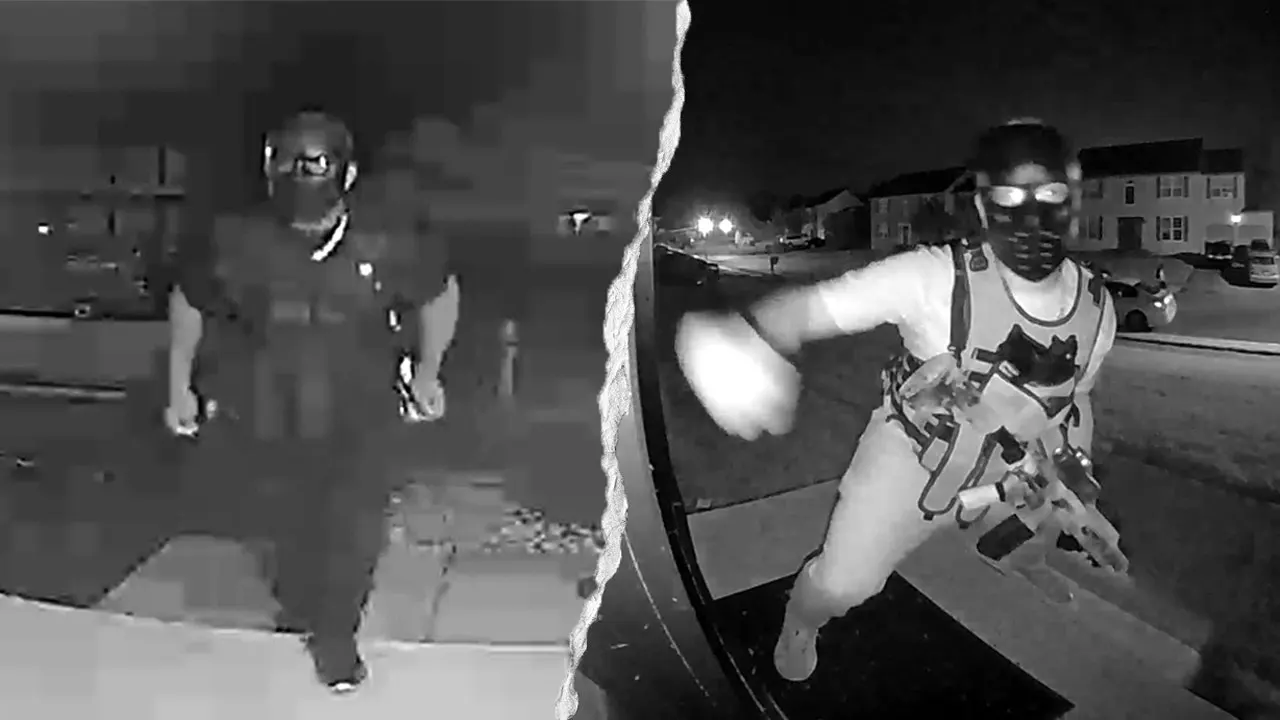
It starts with a perfectly ordinary Friday night in a quiet Delaware neighborhood. Families on the 1200 block of Canvasback Drive in Mallard Pointe, New Castle, were likely settling in—maybe watching a movie, cleaning up after dinner, or getting ready for the weekend. Then came a knock at the door. Not an unusual sound in itself, but the kind of knock that makes you pause before opening. You glance through the peephole or a window, and your heart skips. There is a man standing on your doorstep, his face covered by a black hockey-style mask, a tactical-style vest strapped over his chest, and in his hands something that looks very much like a rifle. Cameras in the neighborhood captured the moment, and the images released by the New Castle County Police Department are enough to make anyone uneasy. One photo shows a man in tactical gear, the outline of a long gun clearly visible, apparently knocking on a home’s front door. Another shows a second individual approaching a doorway, also wearing a black vest and mask. It is the kind of scene that feels ripped from a thriller, except it happened on residential streets where people walk their dogs and kids ride bikes. Police were called around 10:50 p.m. after a resident reported a suspicious person, and suddenly the quiet night became something else entirely—a moment of fear, confusion, and uncertainty.
The police response was immediate, but the mystery only deepened. Officers arrived at the scene to hear from residents that a man in a black hockey-style mask and tactical vest had been approaching homes while carrying what appeared to be a rifle. He knocked on doors, they said, and then ran. That detail—knocking and running—suggests some kind of prank or dare, but for the people on the other side of those doors, it was terrifying. You do not know, in that split second, whether the person on your porch is lost, in trouble, or dangerous. You do not know if the object in their hands is a real weapon or a toy. All you know is that your safe place feels suddenly exposed. Witnesses also told police that four men were seen heading eastbound on Mallard Road—two on bicycles and two on foot. Officers, joined by a K-9 unit, spread out across the neighborhood and searched nearby properties. The flashlight beams moved through backyards and between houses, the dog’s nose working the ground, but no one was found. The men had vanished into the night as quickly as they had appeared. For the residents, that lack of resolution is perhaps the hardest part. It means going to bed with questions, checking the locks again, and wondering if the same figures might return.
What makes this incident even more unsettling is that police have not confirmed whether the weapons were real. In fact, investigators said they believe the guns may have been airsoft-style replicas—toy weapons designed to look convincingly real. But “may have been” is a phrase that offers little comfort to someone who looked out their window at 10:50 at night and saw a masked stranger holding what appeared to be a rifle. In that moment, there is no time to assess the brand of the gun or whether the barrel is plastic. There is only fear. Airsoft guns are often used for recreation, and many are designed to mimic military-style firearms so closely that even trained officers can be fooled, especially in low light. That is why this behavior is so dangerous. Even if the intent was harmless—a prank, a dare, a misguided attempt at humor—the result is a neighborhood on edge, a heavy police presence, and a community left to wonder what was really going on. The masks, the tactical vests, the late hour, the group splitting up on foot and bicycles: it all adds up to something that feels deliberate, and that deliberateness is what makes it so hard to dismiss.
This story also taps into something deeper, something many people feel in an era of active shooter drills, doorbell cameras, and social media alerts. The home has become more than just a place to live; it is a sanctuary, a fortress against the unpredictability of the outside world. When a masked figure appears at your front door carrying a gun-like object, that fortress is breached, even if the weapon turns out to be fake. It forces residents to confront their own vulnerability in a way that is deeply uncomfortable. In the days after the incident, neighbors likely huddled in kitchens and over fences, comparing notes and sharing video clips. Some may have posted warnings on local community pages, urging others to be careful. Others may have laughed nervously, trying to make sense of it all. But beneath the conversation is a shared anxiety: if this was just a prank, why did it feel so threatening? If it was something worse, why did they run? The absence of a clear answer leaves room for imagination, and imagination is rarely kind. What happened in Mallard Pointe could happen anywhere, and that is perhaps the most disturbing thought of all.
That is why police are now asking for the public’s help. Anyone with information about the incident, or anyone with home security footage from the surrounding area, is urged to call 911 or the department’s non-emergency number at 302-573-2800. It is a straightforward request, but beneath it lies a deeper truth: community safety depends on community involvement. Those doorbell cameras that captured the images may hold more clues—perhaps a clearer view of a face, a license plate, or another angle showing where the group went. A neighbor who saw something unusual but didn’t think much of it at the time might now realize the importance of that detail. A parent who hears their teenager mention a group of friends going out with airsoft guns might recognize a piece of the puzzle. The police can search, but they cannot be everywhere. They need the eyes and ears of the people who live and work in that neighborhood. The release of the images is not just a procedural step; it is an appeal, an invitation to join in the search for answers. It is also a reminder that in moments like this, the best response is not panic or paranoia, but attention—looking out for one another, securing your own space, and sharing what you know.
In the end, no shots were fired, and no one was physically harmed. But the emotional ripple effects of a night like this can linger. A child who heard the knocking and saw a masked figure may now be afraid to answer the door. An elderly resident who has lived in the neighborhood for decades may feel less safe than ever before. The memory of those images—the tactical vest, the rifle-shaped silhouette, the dark mask—will not fade easily. Yet there is also a quiet resilience in the community’s response. Neighbors are talking. Police are investigating. Cameras are being checked. The incident has become a cautionary tale, a reminder that safety is not something to take for granted. It is also a reminder that not every strange situation ends in tragedy, and that uncertainty is not the same as danger. The masked men may have been foolish teenagers who did not realize how frightening their actions were. Or they may have had darker intentions that were interrupted. Either way, the community now knows that it must stay vigilant. The night on Canvasback Drive was shaken, but it was also seen—and seen by enough people that the story is being told. That visibility is itself a form of protection. As the investigation continues, the hope is that someone will come forward with the missing piece, that the figures in the masks will be identified, and that the neighborhood can return to the simple rhythms of ordinary life. Until then, the doors are locked a little tighter, the lights stay on a little longer, and the memory of that knock reminds everyone just how quickly a quiet evening can change.