


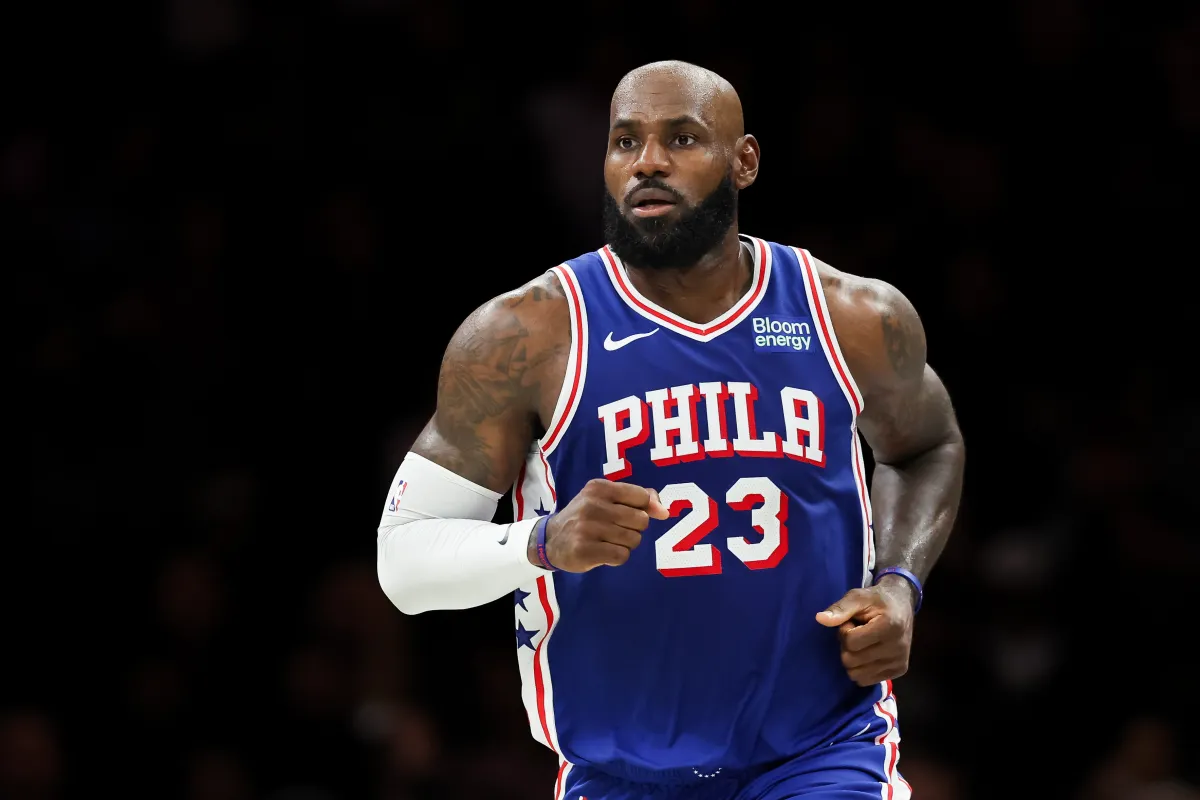
LeBron James has spent his entire professional life making the extraordinary look ordinary. He has carried franchises, redefined what a basketball player can be, and turned the weight of enormous expectations into a daily routine. But even for someone who has seen every defensive scheme and handled every kind of pressure, change still has a way of reminding you that you are human. That is exactly what James is discovering now, after joining the Philadelphia 76ers. On the surface, the transition should be exciting: a new city, a new group of talented teammates, and another chance to chase a championship. The basketball part, he says, has felt comfortable in many ways. The organization has rolled out the red carpet, the locker room is full of energy, and the pieces around him are enough to make any veteran’s eyes light up. But there is one part of this move that no playbook can fix. James told The Philadelphia Inquirer that being away from his family more often has been “a bit of a challenge.” It was a rare, honest admission from a superstar who usually lets his game do the talking. Behind the dunks and the highlight passes, he is still a father, a husband, a son, a friend—someone who needs the people he loves close by. When you uproot your professional life, even voluntarily, you don’t just change uniforms. You change routines. You change goodnight rituals. You change the small, unglamorous moments that make a house feel like home. James acknowledged that each day is getting better, and the positive energy inside the Sixers’ locker room has helped ease the discomfort. Still, the adjustment is real. It is a reminder that no amount of fame or success can insulate you from the ache of missing the people who matter most. For all the scrutiny LeBron invites, this particular challenge is deeply personal, and he is navigating it the way most people do: one day at a time, hoping the distance becomes a little easier to carry.
The challenge is not abstract. It has a very specific shape: a helicopter waiting on a rooftop, a flight path between New York and Philadelphia, and a camera crew capturing every takeoff and landing. James is currently trying to balance his responsibilities to the 76ers with his desire to stay present for his family, and that has meant splitting time between two major cities. For most people, a long commute means sitting in traffic or squeezing onto a train. For LeBron James, it means boarding a helicopter, which is practical for a man of his stature but also impossible to hide. Every departure becomes a spectacle. Every arrival is documented and analyzed, as if the simple act of going to work were a headline. It would be easy to look at this arrangement and see only the luxury—the private travel, the convenience, the ability to bend logistics to his will. But there is another way to see it: a man trying to be in two places at once because he doesn’t want to miss out on life. He wants to show up for his teammates in Philadelphia, but he also wants to be present for his family in New York. He wants to fulfill the obligations of a star player while holding on to the ordinary joys that ground him. The helicopter is not just a status symbol. It is a bridge between two worlds, a way of saying that neither his career nor his family has to lose. But bridges are exhausting to cross. The novelty wears off, and what remains is the fatigue of constant movement, the loneliness of sleeping in a different bed, the quiet moments when he wonders if he is giving enough to everyone. That is the part no stat sheet can capture. The cameras see the helicopter, but they don’t see the emotional toll of a commuter’s life. They don’t see the texts he sends home, the FaceTime calls squeezed between meetings, the guilt that creeps in when he realizes he has missed another dinner. LeBron is doing what so many working parents try to do: giving everything he has to his job while refusing to let go of his family. The only difference is that his commute is a news story.
That is why Draymond Green’s defense of James feels so important. Green, a forward for the Golden State Warriors and one of the fiercest competitors in the league, has spent years battling LeBron in the NBA Finals. They have been rivals, teammates in all-star settings, and eventually friends. So when Green heard the noise surrounding LeBron’s helicopter commute, he decided to speak up. On his podcast, Green said simply that people should “let that man fly in peace.” It was a short sentence, but it carried a lot of weight. Green was pushing back against the idea that every detail of LeBron’s life is public property. He reminded listeners that James is not flying around for fun or to show off. He is trying to get to work, do his job, and get back home to the people he loves. Why, Green asked, should that become a story? Why should a man be scrutinized for making a choice that allows him to be both a great teammate and a present father? It is a fair question, and it speaks to something deeper about the way we treat public figures. We want to know everything about them. We analyze their decisions, judge their motives, and turn their private lives into content. But in doing so, we forget that they are people. We forget that a superstar like LeBron feels the same pull between career and family as anyone else. He just happens to have a helicopter and a camera crew documenting it. Green’s comments were not just a defense of his friend; they were a reminder to all of us that grace matters. We don’t know what goes on behind closed doors. We don’t know the sacrifices, the difficult conversations, the quiet compromises. All we see is a man trying to balance the demands of greatness with the needs of his heart. That deserves compassion, not criticism. If LeBron James wants to fly home after a game, let him. If he wants to spend an extra hour with his kids before heading back to practice, cheer him on. The fact that this needs to be said says more about our culture than it does about LeBron. Green, of all people, understands that the game is only part of the story. The rest is life, and life is complicated.
On the court, meanwhile, James has begun the work of figuring out what this new era in Philadelphia will look like. His preseason debut came on Thursday against the Brooklyn Nets, and it was exactly what a preseason debut should be: measured, thoughtful, and full of curiosity rather than conclusions. James finished with 10 points, five assists, and four rebounds in 18 minutes, playing only the first half. The numbers were modest, but they were not the point. He attempted just one field goal, which might surprise fans used to seeing him dominate the ball. But he made all eight of his free throws, attacking the basket and drawing contact in ways that did not require him to force shots. It was a performance that hinted at something larger: a veteran learning how to fit into a new system, a superstar willing to defer, a leader trying to build chemistry with teammates who have their own remarkable talents. The Sixers lost the game, 114-108, but losses in October are almost meaningless. What mattered was the glimpse of potential. When James shared the floor with Joel Embiid, Tyrese Maxey, Jaylen Brown, and VJ Edgecombe, you could see the outline of something interesting. Embiid provides the interior anchor, Maxey brings the speed and scoring punch, Brown adds versatility and two-way skill, and Edgecombe offers young energy and defensive promise. James, for his part, has the ability to tie all of it together. He can push the pace, make the right pass, and create offense in ways that don’t show up in the box score. The one field goal attempt was not a sign of timidity. It was a sign of intelligence. He is testing the waters, learning where his teammates like the ball, figuring out the rhythm of this new group. Preseason games are like the first pages of a book. You don’t know where the story is going, but you can already sense the tone. For the Sixers, the tone is deliberate, patient, and full of promise. James is not trying to prove anything in October. He is trying to build something that will last through June.
Now comes the next step in that process. Philadelphia’s next preseason game is against the Boston Celtics on Saturday, Oct. 10, at 8 p.m. ET in Boston. It is the kind of matchup that would normally carry some electricity, especially against a team with championship aspirations. But whether James and the other starters play remains uncertain. This is the time of year when coaches and front offices think strategically about rest, workload, and health. Every decision is made with the long season ahead in mind. A preseason game against the Celtics might feel important to fans, but for the team, it is just another opportunity to experiment. Lineups will be mixed, rotations will be tested, and young players will get chances to prove themselves. James, who has seen it all, understands this better than anyone. He knows that the real season begins when the games actually count, and for the Sixers, that starts on Oct. 20 against the New York Knicks. That is when the noise will become real. That is when the chemistry that was built in practice and preseason will be tested in the unforgiving light of regular-season competition. Until then, there is no reason to panic about a loss or overcelebrate a promising possession. The goal is to get better every day, to develop habits that will hold up when the pressure intensifies. James’s presence changes the calculus for Philadelphia. It raises expectations, but it also brings a sense of calm. He has been here before. He knows how to pace himself. He knows that October games are about building trust, not chasing glory. The fans may want to see him go full throttle, but wisdom whispers something else: be patient, be deliberate, and let the process unfold. There is a long road ahead, and the best way to travel it is together.
At the heart of this moment, though, is something more human than basketball. LeBron James is at a point in his life where he is trying to hold on to everything that matters. He is chasing another championship, yes, but he is also chasing something quieter: the ability to be present for his family while doing the job he loves. That is not a simple thing, and it should not be reduced to a headline or a talking point. The helicopter commute is not a scandal. It is a solution—an imperfect, complicated, and very human solution to an impossible puzzle. Every day, James gets on the floor with his new teammates and tries to learn their tendencies. Every night, he tries to find his way back to the people who make it all worthwhile. In between, there are practices, meetings, flights, media obligations, and the endless demands of being LeBron James. It would be easy to let the pressure harden him, but instead he has chosen to be honest. He admitted that the family adjustment is difficult. He talked about how the locker room energy helps. He is allowing himself to be seen not just as a superstar, but as someone who struggles and adapts and keeps going. That is what makes this chapter so compelling. It is not just about basketball. It is about balance. It is about sacrifice. It is about the quiet courage it takes to start over, even when you have already achieved so much. LeBron James is not the first person to move to a new city for work, and he will not be the last. But he is doing it on a stage where every step is watched, every flight is tracked, and every emotion is dissected. And still, he keeps showing up. He keeps trying. He keeps flying home. In a world that often demands we choose between our dreams and our loved ones, LeBron is trying to choose both. That is not a story to mock. It is a story to understand. If we remember that, then maybe we can stop counting his helicopter rides and start appreciating the man who just wants to get to work—and get home.