


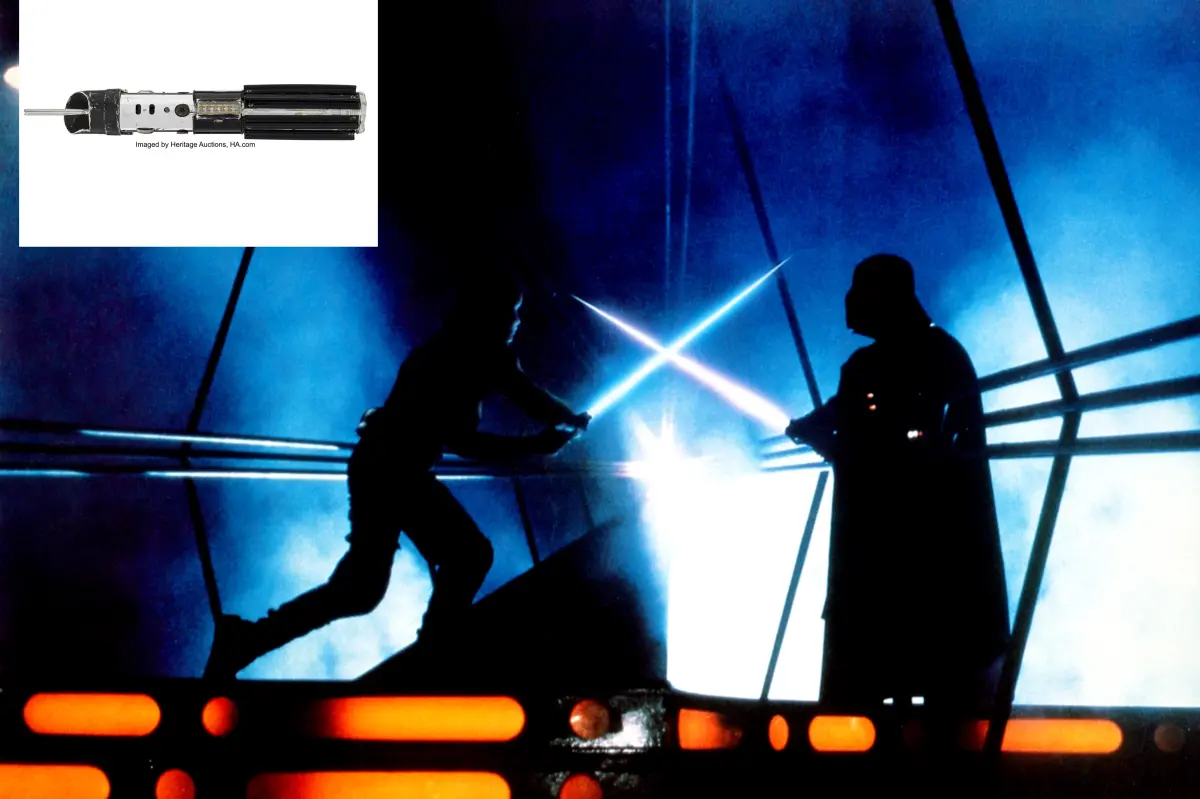
It is one of the most recognizable objects in all of cinema: a weapon of pure menace, a glowing red blade that has haunted generations of moviegoers since its first appearance over four decades ago. The lightsaber Darth Vader carried into battle in “The Empire Strikes Back” is about to go under the hammer, and Heritage Auctions has confirmed that this extraordinary piece of film history will be offered to the highest bidder next month in New York City. For the uninitiated, this is the very crimson laser sword that Vader used to cut off Luke Skywalker’s right hand in the 1980 sequel—a brutal, chilling moment thatarrives just seconds before the father’s identity is shattered with the immortal proclamation, “I am your father.” That single scene, with its blend of physical violence and emotional devastation, remains perhaps the most famous twist in movie history. Now, collectors and fans alike have the chance to own the actual artifact at the center of that mythology. The auction house expects the relic to ignite a bidding war that could push its final price well past the $1 million mark when the gavel falls on November 12. But as with all truly iconic props, the real value lies not insimple dollars but in the way a single object can instantly transport us back to a darkened theater, chewing popcorn, holding our breath as a hero’s world collapses around him.
The story of this particular lightsaber is inseparable from the emotional weight of the films in which it appears. Introduced as Darth Vader’s personal weapon, the blade is physically imposing in a way that modern CG effects often fail to replicate: a heavy, dented, controls-scarred metallic hilt with visible wires and grips, built to be handled by a towering villain incostume. In “The Empire Strikes Back,” it serves as the instrument of Luke’s greatest defeat, not merely slicing off his hand but symbolically cutting down his youthful idealism. The scene unfolds onbespin’s clouds city, where the boy who dreamed of becoming a Jedi knight faces the man who will forever define him. Their duel is a symphony of clashing energies—the untrained, desperate agility of Luke against the cold, patient precision of Vader. When the red blade severs Luke’s hand, the camera lingers on the prosthetic aftermath, and then Vader delivers his devastating line. That weapon, that exact piece of sculpted metal and glowing acolyte, was present for one of the most quoted lines in the English language. And it didn’t retire after that famous confrontation: the same lightsaber returned for the climactic family drama of”Return of the Jedi,” appearing once again as Vader faced his son atop the second Death Star. There, the red blade was used in a quieter, more conflicted confrontation—a father trying to turn his son, a son refusing to strike down his parent. The weapon thus bookends Vader’s complex journey from ruthless enforcer to tragically redeemed father, making it not just a prop but a narrative anchor for one of cinema’s greatest arcs. Owning this blade, then, is akin to owning a piece of that catharsis.
a tangible link to the moment when evil finally recognized its own capacity for love.
The financial history surrounding this particular lightsaber is almost as dramatic as its on screen life. Earlier this year, theolly? Wait, let’s get the timeline right: in 2025, the same Vader lightsaber was sold at Propstore auction in Los Angeles for a staggering $3.6 million, setting a world record at the time for a “Star Wars” prop. That record, however, did not stand long. Over the summer, the blue lightsaber famously used by Luke Skywalker—also the one that had been clutched by his severed hand in that same Empire duel—was sold for $3.75 million, shattering the Vader blade’s short-lived crown. It was a fittingly poetic escalation: the weapon of the apprentice outpriced the weapon of the master, perhaps because Luke’s saber carries with it the hope of the rebellion rather than the cold machinery of the Empire. Now, with Vader’s lightsaber returning to auction, Heritage Auctions is predicting it will fetch upwards of $1 million—though seasoned observers know that estimates for objects of this magnitude are often conservative. The auction house itself describes the prop as an”extraordinary surviving artifact of two of the most consequential confrontations in motion picture history,” and that is no hyperbole. The scene in which this lightsaber appears is studied, parodied, referenced, and beloved across every generation. For serious collectors, acquiring an item like this is about possessing a fragment of a shared cultural dream. It is worth noting that the prop is not in pristine, sterile condition; its wear, scratches, and dents tell the story of decades of handling, of stunt doubles and rehearsals, of the very real physicality behind the fantasy. These imperfections are not flaws; they are authenticity etched into metal, proof that this object was there, on set, when movie magic was made by human hands.
But this auction, scheduled for November 12 in New York, is far more than a one-item spectacle. It is a sprawling celebration of everything “Star Wars,” featuring more than two dozen lightsaber props from across the saga’s nine episodic chapters and numerous spinoffs. If the red Vader blade feels out of reach financially, the sale offers plenty of other treasures for fans at every level of obsession. There is, for instance, the original Yoda hand puppet that Frank Oz himself operated during the character’s first appearance in”The Empire Strikes Back.” That puppet, with its aged, green skin and gentle, wise eyes, is one of the most objectively beloved creatures in cinema history—a tiny, wrinkled being who taught generations that size matters not. Also on the block is a signed, personal third-draft screenplay for the original 1977 “Star Wars,” once owned by Anthony Daniels, the actor who portrayed C-3PO. Daniels’ annotations and autograph turn a faded script into a time capsule from the very dawn of the phenomenon, before anyone knew that a low-budget space opera would become a mythology for the modern world. For those drawn to the darker corners of the galaxy, there is an authentic TIE Fighter pilot helmet used in”Rogue One: A Star Wars Story,” a haunting reminder of the nameless Imperial soldiers who died en masse in that film’s staggering final battle. And perhaps most intriguingly for bounty hunter fans, the sale includes the authentic EE-3 carbine blaster carried by Boba Fett throughout”The Empire Strikes Back.” This production weapon, with its worn barrel and distinctive scope, is a piece of the most beloved mystery man in the saga—a silent, armored anti-hero whose cult following far outweighs his screen time. The EE-3 is estimated to sell for more than $100,000, proving that even a secondary villain’s gear can command seven-figure attention when it carries the weight of such iconic design. Together, these lots transform the auction from a simple sale into a museum-quality exhibition of the galaxy far, far away, available not just to gaze at but to hold, to own, to display.
Why, one might ask, do people throw fortunes at these old, battered objects? The answer lies at the intersection of memory, identity, and the deep human need for tangible connection to the stories that shaped us. “Star Wars” arrived at a particular moment in cultural history—a moment when children were still allowed to lose themselves in the imagination of a shared universe, when heroes and villains were drawn in bold, unmissable strokes, when a farm boy could look at twin suns and dream of a bigger life. For millions of people, those films are not merely entertainment; they are emotional architecture. We watched them at impressionable ages; we memorized their dialogue, traded their action figures, wore their costumes for Halloween, and internalized their lessons about friendship, redemption, and the eternal struggle between tyranny and freedom. To own the lightsaber that cut Luke’s hand is to own a physical doorway into that psychological landscape. Whena collector holds this prop, he or she is not holding scrap metal; they are holding their own childhood, their own awe, their own belief that the impossible could happen. In an increasingly digital world, where films are compressed into streams and art is consumed on screens, there is something profound about an object that was actually there—an object that interacted with the actors, absorbed the studio lights, endured the dozens of takes required to perfect a three-minute duel. It is history you can touch. It is myth rendered physical. It is proof that for a few months,in a freezing soundstage, human beings built something that would outlive them and touch people they would never meet, across distant continents and decades yet unborn.
In the end, the approaching auction is about more than record prices or investment portfolios. It is about storytelling and the strange, beautiful ways that fiction becomes real. Sure, someone will pay more than a million dollars for this Vader lightsaber, and financial headlines will be made. Commentators will marvel at the sums, maybe roll their eyes at the excess. But beneath the dollar figures lies a more tender truth: these props are relics of a collective modern mythology, every bit as powerful as the sword of King Arthur or the shield of Achilles. The red blade of Darth Vader represents the seductive power of fear and anger, but also the possibility of choice, because hopelessly as the scene seems when Luke loses his hand, we know the story doesn’t end there. The father who severed that hand would, in the end, save his son and cast aside the Emperor—and that redemption arc is encoded in the very scratches of this weapon. When the auctioneer calls for bids on November 12, the room will be filled with dealers, fanatics, museum curators, and wonder-struck observers. They will bid not merely on metal and electronics but on the ghosts of actors in capes, on the echo of a breathing respirator, on the exact instant when a galaxy-far-far-away felt impossibly close to home. Whoever walks away with this lightsaber will become the new custodian of one of cinema’s greatest secrets—and that, perhaps, is worth more than any price tag can measure. Because a lightsaber, after all, is not just a weapon. It is a promise that stories endure, that darkness can be overcome, and that even the most battered, damaged artifacts can still shine with the light of a thousand remembered screenings. May the Force be with whoever wins it—and with all of us who have ever loved these films enough to feel our hearts quicken at the hum of that red blade.