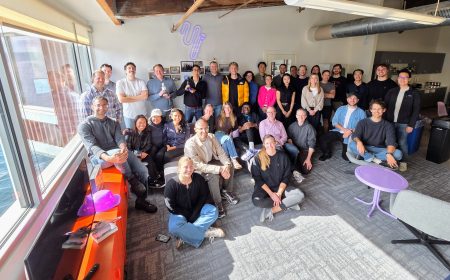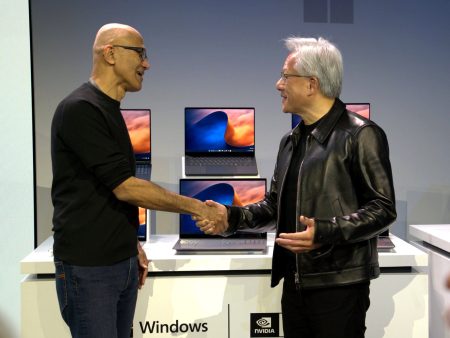



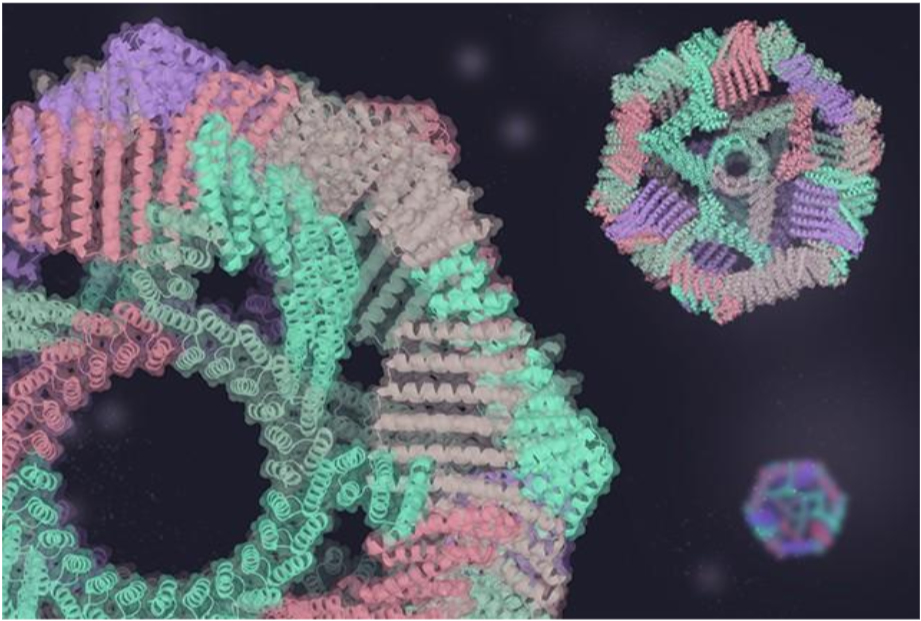
On an overcast afternoon in Seattle, a group of protein scientists gathered as they always do, but this time the air was different. For years, the researchers at the UW Medicine Institute for Protein Design had been doing something almost miraculous: inventing brand-new proteins that don’t exist in nature, molecules with the potential to become medicines, clean up pollution, or break down plastic. But their ambition always collided with reality. Their own computer cluster, a faithful but aging workhorse, could only handle so much. Every Tuesday at 5 p.m., the team would sit down and carefully ration out the week’s computing experiments, deciding which ideas would get tested and which would have to wait. Then came a gift that changed the equation: a massive grant of computing power from the Jen-Hsun and Lori Huang Foundation, an organization co-founded by Nvidia CEO Jensen Huang and his wife, Lori. The donation amounts to nearly seven million GPU hours — a stunning number that translates into the kind of raw processing muscle that can train advanced artificial intelligence models on millions of molecular structures. Beginning in June, the institute started tapping into Nvidia GPUs through the cloud computing company CoreWeave. For David Baker, the institute’s director and a 2024 Nobel laureate in chemistry, the shift was almost too fast to process. “We have made more rapid progress on methods development than any time in my career,” he said. “I mean, it’s just been totally mind-boggling.” The grant is expected to sustain the institute’s expanded ambitions for a full year, and for the scientists who have spent decades dreaming in the face of hard limits, it feels less like an upgrade and more like liberation.
To understand why this matters, you have to appreciate how far the field has come. Proteins are the tiny molecular machines that keep life running — they digest food, fight infections, build tissues, and carry messages between cells. For most of human history, we could only use the proteins nature gave us, tweaking them here and there. But in 2003, Baker and his colleagues at the University of Washington achieved a landmark: using their Rosetta software, they designed a protein with a completely original structure, something never seen in the natural world. It was a proof that proteins could be invented, not just discovered. Over the next two decades, the field accelerated dramatically, especially when the IPD embraced deep learning. The team launched RoseTTAFold, a powerful tool that predicts how a chain of amino acids will fold into a three-dimensional protein structure, and then RFdiffusion, an even more ambitious system that generates entirely new protein designs from scratch. These tools are open source, meaning scientists anywhere in the world can use them. The implications are staggering. Researchers at the IPD and beyond are now using this technology to design proteins that could target intractable diseases, neutralize toxic pollutants, degrade plastic waste, and maybe even solve problems we haven’t thought of yet. But deep learning is hungry, and the algorithms that make these breakthroughs possible require enormous amounts of computational power. Training an AI model to recognize the hidden grammar of proteins means feeding it millions of examples, letting it learn from virtual experiments, and running countless simulations. Without enough computing resources, even the best ideas remain trapped in the imagination.
That lack of resources had shaped the institute’s workflow in quiet but significant ways. Before the grant, the IPD relied entirely on its own computer cluster, which was workable but limited. Baker and his team knew that the next wave of discoveries would require more: larger datasets, more sophisticated model architectures, and the ability to isolate one variable at a time. But with finite compute, researchers often had to make multiple changes simultaneously, hoping the results would reveal something useful, even if they couldn’t tell exactly what had worked. It was a little like trying to fix a recipe by changing three ingredients at once — you might get a better dish, but you wouldn’t know which tweak mattered. The Tuesday meetings became a ritual of prioritization. Scientists would propose experiments, and the group would collectively decide what could fit within the week’s computing budget. They had to be selective, disciplined, inventive. And they still delivered a steady stream of breakthroughs, publishing in top journals like Nature and Science, earning awards and international attention. But there was always a quiet hum of frustration beneath the celebration. Every idea that got shelved, every experiment that had to be simplified, every model that couldn’t be tested because there just wasn’t enough power — these were the hidden costs of scarcity. Then Baker looked at the competition. Google DeepMind, the tech giant’s AI lab, was pursuing similar protein research with vastly more computational resources. Baker knew they had more power than the IPD, but he didn’t fully appreciate what that meant until he reflected on how it changed the culture of creativity itself.
The moment he realized, he said, was when he understood that capacity doesn’t just speed up work — it spawns new ideas. “It spawns more ideas because you know you can test them,” Baker explained. “So it just creates this incredibly fertile, creative environment.” This is a profound insight about how science actually works. When resources are scarce, people learn to be careful, but they also learn to limit their dreams. They stop asking bold questions because they know they won’t be able to follow through. They start optimizing for scarcity rather than possibility. The IPD had always done brilliant work despite those constraints, but the ceiling was real. Google DeepMind’s power allowed their researchers to pursue avenues that would have been unimaginable in a resource-constrained setting. For Baker, seeing that glimpse of what was possible made the limitations of his own institute feel sharper. He and his team didn’t doubt their ideas — they doubted their infrastructure. They knew they were capable of more, but capability without capacity is just potential. Now, with the Huang Foundation grant, the IPD is beginning to taste that same freedom. The new computing power allows them to train AI on tens of millions of molecular structures, running virtual experiments and exploring design spaces that evolution never touched. Jensen Huang, speaking about the foundation’s vision, predicted that many of the most important future medicines will come from proteins that have never existed. That may sound like science fiction, but it is exactly the kind of science fiction this institute was built to make real.
The implications reach far beyond one lab or one grant. If proteins can be designed like software, then our ability to solve biological and environmental problems becomes almost limitless. Imagine a medicine that binds to a disease-causing protein with perfect precision, leaving healthy cells untouched. Imagine an enzyme that chews up plastic bottles and turns them into harmless compounds. Imagine a biosensor that detects pollutants in drinking water at concentrations far below what current instruments can find. These are not abstract possibilities; they are active research goals at the IPD and in the broader field of computational protein design. But every one of those breakthroughs depends on compute. The AI models that generate new protein structures are trained on enormous datasets, and the process of refining them is iterative and expensive. Each experiment requires neural networks to process millions of sequences, predict folding patterns, simulate molecular interactions, and then do it again with a small adjustment. The difference between a good protein design and a great one often lies in the ability to test many variations rapidly. With the new allocation of roughly seven million GPU hours, the IPD can now afford to be methodical. Instead of throwing a handful of changes at a model and hoping for the best, researchers can isolate individual variables, see exactly how each one affects the outcome, and then build on that knowledge with confidence. This is not just faster science; it is better science. It creates a virtuous cycle: more compute leads to cleaner experiments, which lead to deeper understanding, which leads to more ambitious hypotheses, which require even more compute. The Huang Foundation’s gift is not just a donation; it is an investment in accelerating that cycle.
Baker and his team still hold their Tuesday meetings, but the conversation has changed. Instead of asking “Do we have enough computing power to test this?” they now ask “What do we want to test next?” The new capabilities — which Baker called “transformational” — have opened up a landscape of options that were previously out of reach. “The team is iterating fast,” he said. “We get feedback on all these different computational architecture explorations, and there’s just so many different things you can try.” It is a remarkable moment for the field. The same technologies that gave us language models capable of writing essays and generating images are now being pointed at the fundamental chemistry of life. With every new protein their models design, the researchers at the IPD are expanding the boundaries of what biology can do. They are not merely predicting what already exists; they are inventing what could exist. And now, with the computing power to match their creativity, there is no telling how far they might go. The grant from the Jen-Hsun and Lori Huang Foundation will last a year, but the momentum it creates could last much longer. In that time, scientists will train models on molecular structures at an unprecedented scale, learning lessons from countless virtual experiments, and inevitably stumbling upon designs that nature overlooked. If Jensen Huang is right, some of those designs will become the medicines of tomorrow — treatments for diseases that today seem incurable. But even more than that, this moment represents something hopeful: a reminder that when you give brilliant people the tools to dream big, they will rise to the occasion. The proteins of the future are being born on a computer screen in Seattle, one GPU hour at a time, with the entire world waiting to see what they can do.