


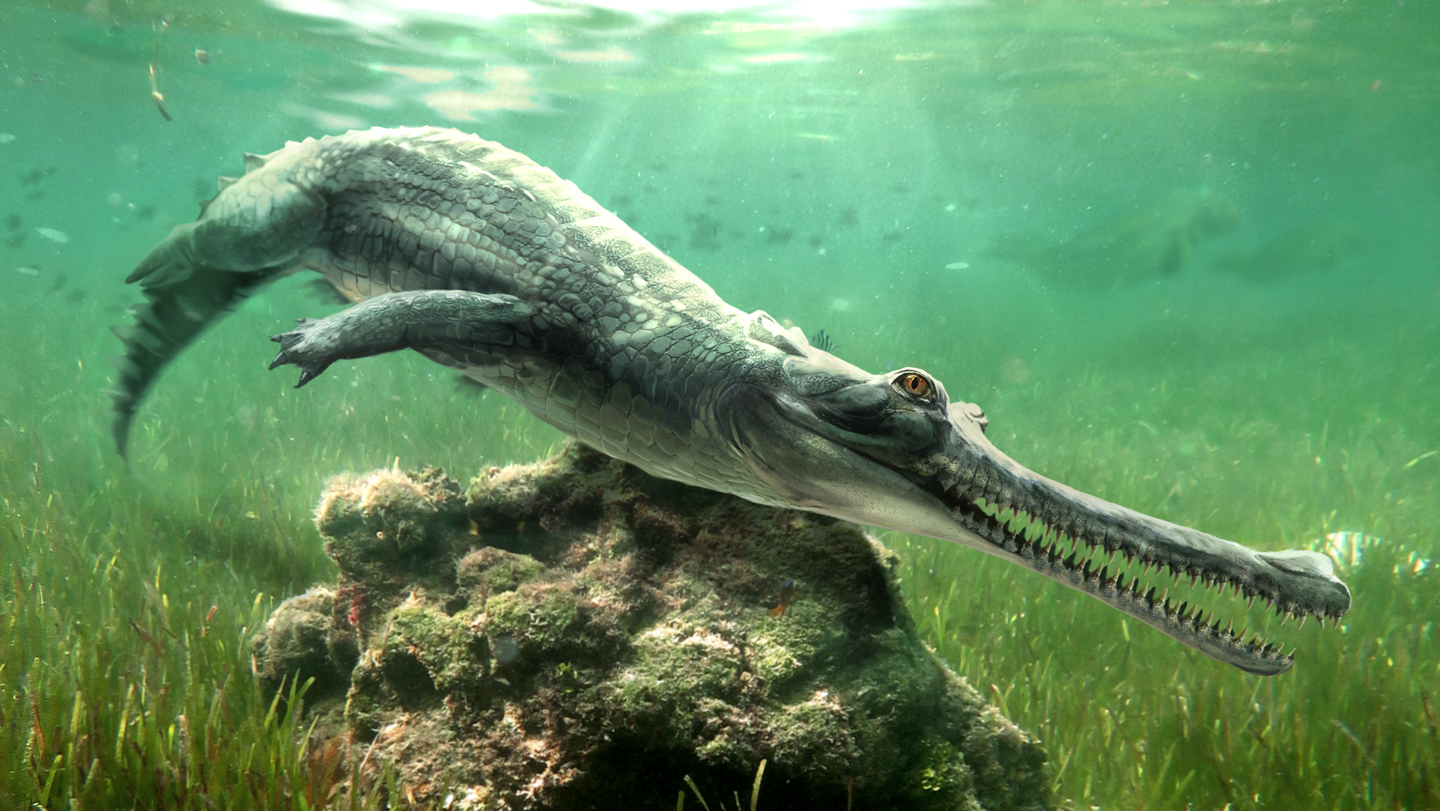
The Great Sphinx of Giza has watched over the Egyptian desert for thousands of years, its face worn by time, its nose famously missing. But the Sphinx is not the only ancient stone visage in that part of the world with a broken face. Hidden in the same 45-million-year-old limestone that ancient Egyptians once quarried to build the Sphinx, paleontologists have found the fossilized skull of a crocodilian that is also missing the tip of its snout. This damaged specimen, however, still holds enough detail to reveal an extraordinary story. Researchers have now reclassified it as an entirely new branch of the gavial family tree, a group of long-snouted, fish-eating crocodilians that once lived in oceans and rivers around the world. The findings, published on October 7 in Royal Society Open Science, show that even a broken fossil can change our understanding of deep history. There is something quietly poetic about the coincidence: a creature from the same stone as the Sphinx, sharing the same kind of loss, has finally been given a name that honors the ancient monument’s connection to the god Horus. It is a reminder that the past is full of strange connections, and that the ground beneath our feet holds treasures far older than any kingdom.
To understand why this fossil matters, it helps to know a little about gavials. Most people are familiar with crocodiles and alligators, but gavials are more mysterious. Today, only two species survive, both in tropical Asia, and both are enormous, critically endangered reptiles with long, slender snouts lined with needlelike teeth. They are specialized fish-eaters, beautifully adapted to life in freshwater rivers, but their ancestors once had a much wider range. Fossil gavials have been discovered all over the world, including in Africa, Europe, and the Americas. One of those fossils, a skull collected from hills near Cairo, was first reported in 1927 by German researchers. For nearly a century, it was classified as an extinct species of Tomistoma, a genus that today survives as a single species in Southeast Asia. That identification seemed reasonable at the time, but as evolutionary science grew more sophisticated, researchers began to doubt it. The skull did not quite fit the patterns expected of Tomistoma, and the question of what it really was lingered, waiting for someone with the right tools and curiosity to look again.
That someone turned out to be Paul Burke, a paleontologist who traveled to Germany in 2023 while working on his doctoral degree at University College London. Burke and his colleagues did not simply dust off the old specimen and admire it. They put it through a battery of modern techniques, using three-dimensional X-ray imaging to look inside the skull and measure the shapes of the braincase and nasal cavities. Those internal features can be surprisingly telling, revealing relationships that are not visible from the outside. “As we’ve advanced in the last 100 years, we’ve got so many new methodologies we could implement to figure out what kind of species this fossil is,” Burke said. Now based at the Swedish Museum of Natural History in Stockholm, he compared his measurements with those taken from living and fossil gavials from around the world. The result was unambiguous: the old label was wrong. The Egyptian fossil was not a member of Tomistoma at all. It was a completely undescribed gavial genus, a distinct lineage that had branched off from other gavials early in their evolutionary history, and it had been hiding in plain sight for decades.
The researchers named the new species Herugavialis cairensis. The name honors Heru, or Horus, the ancient Egyptian god often associated with the Sphinx and with kingship, while cairensis points to Cairo, near where the fossil was found. There is a delightful symmetry in the fact that the skull, like the Sphinx itself, is missing the end of its snout. That missing piece did not prevent identification, and it now ties the animal even more closely to the iconic monument in the public imagination. “So many species are found from the same [geologic] formation,” Burke said, noting that fish, sharks, and mammals have all been discovered there. “But this is the first one with the name associated with the Sphinx.” For Burke, that link makes the discovery resonate far beyond scientific journals. It connects the ancient quarry that gave humanity the Sphinx with a predator that prowled a very different landscape millions of years before humans existed. When ancient builders shaped the limestone into a mythical beast, they could not have known that the same stone contained the remains of a real one.
The environment in which Herugavialis lived was nothing like the desert we see today. Tens of millions of years ago, northern Egypt was covered by the ancient Tethys Ocean, a vast warm sea that stretched across much of the region. Herugavialis appears to have been a coastal predator, hunting in nearshore saltwater waters that teemed with marine life. This is an important clue because modern gavials are strictly freshwater animals. Their presence in ancient oceans proves that the family was once far more adaptable, capable of crossing seas and colonizing new continents. Khalafallah Salih, a paleontologist at Al Neelain University in Khartoum, Sudan, said the discovery supports the growing idea that the evolution of gavials and their relatives in Africa was far more complex than scientists once thought. Herugavialis does not appear to be closely related to other known gavial-type crocodilians from Africa or the Mediterranean. Instead, it seems to have split off from the main lineage very early, taking its own evolutionary path. That raises new questions about how these animals spread, how they diversified, and why they eventually disappeared from regions where they once thrived.
Beyond the scientific details, there is a larger lesson in this broken fossil. Gavials are easy to overlook in a world that tends to focus on the more famous crocodilians, but they have a long and remarkable history. They are living dinosaurs in the same way birds are, ancient survivors that have witnessed the rise and fall of countless species. Burke hopes the discovery will help bring them into the public consciousness. “They’re still alive today and they’re endangered,” he said. “So, we should know about them and their long history.” A fossil from the Sphinx’s own quarry, missing its nose just like the monument above it, is a perfect ambassador for that message. It reminds us that the stones of ancient Egypt are not just human heritage; they are a window into an even older world, one filled with strange reptiles, vanished oceans, and stories that are only now being told. The next time someone looks at the Sphinx, wondering who took its nose, they might also wonder what else lies hidden in the same limestone, waiting for a careful scientist to bring it back to light.