



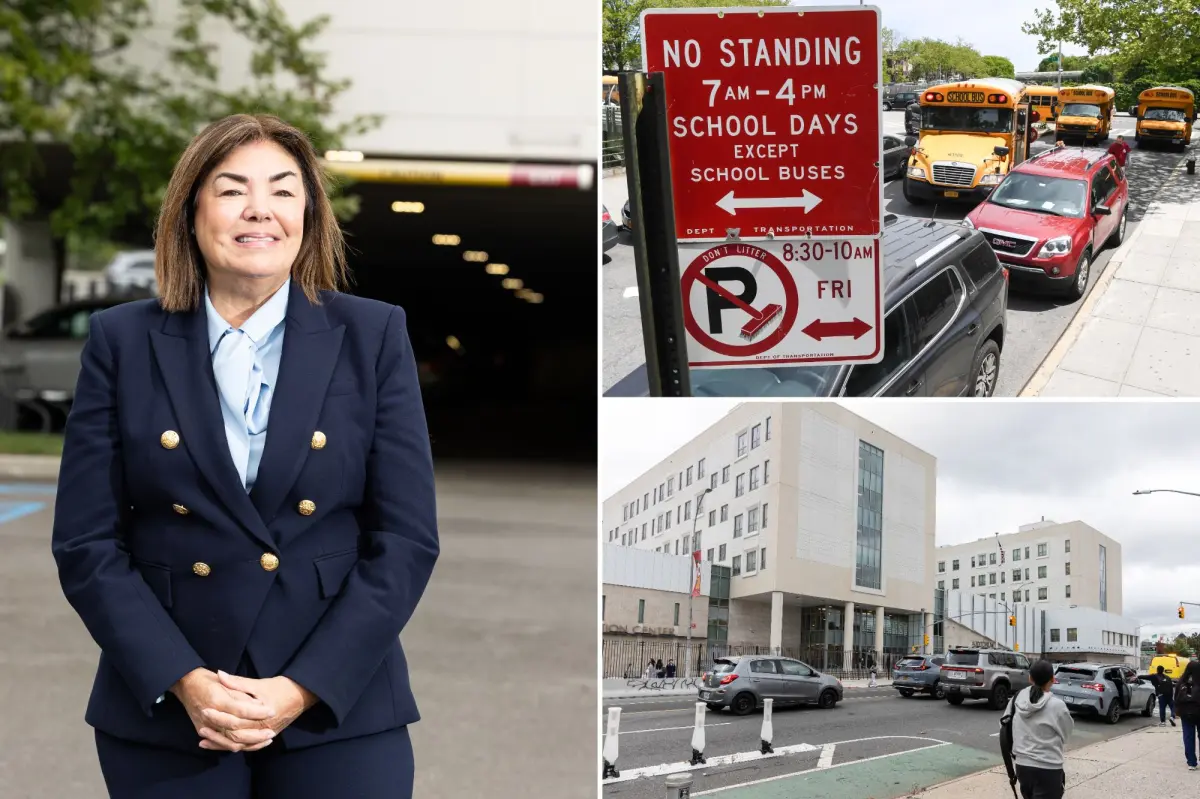
For a decade, Janet Elias began her mornings not with coffee and lesson plans, but with a quiet ritual of financial surrender. Every month, she handed over $100 to a homeowner in Alley Pond, Queens, for the simple, almost absurd privilege of a guaranteed parking spot in their driveway between 7:30 in the morning and 3:00 in the afternoon. This was not a luxury; it was survival. As a New York City public school teacher since 2005, Elias spent years as a technology instructor at nearby PS 46, where finding a place to leave her car before the first school bell was a daily gauntlet. She would routinely circle residential blocks for up to half an hour, praying for a curb to open up within walking distance of the school. When the weather betrayed her, the ordeal became genuinely cruel. “God forbid it snowed—forget about it. Then you were really screwed,” she recalled to The Post. Even after retiring, Elias remains fiercely devoted to the cause, speaking up at city council meetings and posting online on behalf of active educators who still face the same relentless hunt. She calls the parking debacle one of the city’s most ignored injustices, and current teachers across Queens, Manhattan, and the Bronx say it has only metastasized. Their mornings are now dictated by a mad, maddening scramble, with many waking over an hour earlier than their commute actually requires, knowing full well they will spend 40 to 50 minutes patrolling neighboring streets like crows circling for scraps. It is a second job—unpaid, unglamorous, and undertaken before they’ve even stepped foot in a classroom packed with children who deserve their full attention.
The problem is deeply entrenched in the daily texture of New York City school life, and it is made worse by the people who should be neighbors, not adversaries. Several teachers told The Post that residents in school zones deliberately park in ways that box out educators, leaving those impossible two-car-length gaps that no sedan can ever fill. The residents, frustrated by their own lack of spots, seem to be sending a message: if you want to teach here, pay us. Some even monetize the scarcity, renting out their private driveways for $100 or more a month—a fee that teachers, already stretching modest salaries to cover supplies and city living expenses, are often forced to pay just to guarantee they can arrive on time. One city official, who refused to speak publicly, suggested that teachers simply take public transit or bike to work, brushing off the crisis as irrelevant because many educators already ride the subway. But that logic collapses in the face of reality. For teachers commuting from Long Island, or working in hard-to-reach school zones that require multiple transfers across boroughs, public transportation is not a practical alternative—it is a punishing marathon. According to 2024 census data, nearly half of all Department of Education workers take public transit, while only 21% drive and a mere 2% bike, even as the city continues to carve out more bike lanes and bus lanes that eat away at already scarce curb space. The situation has only deteriorated as new charter and private schools multiply without any designated faculty parking, and because no official data exists on how many teacher-reserved spots actually exist citywide, it is impossible to know the true scale of the crisis. The Department of Education and the Department of Transportation both refused to tell The Post how many teacher-assigned spaces exist—an omission that feels less like bureaucratic oversight and more like willful blindness.
The human cost of this oversight is visible in the harrowing morning routines of veteran educators. One 38-year-old South Bronx teacher, who asked that his name be withheld, has worked for the Department of Education for 14 years and commutes forty minutes each way from Yonkers. His official workday begins at 7:35 a.m., but he wakes at 5:15 a.m., sacrificing nearly two hours of sleep just to ensure he can park safely and legally. Parking has always been difficult, he admitted, but it worsened dramatically last year when police officers arrived with a new directive: the school-side parking that had once been the last “safe” bastion for teachers was now reserved strictly for school buses. The change came after a landlord complained about the glut of cars surrounding the school. The officers informed the staff that the signs in front of their building were now bus-only, yet the buses themselves never actually park in those designated lanes, leaving them conspicuously empty all day. Instead of protecting children or improving traffic, the new rule simply turned teachers into targets. They began receiving tickets topping $150 each—a devastating financial blow for educators who already spend their own money on classroom supplies. Out of sheer desperation, the teacher took his story to TikTok, where his plea caught the attention of a local assemblywoman. But despite the viral attention, no solution has materialized. “I’m just hopeful that we can get our street signs changed so teachers can park in front of the school and continue to serve the amazingly brilliant children of the South Bronx,” he said, his exhaustion palpable. The United Federation of Teachers notes that DOE parking spaces are capped citywide, and even when a school relocates to a new building, it cannot transfer its designated spaces, leaving many educators permanently stranded.
The absurdity reaches its peak in brand-new buildings designed to impress. At the Queens Innovation Center on Northern Boulevard, a gleaming campus that opened in September 2025, teachers were stunned to discover there was no practical parking option for staff. The school, which cost $178.8 million and boasts state-of-the-art science labs, an Olympic-sized gym, and a partnership with Bloomberg Philanthropies, simply could not accommodate the cars of the people who work there. So teachers have been forced to hunt for spaces at nearby businesses—McDonald’s, Staples, a local shopping center—hoping they won’t get towed or booted before their shifts end. But they often are. “Folks have been booted,” one high-school teacher told The Post, her frustration barely contained. The irony is staggering: a school built to represent the future of education cannot provide its educators with a basic municipal resource, while many of those same teachers are paid the bare minimum salary for NYC teachers. This struggle, it turns out, is nothing new. The dispute over teacher parking goes back nearly two decades. In 2007, according to court records, the Department of Education issued more than 63,000 parking permits for roughly 25,000 DOE spaces. The Bloomberg administration then slashed that number dramatically, claiming city employees were abusing permits, hogging street parking, and contributing to congestion and pollution. In the years since, the available curb space has only shrunk further, eaten away by outdoor dining sheds, Citi Bike docking stations, and ever-expanding bus lanes. Even teachers who are lucky enough to hold a permit often find no actual spot waiting for them.
The emotional toll of this daily grind is impossible to overstate, and it is compounded by a lingering sense that the city simply does not care. One former PS 62 teacher, who asked to remain anonymous, described her years commuting from Long Island to second-grade classrooms in Chester Park, Queens. For four years, she left her house at 5:50 in the morning and arrived by 6:30, just to spend the next hour searching for a place to park. The stress became so unbearable that she finally gave in and paid $100 a month to rent a spot in someone’s driveway, just like Janet Elias. She explained that teachers couldn’t get official parking passes because the school was in a residential area, and the people who lived there would deliberately park in such a way that no teacher could fit into the remaining gaps. It was a quiet, relentless campaign of intimidation against the very people entrusted with educating the neighborhood’s children. For teachers who live closer to the city, the recommendation to bike or take public transit might seem reasonable on its face, but it ignores the realities of those who teach in zones requiring multiple transfers, late evenings, parent conferences, and the simple fact that carrying heavy materials and supplies is not always compatible with a bicycle commute. The official indifference feels like a betrayal, especially to educators like Elias, who has watched administrations come and go without addressing the issue for more than two decades. She points out the strange priorities of city leaders: they can promise childcare for municipal workers, but they cannot seem to provide parking for teachers. “If he’s going to start providing childcare for municipal workers, he should provide parking for teachers,” she said, referencing the mayor directly. The Mayor’s Office did not respond to The Post’s request for comment, nor did the School Construction Authority or the Department of Education.
What emerges from this entire saga is not just a logistical failure but a profound cultural message about who the city values. Teachers are repeatedly told they are essential, that they are the backbone of the future, that their dedication to New York’s children is heroic—and then they are left to circle blocks before dawn, terrified of $150 tickets, forced to rent driveways from hostile neighbors, or towed from shopping center parking lots after a long day of educating the next generation. The city’s silence on the issue is deafening. Elias, now retired but still fighting for her former colleagues, has become a reluctant activist, chronicling the injustice on social media and testifying at public meetings. She believes the problem reflects a broader systemic disrespect, one that has persisted through multiple mayoral administrations. “This has been going on for 23 years; nobody cares,” she said, her voice carrying the weight of two decades of frustration. “In all my years as a teacher, I never felt the city made us a priority.” Her words are a damning indictment, and they echo in the stories of every teacher who wakes before the sun, who pleads with strangers for a piece of curb, who watches their paycheck shrink under a pile of unjust tickets. The issue is not merely about parking spaces; it is about recognition, respect, and the willingness of a city to support the people who shape its future. Until that changes, the parking struggle will remain a daily reminder that for all the rhetoric about honoring educators, New York still asks them to pay an unofficial tax of time, money, and dignity just to walk through the school doors.