


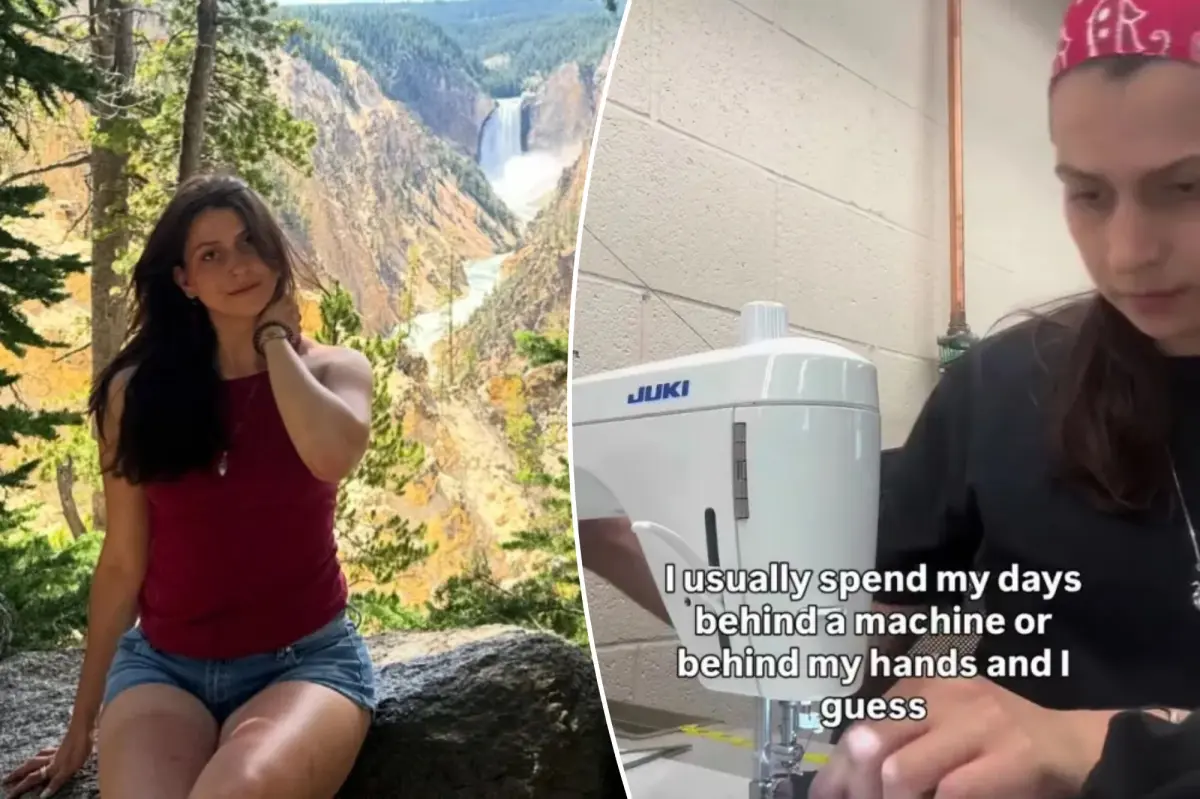
Just a year ago, Zoe De La Paz’s life looked like a well-constructed blueprint. At 26, she was earning $75,000 a year as a mechanical designer at an engineering firm in Chicago, splitting the rent on a comfortable apartment with a roommate, and doing everything society told her to do. By any external measure, she was successful. But inside, the structure was hollow. She showed up to her corporate job, clocked in with her badge, and felt a quiet, growing unhappiness that she couldn’t shake. It wasn’t a crisis; it was more like a persistent whisper that something was missing. There was no single breaking point, no dramatic failure. Just a slow realization that she was trading her days for a paycheck and getting nothing truly nourishing in return. Then, in 2024, she took a trip to visit a friend who worked at Yellowstone National Park. Standing in the vast, wild landscape, surrounded by geysers, mountains, and animals that seemed utterly indifferent to the rhythms of office life, she felt a shift. “It was what made me realize that life was too short and that I was very unhappy at my corporate job,” the 26-year-old told CNBC Make It. The trip didn’t just offer a vacation; it offered a glimpse of an alternative, a working life embedded in nature. Earlier this year, she decided to act. She began searching for new opportunities, and eventually found a job at Yellowstone as a seamstress for Xanterra Parks & Resorts, the company that operates hotels and lodges inside the park. It wasn’t a glamorous title, and it came with a pay cut, but for De La Paz, it represented something far more valuable: a chance to stitch together her passion, her values, and her daily life. She had loved sewing since she was young, but had never thought it could be anything more than a hobby. “From a young age, I had been told that work must be work and play must be play, and that there isn’t necessarily a world that allows both to coexist with one another,” she said. “I never thought that my hobby could become my career.” Now she was about to prove that it could.
The job itself is not what most people would call glamorous. As a seamstress, De La Paz earns $19.25 an hour, less than half of what she made in Chicago. But the cost of living at Yellowstone changes everything. Her rent is shockingly low: just $96 a month, deducted directly from her paycheck, and that amount covers not only her bed but also WiFi and utilities. She lives in a dorm-style room in Yellowstone’s Mammoth Village, sharing the space with a roommate. For food, she pays $359 a month as a meal stipend, which she uses at Xanterra’s dining halls. Add it all up, and her fixed living costs in one of America’s most iconic national parks are significantly smaller than what she was paying to split rent in a city apartment. She trades the noise of Chicago for the quiet of the mountains, the pressure of corporate timelines for the steady rhythm of a sewing machine. “Staying in Yellowstone can be just as expensive as traveling internationally,” she said, “and I’m really grateful that I get to stay for pennies and dimes, essentially, to live inside of the park.” The financial trade-off is dramatic: she earns less, but she also spends far less, and what she loses in salary she gains in experiences. Her workplace is surrounded by natural beauty, her commute is a walk through a landscape that tourists pay thousands of dollars to see, and her weekends can be spent hiking, watching wildlife, or simply breathing air that doesn’t smell like exhaust. The move was not about escaping responsibility; it was about redefining what a good life looks like. For De La Paz, it meant realizing that a bigger paycheck cannot compensate for a soul-crushing routine. It meant accepting that she might never become rich in the traditional sense, but she could become rich in sunsets, silence, and a sense of purpose. The seamstress role may not carry the prestige of an engineering title, but it connects her to a tradition of craftsmanship and to the daily needs of a place she loves.
Her schedule has a reassuring regularity that mirrors the rhythms of the park. De La Paz works 40 hours a week, Mondays through Fridays, from 7 a.m. to 4 p.m., with an hour-long lunch break. It is a typical full-time schedule, but nothing about her setting feels typical. Instead of rushing to catch a train, she wakes up in the shadow of the Rocky Mountains. Instead of staring at a screen during lunch, she can step outside and see elk grazing nearby. The work itself—mending fabrics, repairing linens, altering uniforms, keeping the lodge’s textile world in order—is tangible and satisfying in a way that sitting in meetings never was. There is an honesty to the task: a needle, some thread, and a garment that is transformed by patience and skill. She makes less than she did in Chicago, but she wouldn’t change a thing. “The trade-off is really worth it to me because I get to live in one of the most beautiful places in the world,” she said. There is an emotional arithmetic at play, one that cannot be captured in a spreadsheet. In her corporate life, she had a comfortable salary and no sense of fulfillment. In Yellowstone, she has a modest paycheck and an abundance of meaning. She has also discovered a community of seasonal workers, travelers, and park enthusiasts, all of whom have chosen a different path from the conventional career ladder. They share meals, swap stories, and support one another in the strange, wonderful experiment of living inside a national park. De La Paz has learned to redefine success for herself. It is no longer about job titles or annual reviews; it is about waking up each morning and feeling that her work matters, not just to a company’s bottom line, but to her own heart. The sewing machine has become a symbol of that transformation. With every seam she sews, she is stitching together a new identity, one that allows work and play, practicality and passion, to exist in the same space.
The financial reality of her new life is modest but workable. In July, De La Paz earned roughly $2,640. She spent the bulk of that money, $1,162, on gifts, entertainment, household items, and pet care. Another $742 went toward food—an amount that reflects both the meal stipend and the moments when she wants a treat outside the dining hall. She still managed to put $586 into savings. That may not sound like a lot, but it is a powerful indicator of how far her money goes now. Living in Yellowstone has dramatically lowered the cost of the essentials: no expensive city rent, no daily commuting costs, no pressure to spend money on entertainment because the mountains are free. Her July budget reveals a woman who is not scraping by but savoring; she can buy gifts for people she loves, care for her pet, and still watch her savings grow. She also came into this adventure with a financial cushion. De La Paz maintains an emergency savings fund of $11,000, and she has a 401(k) from her previous employer with more than $34,000 in it. That safety net gives her the freedom to take a lower-paying job without the constant anxiety of financial ruin. It also shows that her decision was not reckless; it was intentional. She had built enough stability to take a leap. The way she spends her money has changed too. Instead of paying for overpriced city apartments and the lifestyle that comes with them, she spends on experiences, on the people she loves, and on the small comforts that make dorm life feel like home. She can buy a gift for a friend, take care of her pet, or enjoy a dinner off-site without guilt, because her baseline expenses are so low. In a world where so many people feel trapped by their bills, De La Paz has found a way to loosen the ties between earning and existing. She is not living wildly or extravagantly, but she is living on her own terms. And there is a kind of wealth that has nothing to do with bank balances: the wealth of knowing exactly why you work and what you are working for.
One of the greatest joys of her new life is that she doesn’t have to keep Yellowstone to herself. Her friends and family can visit, and because she works for Xanterra, they can stay overnight at the park for just $5. That tiny fee transforms what would otherwise be an expensive pilgrimage into an accessible escape. De La Paz is deeply aware of the privilege. National parks are often described as land for the people, but the truth is that reaching them and staying in them can be prohibitively expensive. Flights, rental cars, hotels, and entrance fees add up quickly; a night inside Yellowstone can cost several hundred dollars, sometimes as much as an international trip. For many Americans, visiting a national park is a once-in-a-lifetime bucket-list item, not a spontaneous weekend plan. By living there, De La Paz has essentially removed those barriers for the people closest to her. She can share the magic of geysers, bison, and star-filled skies with loved ones without asking them to take out a loan. “Even though the national parks are land for the people to come visit, there is just a geographical distance and then a financial distance for people to be able to come and visit and stay in the park,” she said. Her own presence is a bridge across that distance. When friends or family arrive, she can act as a guide, showing them the hidden corners and quiet moments that make Yellowstone feel sacred. She can watch their faces as they see the Grand Prismatic Spring for the first time, or listen to them laugh as a bison ambles across a road, and she can be part of those memories, not just a worker who serves them and disappears. Living in a place that others only dream of visiting has given her a profound sense of generosity. She isn’t hoarding the experience; she is inviting people in. The $5 overnight rate is a small detail on paper, but in practice it is a gift of access, an invitation to experience transcendence without financial strain.
De La Paz’s seasonal contract at Yellowstone ends at the end of December, and the future is far from certain. She is weighing job opportunities in two very different cities: Los Angeles and New York City. It would be easy to see that as a return to the grind, but De La Paz doesn’t want to simply repeat the past. She knows that whatever she does next will be shaped by the courage she found here. “It’s scary to think about the fact that less than six months ago, I was working my corporate job, clocking in with my badge, and now it’s like: What comes next?” she said. That question, once paralyzing, now feels like a doorway rather than a wall. She has learned that she can change her life, not by waiting for the perfect moment, but by making a series of imperfect, brave choices. She has also learned that the thread connecting all of her futures is her craft. “I know that regardless of where I end up, the work I will be doing will continue having me be behind a sewing machine,” she adds. That certainty grounds her. Whatever city she lands in, she will bring her needles, her thread, her skill, and the quiet confidence that comes from having followed her heart once. The thought of moving from a dorm room in a national park to a crowded city is intimidating, but it is also exhilarating. She is no longer the same person who sat in a cubicle dreaming of something else. She is someone who took action, who sacrificed salary for sanity, who learned that happiness is not always found in a bank account. “I’m excited for what comes next,” she said, and there is no reason to doubt her. The past year has proven that she is willing to take risks, to live differently, and to trust her own instincts. Yellowstone gave her more than a job; it gave her a new story. And as she gets ready to turn the page, she will carry that story with her, along with every seam she has sewn and every sunrise she has been lucky enough to watch. The future is uncertain, but so is all of life. De La Paz has found her thread, and she will keep pulling it.