



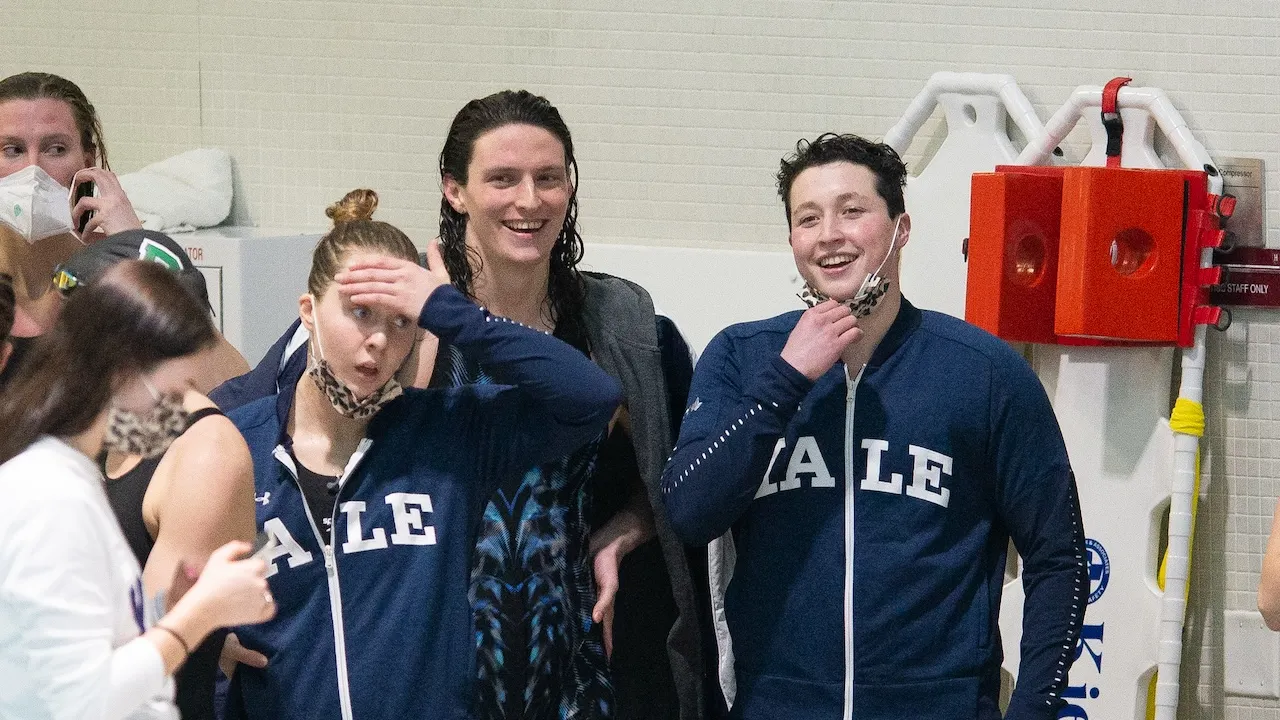
In the hushed, marble-lined corridors of the Dirksen Senate Office Building, the air was thick with the gravity of a reckoning long overdue. The Senate Judiciary Committee had convened not for a debate on legal statutes or constitutional abstractions, but for something far more visceral: the raw, unvarnished testimony of women who had been caught in the crosshairs of a cultural revolution they never asked to join. Senator Josh Hawley of Missouri, a sharp and probing presence on the panel, turned his attention to Kim Jones, a witness seated before him. Her presence was not that of a political operative or a legal expert, but that of a mother—a woman whose quiet determination masked the sleepless nights and whispered fears she had endured on behalf of her own daughter. Hawley’s question cut through the procedural noise like a blade: had the female swimmers at Yale ever been asked if they consented to sharing their locker room with Lia Thomas, a biological male who identifies as transgender and who had become the epicenter of a national firestorm over fairness in women’s sports? The question was simple, direct, and devastatingly personal, yet it peeled back the layers of a policy failure that had left countless young women vulnerable, humiliated, and silenced in the most intimate spaces of their athletic lives. Jones’s answer, delivered with a steady voice that belied the trembling beneath, was a resounding, unequivocal “no.” That single syllable carried the weight of years of institutional complicity, bureaucratic evasion, and the painful reality that the bodies and boundaries of female athletes had become collateral damage in an ideological experiment.
The figure of Lia Thomas loomed over the proceedings like a ghost that refused to be exorcised. A biological male who had competed for three years on the University of Pennsylvania’s men’s swimming team before transitioning, Thomas had shattered records and expectations alike when she began competing against women during the 2021–2022 season. The images of Thomas towering over her female competitors on the starting blocks, her physical advantages—broader shoulders, larger hands, greater lung capacity—were impossible to ignore. But for Riley Gaines, who had sat in that very same witness seat three years earlier, the trauma was not merely about losing races. It was about the violation of privacy, the dehumanizing ritual of being forced to undress in front of a biological male in the locker room, her body exposed without her consent, her objections drowned out by administrators who refused to acknowledge the elephant in the room. Gaines’s testimony had been a searing indictment of the system, a litany of humiliations that included sharing a podium with Thomas after a tied finish, a moment that symbolized the erasure of female achievement. Her words had ignited a movement, giving voice to thousands of women who had suffered in silence. As Hawley recalled her testimony to Jones, the parallels were undeniable. He spoke of the forced undressing, the unfair competition, the utter violation of basic dignity—and he drew a direct line to Jones’s own daughter, who had swum competitively at Yale, an institution that, like Penn, was part of the Ivy League’s tangled web of policies. When Jones confirmed that her daughter had faced Thomas in multiple competitions during that fateful season, the room seemed to hold its breath. This was not an abstraction; it was a lived reality, a mother’s ache translated into testimony, a daughter’s quiet resilience turned into a public reckoning.
To understand the depth of this violation, one must step into the chlorine-scented world of collegiate swimming, a domain governed by discipline, sacrifice, and the unspoken trust that exists between teammates who bare their bodies and their souls in pursuit of a shared goal. For Jones’s daughter, the pool had always been a sanctuary—a place of rigorous practice, fierce camaraderie, and the pure, unadulterated joy of pushing one’s limits. But the arrival of Lia Thomas shattered that sanctuary. The pool deck became a battlefield, not just for lane times but for the very definition of womanhood. The locker room, once a haven of vulnerability and mutual respect, became a minefield of anxiety. Jones, describing the reality her daughter and her teammates faced, was unequivocal: the girls were never asked if they were comfortable sharing that space with Thomas. There was no vote, no survey, no acknowledgment that their feelings, their privacy, or their sense of safety mattered. Instead, they were subjected to a regime of silence enforced through institutional intimidation. Regular mandatory meetings were convened, where swimmers were reminded that the decision to allow Thomas to compete and share their facilities was a matter of league policy, not open for debate. The message was clear: dissent would not be tolerated. If they wished to speak publicly about their concerns, their words had to be pre-approved by coaches and athletic directors—a chilling form of censorship that stripped them of their agency. Jones recounted how the young women were told to “control their families,” a directive that transformed parents into potential liabilities, and how the threats—both subtle and overt—hung over them like a dark cloud. The pressure, she said, was enormous, recurring, and relentless, crushing the spirit of girls who had simply wanted to swim.
The emotional weight of Jones’s testimony cannot be overstated, for it humanizes a debate that is often reduced to legal jargon and political talking points. Behind every statistic about declining participation rates or every court ruling on Title IX, there are real people—young women who stare at their reflections in the locker room mirrors, who wonder if their bodies are their own, who grapple with the existential terror of having their most private moments surveilled and commodified. Jones’s daughter, and the other swimmers at Yale, were not activists or provocateurs; they were athletes who loved their sport, who had worked their entire lives to earn a spot on an elite roster. And yet, they found themselves cast as villains simply for asserting the most basic of biological realities. The mandatory meetings, the gag orders, the suffocating pressure to conform—these were not the tools of a compassionate institution but the machinery of a bureaucracy that had decided, in advance, which side of history it wanted to be on. The girls were told to accept, to endure, to remain silent. Their discomfort was dismissed as bigotry; their pain was pathologized as transphobia. In that environment, simply existing as a female athlete felt like an act of rebellion. Jones’s description of the “gigantic threats” and the “enormous pressure” painted a picture of a campus where free speech was a privilege reserved for those who agreed with the prevailing orthodoxy, and where the safety of women was deemed a lesser priority than the comfort of ideological purity. It was, as Hawley acknowledged, an “incredible” scenario—though not in the sense of being unbelievable, but rather in the sense of being almost too painful to accept as true.
Hawley’s reaction to Jones’s testimony was telling. He called the dynamic “incredible,” but immediately sharpened the definition, emphasizing that he found it entirely believable “based on what we know and your daughter’s experience.” This moment of judicial clarity cut through the fog of euphemism that has long surrounded this issue. It acknowledged that the systemic silencing of women in these spaces is not a hypothetical or an exaggeration, but a documented pattern of abuse. The context of this hearing, however, extends far beyond a single locker room or a single swim meet. It is inextricably linked to the broader legal battles unfolding across the nation, most notably the recent Supreme Court ruling that allowed a lawsuit to proceed against a school district over transgender bathroom policies. That ruling, which declined to overturn an injunction requiring a biological male to use a private bathroom, has opened the door for women to seek damages for the violations they have endured. As the legal framework around Title IX continues to shift, the testimony of women like Kim Jones and Riley Gaines becomes critically important. They are not merely anecdotal witnesses; they are the living evidence of the harms inflicted when the biological distinctions between the sexes are erased in the name of inclusion. Their stories provide the factual foundation for lawsuits seeking compensation for the emotional distress, loss of opportunity, and violation of bodily autonomy that have become endemic in women’s sports. The subpoenas, the depositions, the court filings—all of it traces back to the moment when a young woman, fresh from a practice or a meet, was forced to confront a reality she never signed up for, and was denied even the basic courtesy of being asked for her consent.
Ultimately, the hearing was not just about Lia Thomas, or Yale, or even the Ivy League. It was about the soul of women’s athletics and the fundamental question of whether female bodies are entitled to their own spaces. Kim Jones’s testimony, delivered with the quiet strength of a mother protecting her child, served as a powerful rebuttal to the notion that women who object are simply misguided or hateful. She illuminated the human cost of a policy that prioritizes ideology over biology, and she gave voice to the voiceless—the countless girls who have been pressured, threatened, and silenced into submission. As the hearing drew to a close, Hawley’s parting observation hung in the air: the situation was believable, painfully and tragically so. And in that believability lies the tragedy of our times. We have created a world where young women are taught that their discomfort is invalid, their privacy is negotiable, and their voices are unwelcome. We have asked them to sacrifice their safety on the altar of a principle they never agreed to. But in the resilience of mothers like Kim Jones, and the courage of athletes like Riley Gaines and the anonymous daughters who swim silently in the lanes behind them, there is a glimmer of hope. They are fighting back, one testimony at a time, refusing to let the world forget that behind every policy debate, there is a human being—a girl who deserves to undress in peace, to compete on a level playing field, and to be asked, just once, if she is okay. That is not a radical demand; it is the bare minimum of dignity. And it is time, as the Senate chamber fell silent that afternoon, for the world to listen.