

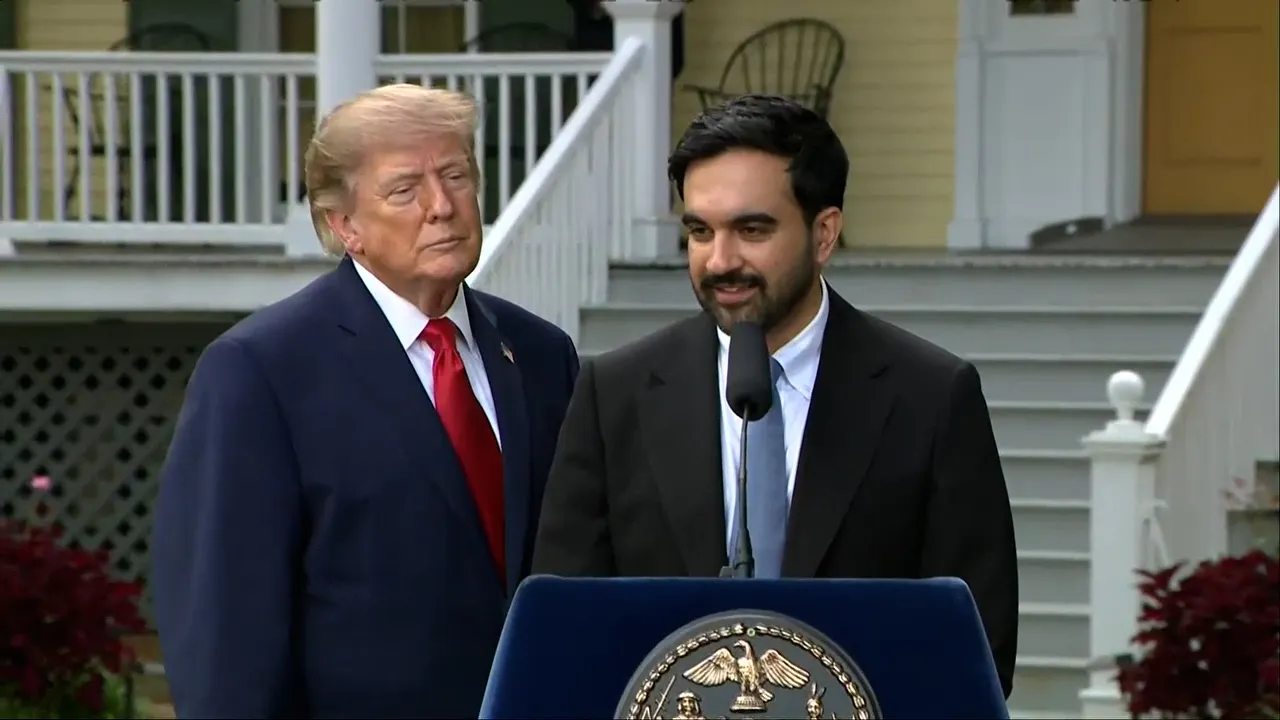
There was something almost defiant about the setting on Monday afternoon. Gracie Mansion, the official residence of New York City’s mayor, sat bathed in early spring light while reporters jostled for position on the lawn, cameras rolling and notebooks open. Mayor Zohran Mamdani stood before them, but he was not the only headline. President Donald Trump had arrived for a joint meeting, and the gathering had become, perhaps unintentionally, a powerful visual counterpoint to the ongoing fight over press access in Washington. Days earlier, the Trump administration had barred CNN, MSNBC, and Politico from certain White House events, a decision that sent shockwaves through the media world and reignited a familiar battle over who gets to ask questions of the most powerful person in the country. Now, here in New York, a city that often sees itself as the media capital of the world, Mamdani seemed determined to send a message: all press is welcome, no matter what outlet they represent or how harshly they may critique the government. The contrast was stark, and it hung in the air as reporters waited to see whether the president would defend his policy or soften his stance in this friendlier, more controlled environment.
A reporter eventually asked the question that had been on everyone’s mind: had Mayor Mamdani challenged President Trump directly about excluding CNN, MSNBC, and Politico from the White House? Mamdani’s answer was measured, but clear. He said he had told the president that every member of the press would be present on the lawn at Gracie Mansion, and that he believed in that openness deeply. “Everyone, no matter the opinion or the critique that we engage in,” he said, emphasizing that the free exchange of ideas and the presence of a diverse media are essential, especially when powerful officials are speaking. It was a quiet but firm rebuke, not delivered as a confrontation, but as a statement of principle. He did not claim to have changed the president’s mind. He did not suggest that a single conversation could undo a policy that had already drawn legal threats and widespread condemnation. But by hosting Trump in a space where journalists from every outlet were allowed to observe and report, Mamdani made his point without raising his voice. The message was simple: in New York, the press is not the enemy, and a leader should be able to face questions from anyone, including those who might be critical or even hostile in their coverage.
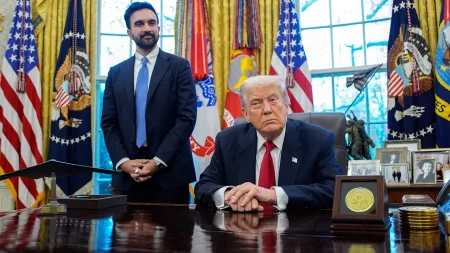
President Trump, however, was not about to let the moment pass without responding. When he took the stage, he was relaxed, almost amused, and he directly addressed the controversy swirling around him. He noted that several news organizations, including Fox News Media, ABC News, CBS News, CNN, and NBC News, had suspended their participation in the presidential press pool, an arrangement that normally ensures a small group of reporters can document the president’s movements and remarks. The president dismissed the move as a boycott that never actually materialized. “It’s interesting because they said they were going to boycott me, but they never boycott me,” he said, gesturing toward the sea of cameras and reporters in front of him. “So I wasn’t very worried about that. Look at all that press.” He seemed to relish the irony: despite all the outrage and all the talk of protest, the press was still showing up, still asking questions, still giving him a platform. Then he pivoted to why he had agreed to appear before the very outlets he had been excluding from the White House. He claimed that the press has an obligation to cover the work of the government fairly, and that he was giving them a chance to fulfill that duty, even if they had not done so in the past.
Trump’s defense of his decision was broad and, at times, sweeping. He boasted about his administration’s achievements, citing economic numbers he described as the best in the history of the country. He mentioned “$21 trillion pouring in,” a figure he said was the largest ever recorded, and he insisted that no one had accomplished what his administration had accomplished. He also brought up foreign policy, particularly the situation with Iran, and complained that even in times of war and diplomacy, the coverage he received was relentlessly negative. “I never get anything positive. It’s always negative, even having to do with the war. We’ve done so well,” he said, his voice carrying a hint of frustration. He saved some of his harshest words for CNN, which he called “fake news,” saying that you would think an outlet would at least write reasonably well about his administration, but that never happens. Then he made a more serious assertion, one that goes to the heart of the current dispute. He argued that allowing certain media outlets into the White House is not just about fairness or access, but about national security. “They’re very bad for the country, very bad for national security,” he said, suggesting that the coverage produced by these outlets is harmful in ways that go beyond politics. “So I have that obligation. So we’ll see how it works out.” It was a striking line, tying press freedom to national security and casting the media not as a check on power, but as a potential threat to it.
The broader context makes the exchange even more significant. This is not the first time Trump has clashed with the press, and it likely will not be the last. But the decision to bar specific outlets from White House events marks a new escalation, one that legal experts say could end up in court. An attorney following the situation predicted that the White House will not back down, and that the latest press tussle may ultimately be resolved by a judge rather than by a change of heart. Meanwhile, the suspension of the presidential pool by the major television networks has created an unprecedented situation: the very organizations that are supposed to provide the public with independent coverage of the president are now refusing to participate in the traditional mechanism for doing so. That leaves a complicated void, one that raises questions about how the press should respond when a leader decides to pick and choose who gets access. For Mamdani, the answer seems to be to open the doors wider, not to close them. By welcoming all media to Gracie Mansion, he offered a small but meaningful contrast to the White House approach. He did not have the power to overturn the president’s policy, but he could create a space where journalists from every outlet, regardless of their editorial stance, were treated equally and given the opportunity to do their jobs.
What happens next is uncertain. The president has said he will see how things work out, which leaves room for either further escalation or a quiet retreat from the policy. The networks that suspended their participation in the press pool are likely waiting to see whether their protest changes anything, or whether it simply cedes more ground to friendly outlets and official statements. The legal challenges may move forward, and the courts may ultimately have to decide whether the White House can exclude certain news organizations from press events without violating the First Amendment or long-standing norms of press freedom. In the meantime, the images from Gracie Mansion will linger: a New York mayor standing alongside a president, not as an ally, but as a host, insisting that the press be present, even when the president does not want them. There is something almost old-fashioned about that moment, a reminder that the relationship between leaders and the media is not supposed to be comfortable. It is supposed to be tense, even adversarial, because that tension is what keeps the public informed. For one afternoon in New York, that principle was on full display, not in a courtroom or a newsroom, but on the lawn of the mayor’s home, where the press was allowed to do what it has always done: ask questions, challenge power, and remind the world that no leader, no matter how powerful, gets to decide who counts as a journalist.