


A Legal Battleground: The Fight Over Missouri’s Congressional Map
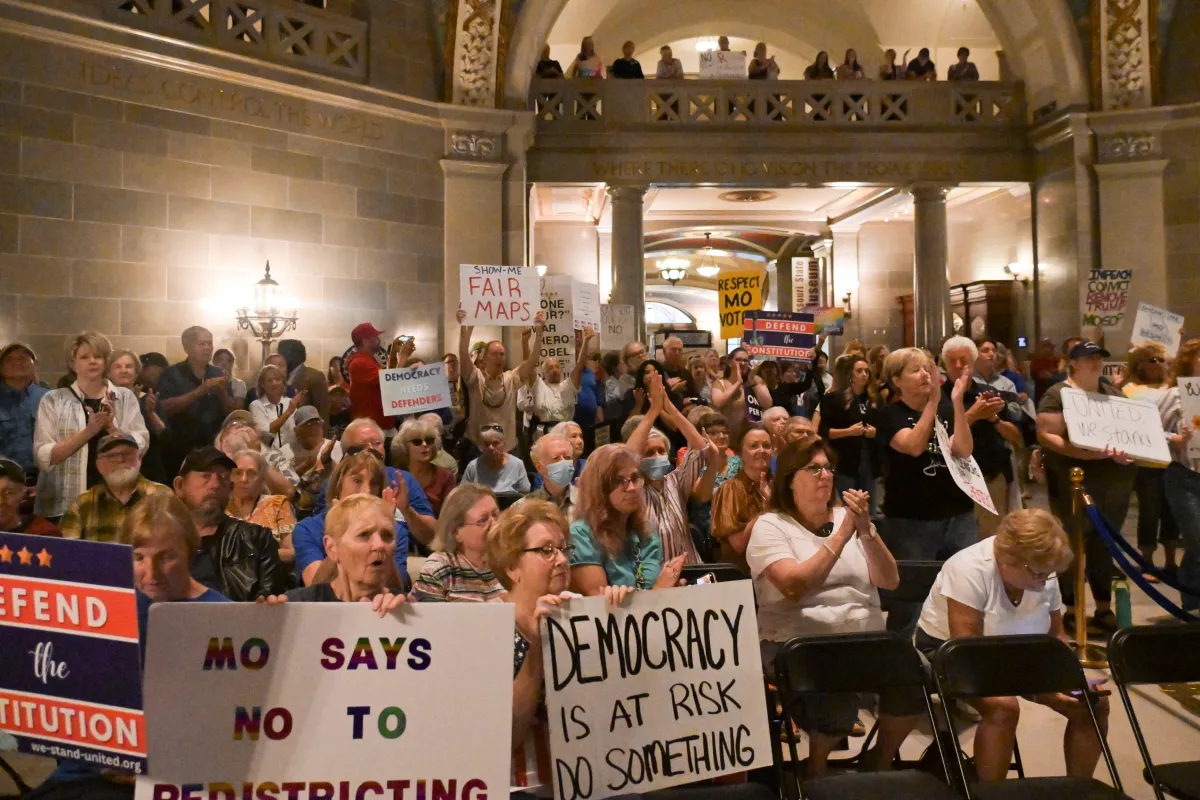
The 8th U.S. Circuit Court of Appeals has delivered a pivotal ruling in the ongoing legal saga over Missouri’s congressional districts, determining that the state must use a newly drawn, Republican-backed map for the 2026 midterm elections. The three-judge panel’s decision, which reverses a lower court’s stance, asserts that this new 2025 map is the only one that “complies with the Constitution and federal law,” while the previous plan from 2022 is deemed unconstitutional for the upcoming general election. This latest development injects a fresh wave of uncertainty into an already chaotic electoral process, leaving voters, election officials, and legal experts scrambling to understand which map will ultimately dictate their representation in Washington. The ruling is a significant victory for Republicans who crafted the new boundaries, but it is far from the final word, as the legal battles are almost certainly heading to the Supreme Court.
The panel’s decision, authored by a mix of judges appointed by Republican presidents, directly contradicts the Missouri Supreme Court, which had previously declared the 2025 map unlawful. The state court argued that the new map was drawn by the legislature without proper voter approval on a related constitutional amendment, violating state law. However, the federal appellate court has now framed the issue in terms of federal law, stating that reverting to the 2022 map would create an unconstitutional disruption to the electoral process, specifically concerning the timing of changes relative to the general election. This creates a profound legal conflict between state and federal interpretations of election law. The federal court is essentially arguing that even if the state process was flawed, the practical consequences of changing districts now, after primaries have been conducted under the 2025 map, violate the Constitution’s guarantee of a republican form of government by effectively disenfranchising voters who participated under the new boundaries.
This decision comes after a whirlwind of legal filings and emergency appeals. Earlier in the month, the U.S. Supreme Court had temporarily blocked the implementation of the new 2025 map, suggesting they were sympathetic to the arguments of the challengers. Now, the 8th Circuit has overruled that trajectory, ordering the permanent injunction that allows the 2025 map to be used. The courts are engaged in a high-stakes game of procedural tug-of-war, with each new ruling creating more confusion. The judges on the appellate panel have even offered a one-week stay until September 28th to allow for an emergency appeal to the Supreme Court, acknowledging that without it, election authorities would be immediately forced to pivot to the 2025 map while the nation’s highest court might still be considering the case. This stay is a practical recognition of the chaos that could ensue, yet it underscores the deep division and uncertainty plaguing the electoral timeline.
The constitutional question at the heart of this dispute revolves around Article I, Section 2, which governs the election of House members, and the “Purcell principle,” a legal doctrine that discourages courts from changing election rules too close to an election to avoid voter confusion. While Judge David R. Stras, one of the panel members, agreed with the probable constitutional violation, he voiced strong dissent on other grounds, arguing that the plaintiffs lacked standing to bring the case. He felt the group, People Not Politicians, and its executive director, Richard von Glahn, had not proven they had suffered a specific injury that would give them the right to sue. This dissenting opinion highlights a fundamental disagreement even within the majority, exposing the fragility of the legal reasoning and suggesting that the case’s legal footing is far from solid.
For the voters of Missouri, the immediate impact is a logistical and psychological nightmare. Absentee ballots had already been shipped to military and overseas voters using the old 2022 map, under the assumption that this was the plan for the election. The state law mandates that absentee ballots become available to all other voters starting September 22, which is just days away. The 8th Circuit’s ruling creates a scenario where election officials may have to recall, reprint, and resend millions of ballots in a matter of days, a task of immense logistical difficulty and high error potential. This is not just an administrative inconvenience; it erodes public trust in the entire electoral system. As Democratic Congressman Christian Menefee of Texas pointed out, the timing feels designed to silence certain voters, particularly in a Kansas City district that was redrawn, creating a perception of a rigged system and causing catastrophic damage to confidence in fair elections.
Legal experts are sounding the alarm over the unprecedented nature of this conflict. Neama Rahmani, a former federal prosecutor, described the situation as a “total mess,” highlighting the clear conflict between state and federal law. He noted that normally, a state Supreme Court is the final authority on state law, but the federal circuit court has now intervened, asserting that federal law must take precedence. The policy behind the federal ruling is to prevent the disruption of an ongoing general election, but the practical reality is that the state’s decision to use the 2025 map without a ballot referendum ignored the state’s own constitution. This failure to follow a clear legal process at the state level has created a void that federal courts are now desperately trying to fill, but with conflicting results. The only entity that can now resolve this chaotic stalemate is the Supreme Court, which will likely have to act with unprecedented speed to give election officials a clear directive before voting begins in earnest.