


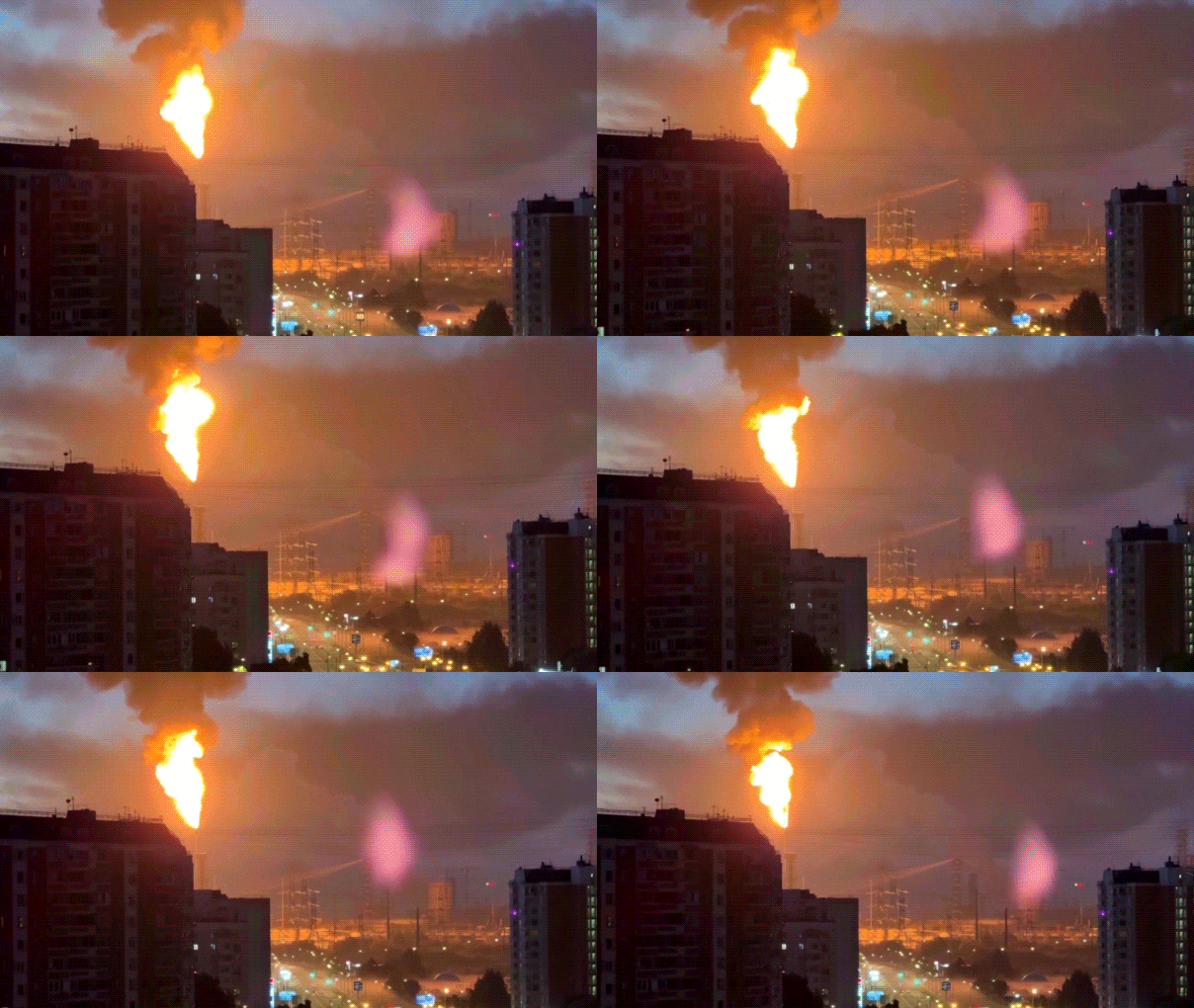
For the people of Moscow, the night arrived not with the quiet hum of a city settling down, but with the distant, ominous roar of drones and the sharp crack of air defenses. In the early hours of Sunday, Ukraine launched what Russia’s Ministry of Defense called the largest aerial assault of the entire war—a coordinated barrage of missiles and more than 1,000 drones aimed deep into Russian territory. The timing was deliberate: Russia was wrapping up the final day of its parliamentary elections, a carefully staged show of national unity around President Vladimir Putin. Ukrainian President Volodymyr Zelenskyy did not hide the intent. In a message posted to X, he framed the strikes as a direct response to the machinery of war, targeting the economic arteries that keep Russia’s invasion alive. “Tonight in the Moscow region, our long-range responses were felt very acutely,” he wrote. “One of the key enterprises of the Russian Federation’s oil industry and an aggressor’s logistics facility have been struck. These are billions of dollars that support the war machine.” For Ukrainians, this was not an act of random violence but a desperate, calculated effort to bring the war home to those who started it—to make the Kremlin understand that its own people cannot remain insulated from the suffering it has inflicted on others.
Zelenskyy’s words carried the weight of a leader who has spent nearly three years pleading for support while watching his country endure relentless bombardment. He used the moment not only to justify the strikes but to remind the world of the asymmetry of suffering. “This week alone, Russia has launched more than 2,000 attack drones against us, most of them jet-powered, as well as 1,700 aerial bombs and 19 missiles of various types,” he wrote. The numbers are staggering, almost impossible to process—a weekly rain of steel and fire designed to break a nation’s spirit. Yet Ukraine, he insisted, keeps finding ways to fight back. The attack on Moscow was not just about oil refineries or logistics hubs; it was about sending a message that no Russian city is beyond reach, that the cost of aggression must be felt at home. He called on the United States, Europe, and the G7 to match Ukraine’s resolve with new sanctions, arguing that now is the moment to “force peace through strength.” There is a raw, human plea beneath the geopolitical language: a father, a president, a citizen asking the free world to stop hesitating, to stop fearing escalation, and to stand firmly behind a nation that refuses to be erased. For Ukrainians waking up to another day of sirens and smoke, his words are both a comfort and a challenge—a reminder that their survival depends not only on their own courage but on the will of distant allies who have grown weary of the war.
On the Russian side, the official response was a mixture of defiance and damage control. Moscow Mayor Sergei Sobyanin took to Telegram to reassure residents that the attack had been repelled, calling it “the biggest attack by enemy drones” and claiming it was “clearly planned with the aim of disrupting the elections.” He insisted the enemy did not succeed. Russia’s Ministry of Defense reported that its forces shot down 1,110 Ukrainian drones across the country, including over Crimea and the Black Sea, with 450 destroyed en route to the capital. But the official narrative of total success could not hide the cracks. The Moscow Oil Refinery, a critical piece of Russia’s energy infrastructure, was damaged, and a residential building was hit. Local Governor Andrei Vorobyov confirmed that two people were killed and twenty wounded. For ordinary Muscovites, the attack was a jarring intrusion of reality into a carefully managed existence. Many had grown accustomed to the war as a distant television event, something happening to soldiers and civilians far away in Ukraine. Now, the explosions were overhead, the smoke was in their neighborhoods, and the fear was in their chests. The Kremlin’s attempt to frame the attack as a failed election provocation rang hollow for those who saw the damage with their own eyes. The war, it seemed, had finally come to the capital—not as a rumor or a warning, but as a terrifying, undeniable fact.
Yet even as Moscow reeled from the unprecedented assault, the human cost of the war continued to fall heaviest on Ukraine. In the southern region of Kherson, a Russian drone strike hit a monastery, killing a member of the clergy and wounding four others. The image is haunting: a place of prayer and sanctuary, reduced to rubble and blood. In Kyiv, the grief was even more personal. Tymur Tkachenko, head of the Kyiv regional state administration, reported that a Russian attack on the capital killed three children and their mother on Saturday night. Three children. A mother. A family erased in a single moment of violence. These are not statistics; they are names that will be whispered in memorials, faces that will fade in photographs, futures that will never unfold. The war has become a brutal arithmetic of loss, each side counting drones and missiles while the real numbers—the dead, the wounded, the displaced—grow beyond comprehension. For Ukrainian parents, every siren is a lullaby of terror, every quiet night a fragile gift. For the children who survive, the war will be the backdrop of their childhood, a shadow that never fully lifts. The strike on the monastery and the deaths in Kyiv are reminders that this conflict is not a chess game of generals and politicians, but a human catastrophe unfolding in real time, with real blood soaking the soil of a nation that only wants to live in peace.
The political context of the attack adds another layer of complexity. Russia’s parliamentary elections, held over three days, were a carefully orchestrated exercise in control, virtually devoid of genuine opposition to Putin’s policies. The vote was also conducted in the four Ukrainian regions that Moscow claimed after the war began but does not fully control, as well as in Crimea, the Black Sea peninsula annexed in 2014. For Ukrainians, these elections are a cruel farce—a mockery of democracy staged on stolen land, with terrified civilians forced to participate under the shadow of occupation. Putin, in his televised address before the vote, accused Ukraine of trying to interfere, citing an alleged Ukrainian strike that killed an election official in her home in the Russian-controlled part of Zaporizhzhia. The details could not be independently verified, and Kyiv offered no comment, but the accusation served its purpose: to rally Russians around the flag, to frame the war as a defensive struggle against a hostile West, and to cast any dissent as treason. For ordinary Russian voters, the election was less a choice than a ritual—a chance to affirm loyalty to a leader who has staked his legacy on a war that has already cost tens of thousands of lives. The Kremlin’s message was clear: we are united, we are strong, and no one can divide or intimidate us. But the drone attack on Moscow exposed the fragility of that narrative. The war is not a distant operation; it is a boomerang, returning to the streets of Russian cities, forcing citizens to confront the consequences of a conflict they were told would be quick and victorious.
In the end, Zelenskyy’s call for peace through strength remains the central paradox of this war. He insists that de-escalation is possible, that steps toward peace are on the table in energy and food security, but that they require political will. “Moscow must end its brutal war and choose peace instead of building layered rings of air defense at the expense of other regions,” he wrote. It is a plea that echoes across the rubble of Kyiv, the burned fields of Kherson, and the grieving homes of mothers who have lost children. But the path to peace is obscured by the fog of war, by the mutual hatred that has grown with every missile, every drone, every death. The attack on Moscow was a message, but messages in war are written in blood, and blood only begets more blood. As the world watches, the cycle continues: Ukraine strikes, Russia retaliates, civilians die, and the leaders on both sides dig deeper into their trenches of rhetoric. The United States, Europe, and the G7 have the power to change the equation, to impose sanctions that bite, to force a reckoning. But power without will is just potential, and potential does not stop bombs. For now, the people of Ukraine hold their breath, the people of Moscow look to the skies, and the war grinds on—a human tragedy with no end in sight, only the faint, fading hope that somewhere, somehow, someone will choose peace over destruction.