




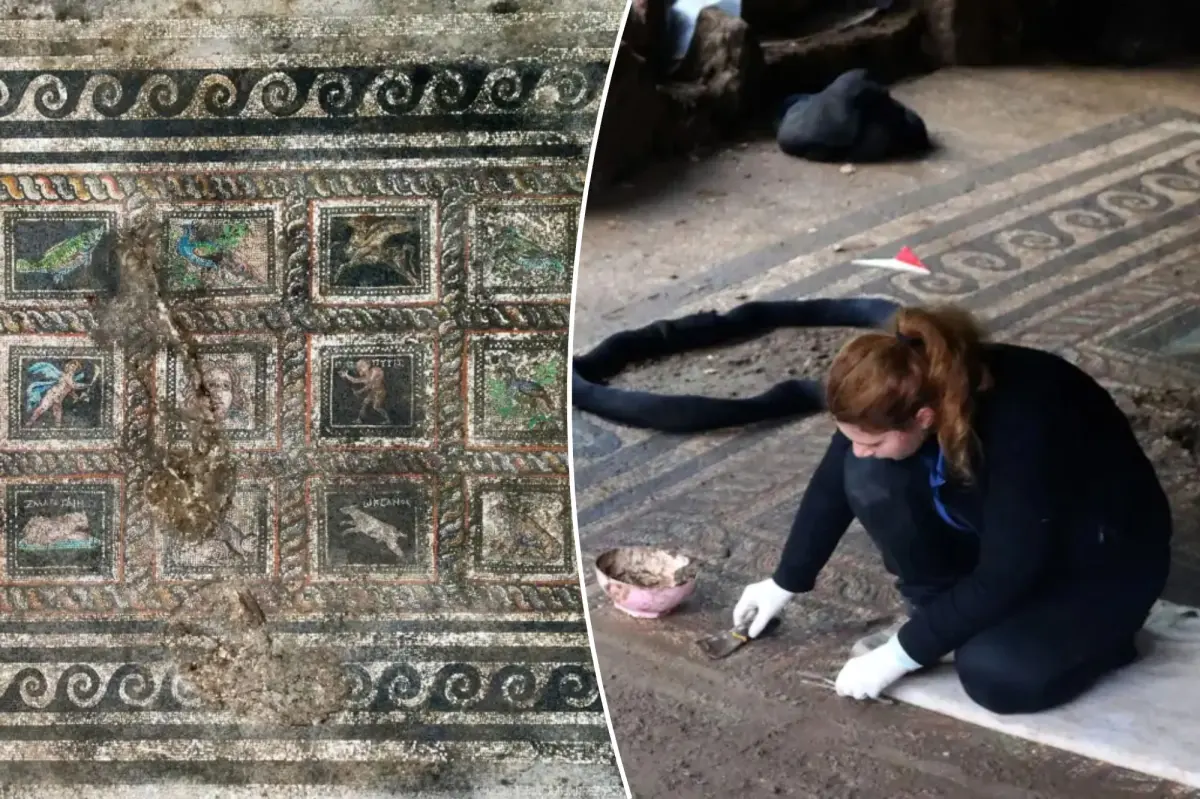
Fur-ever immortalized: that could be the headline for one of the most touching discoveries to come out of ancient Rome in years. Archaeologists working beneath the ruins of Adramytteion, an ancient harbor city on Turkey’s Aegean coast, have unearthed a mosaic floor that a Roman household commissioned nearly two thousand years ago to honor its beloved cat and dog. The artwork, believed to date to the late second or third century AD, was found inside the remains of a Roman villa, and it stopped researchers in their tracks. According to Live Science, the mosaic is an expansive, show-stopping piece measuring about 16.4 feet by 11.8 feet, made up of fifteen individual scenes that depict birds, fish, mythological figures, and all sorts of animals. At its center is the snake-haired Gorgon Medusa, a familiar and protective image in Roman decorative art. But the true stars of the masterpiece are not gods or monsters. They are a pale cat stretched out on a blue-green cushion, looking utterly at ease, and a dog caught mid-leap or mid-run, full of energy and motion. What makes them extraordinary is that both are named in ancient Greek letters—Emerald for the cat, and Ocean for the dog. In a world where most animals in mosaics remained anonymous, these two small labels transform a lavish floor into a personal tribute, a kind of ancient family portrait that speaks across the centuries to anyone who has ever adored a pet.
The details of the mosaic are as charming as they are archaeologically significant. The cat, identified by the inscription ΖΜΑΡΑΓΔΙΝ, meaning “emerald,” is depicted in a pose that feels astonishingly modern to anyone who has ever lived with a feline. She is not hunting, crouching, or performing any symbolic role. Instead, she lies stretched out on a blue-green cushion as if she owns the villa itself, her body relaxed and confident, her gaze perhaps saying that the household existed to serve her. The way she is rendered suggests comfort, privilege, and affection. Hüseyin Özgen, who leads the Adramytteion research team at Mimar Sinan Fine Arts University, noted in a study published in the Journal of Mosaic Research that this laid-back posture is a strong hint that Emerald was a beloved presence in the household, not merely a stray or a working cat. She may have been a companion in the most genuine sense, curled up in the warmest corners of the villa, watching daily life unfold around her, and accepted as part of the family. The dog, on the other hand, is portrayed in entirely different form. The panel showing the animal, identified by the Greek word ΩΚΕΑΝΟΣ, or Ocean, captures him in a burst of motion, either springing after something or racing across a courtyard with his legs stretched and his body angled forward. Where Emerald is stillness and calm, Ocean is energy and joy. The contrast between the two animals makes the mosaic feel all the more real, as if the artists were not decorating a room with generic creatures but commemorating two very distinct personalities.
Emerald’s name, beautiful and unusual, has prompted scholars to wonder about the family that commissioned the mosaic. Özgen wrote that one possible explanation for the name lies in the deserts of Roman Egypt, where emeralds were mined in antiquity. The word “emerald” carries exotic and luxurious overtones, and a connection to North Africa suggests the villa’s owner may have been a merchant with trade links to Egypt or the wider eastern Mediterranean. Perhaps he brought back goods, stories, and a fondness for the region, and chose to name his beloved cat after the glittering green stones that were part of his livelihood. It is impossible to know exactly why the name was chosen, but the very fact that it was chosen matters. In the ancient Roman world, animals were everywhere—in the streets, in the fields, in the kitchens—but they were not usually given individual names in expensive, permanent works of art. To write a cat’s name in Greek on a mosaic floor was to say that this particular creature mattered. It was a small act of immortality, a way of ensuring that Emerald would be remembered long after her whiskers had turned gray and her paws had stopped padding across the villa’s stone floors. The image of her lounging on a cushion, with her name floating above her, feels almost like a portrait of a queen, and perhaps in the household’s own affectionate eyes, that is exactly what she was.
The dog’s name, Ocean, is equally rich in meaning, and Özgen suggested that it was probably no accident. Adramytteion was a city that sat right on the water, a working harbor where ships came and went, where the sea was part of everyday life. Naming a dog Ocean may have been a tribute to the city itself, or perhaps a nod to the dog’s boundless energy, his endless running like waves that never stop. It could also have been a playful contrast: a small, lively creature carrying the name of a vast and powerful body of water. One can imagine the household’s children shouting “Ocean! Ocean!” as the dog dashed along the waterfront, his name echoing the roaring waters beside their home. Even if Ocean was not what we today would call a pet in the modern sense—a beloved family member with a bed and a bowl and a place at the hearth—he was clearly familiar enough to be immortalized in the stunning mosaic. The same goes for Emerald. These were not anonymous animals used as decorative motifs. They had identities, names, and relationships with the people who lived in the villa. In that way, the mosaic offers a rare and precious glimpse into the emotional lives of ancient Romans, reminding us that the bonds between humans and animals are not a modern invention. People in the second and third centuries loved their animal companions enough to preserve their images in the most lasting medium available to them: art made of thousands of tiny colored stones.
The discovery is part of a much longer archaeological story. Özgen has been digging at Adramytteion since 2012, slowly uncovering layer after layer of a city that once flourished at the crossroads of trade and culture. The Roman villa that housed the mosaic was only recently brought to light, with excavations taking place in 2025 and continuing into early 2026. It is a reminder that archaeology is often a slow, patient craft. Beneath the soil, beneath the rubble, beneath centuries of abandonment and forgetting, lie the floors that people once walked on, the walls that sheltered them, and the small details that reveal who they were. Mosaics like this one are particularly valuable because they combine artistic achievement with everyday life. The wealth required to commission such a piece tells us about the villa’s owner and his standing in the community. The choice of subjects tells us about taste, religion, and cultural influences. But the naming of Emerald and Ocean tells us something more intimate. It tells us about love, affection, and the instinct to memorialize the creatures that shared a home with us. The fact that the mosaic includes birds, fish, wild felines, and mythological characters shows that the artisans drew on a wide repertoire of imagery. Yet among all those possibilities, the family chose to give individual names to two animals—perhaps their favorites, perhaps the ones that lived closest to them, perhaps the ones that simply could not be left out of this grand and permanent statement.
In the end, what makes the Adramytteion mosaic so moving is not its size or its craftsmanship, remarkable as they are. It is the way it collapses the distance between the ancient world and our own. We will never know whether Emerald was a quiet lap cat or a mischievous troublemaker. We will never know whether Ocean liked to chase seabirds along the shore or greet every ship that came into the harbor. But we know they were loved. We know that someone looked at those animals and decided they deserved to be remembered forever, side by side with Medusa and the gods, woven into the life of the household for as long as the villa stood. As Özgen and his team continue to excavate Adramytteion, there may be more stories buried beneath the ancient city, more names waiting to be found, more glimpses of the everyday hearts of the past. But for now, the mosaic of Emerald and Ocean carries a universal message that transcends language and time: the animals we share our lives with become part of our history. They are family. And whether we carve their names in stone, paint them on canvas, or simply keep a photograph by our bed, we are all trying to do what one Roman family did nearly two thousand years ago—hold on to the creatures we love and keep them with us, fur-ever.