



The Extraordinary Return: A 130-Year-Old Library Book Finds Its Way Home
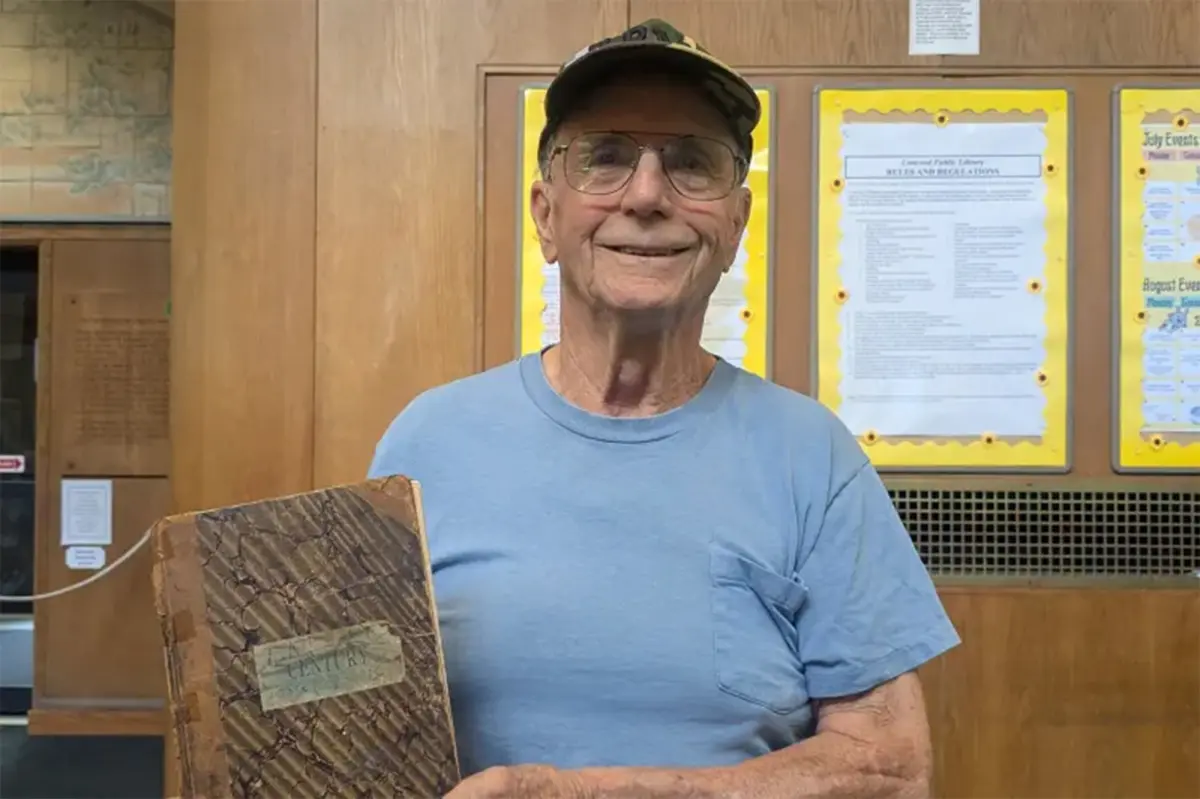
In the quiet, unassuming town of Concord, New Hampshire, a remarkable story has unfolded that speaks to the enduring power of patience, memory, and second chances. At the heart of this tale is John Hanson, an 84-year-old resident of Barrington, who recently did something that most of us would consider either deeply admirable or slightly terrifying: he returned a library book that was more than 13 decades overdue. The book in question, a September 1894 issue of “The Century Illustrated Monthly Magazine,” had been sitting in his possession for so long that it had effectively become a family heirloom, a silent witness to generations of history unfolding around it. When Hanson finally decided to bring it back to the Concord Public Library, he wasn’t just returning a piece of reading material—he was closing a chapter on a long, strange journey that began in an era when Grover Cleveland was president, the telephone was a novelty, and the very concept of a “fine” for late books was probably calculated in pennies, not dollars.
The magazine itself is a fascinating artifact of its time, a window into the intellectual and cultural life of late 19th-century America. “The Century Illustrated Monthly Magazine” was one of the most prestigious publications of its day, a literary and political journal that featured the works of Mark Twain, Henry James, and other luminaries of the American literary renaissance. The September 1894 issue would have contained serialized novels, essays on politics and science, and beautifully engraved illustrations that captured the imagination of its readers. To hold such an object today is to touch a piece of history, to feel the texture of paper that was manufactured when the Industrial Revolution was reshaping the American landscape. For Hanson, however, the magazine wasn’t just a historical curiosity—it was a mystery. He admits he has no idea how it came into his possession, a confession that adds an almost magical quality to the story. Somewhere along the winding path of his 84 years, through moves, inheritances, garage sales, and the general chaos of a long life, this magazine found its way into his hands and simply stayed there, accumulating dust and decades in equal measure.
The decision to finally return the magazine came about in the most serendipitous way possible. Hanson, like many New Hampshire residents, was reading his local newspaper, the Concord Monitor, when he came across an article about the Concord Public Library’s decision to freeze all late fines. This simple policy change, designed to encourage people to bring back overdue materials without fear of financial punishment, struck a chord with the octogenarian. In that moment, he realized that the time had come to unburden himself of this century-old literary stowaway. “Yeah, when I saw that, I said to myself, ‘Boy, this would be a good time to bring it back,'” Hanson told NBC News, his words capturing a mix of relief, humor, and perhaps a touch of sheepishness. It’s easy to imagine the scene: an elderly man, surrounded by a lifetime of accumulated possessions, suddenly recognizing that the moment of reckoning had arrived. The fine freeze was his get-out-of-jail-free card, a golden opportunity to do the right thing without suffering financial consequences that would have been absolutely astronomical.
And those consequences were indeed staggering. If the library had still been charging its standard late fees, Hanson would have been on the hook for an estimated $12,055—a sum that would make even the most dedicated bibliophile think twice about their borrowing habits. The math is almost comical in its absurdity: 48,220 days overdue, a number so large that it’s difficult to wrap one’s head around. That’s over 132 years of accumulated fines, a debt that spans multiple lifetimes and would have required Hanson to pay roughly the cost of a used car or a modest vacation for the crime of forgetting to return a magazine. Fortunately, the fine freeze meant that Hanson could walk into the library with his head held high, hand over the ancient periodical, and leave with his wallet intact and his conscience clear. The library, for its part, responded with grace and good humor, posting about the incident on social media with a tone of delighted astonishment. “We’ve witnessed many happy faces since announcing our fine freeze! Of course, we expected long overdue books to be returned, but certainly not something from the late 19th century!” the library wrote, perfectly capturing the delightful absurdity of the situation.
The story of this 130-year-old magazine is about much more than just a library fine, of course. It’s a testament to the role that libraries play in our communities as repositories not just of books, but of shared history and collective memory. The Concord Public Library, like thousands of institutions across the country, has evolved over the decades from a quiet reading room into a vibrant community hub, offering everything from internet access to children’s programs to meeting spaces for local organizations. Yet at its core, the library remains a place where the past and present coexist, where a magazine from 1894 can sit on a shelf next to the latest bestseller, each waiting for a curious reader to pick it up. The decision to freeze late fines reflects a growing movement in the library world to remove barriers to access, recognizing that punishing people for overdue books often hurts the very patrons who need library services the most. In this context, Hanson’s return of the century-old magazine becomes a heartwarming illustration of how a simple policy change can ripple outward in unexpected and delightful ways.
Perhaps the most beautiful aspect of this story is what it reveals about human nature and the strange ways we form attachments to objects. Hanson kept this magazine for reasons he can’t fully explain, carrying it with him through the decades like a quiet companion. It survived wars, economic depressions, technological revolutions, and countless personal milestones—marriages, births, moves, and the inevitable losses that come with a long life. In a world that often feels obsessed with the new and the disposable, there’s something deeply moving about a person who held onto a piece of reading material for over half a century, even inadvertently. When Hanson finally let it go, he wasn’t just returning a book; he was releasing a piece of his own history, trusting that the library would give it a proper home where future generations could appreciate its significance. The library, in turn, has promised that the magazine won’t return to circulation but will be preserved, recognizing its historical value. And so, a story that began in 1894 with a reader checking out a magazine comes full circle, a reminder that it’s never too late to do the right thing, that forgiveness is always possible, and that sometimes the most profound moments in life come from the simplest acts of honesty and connection.