



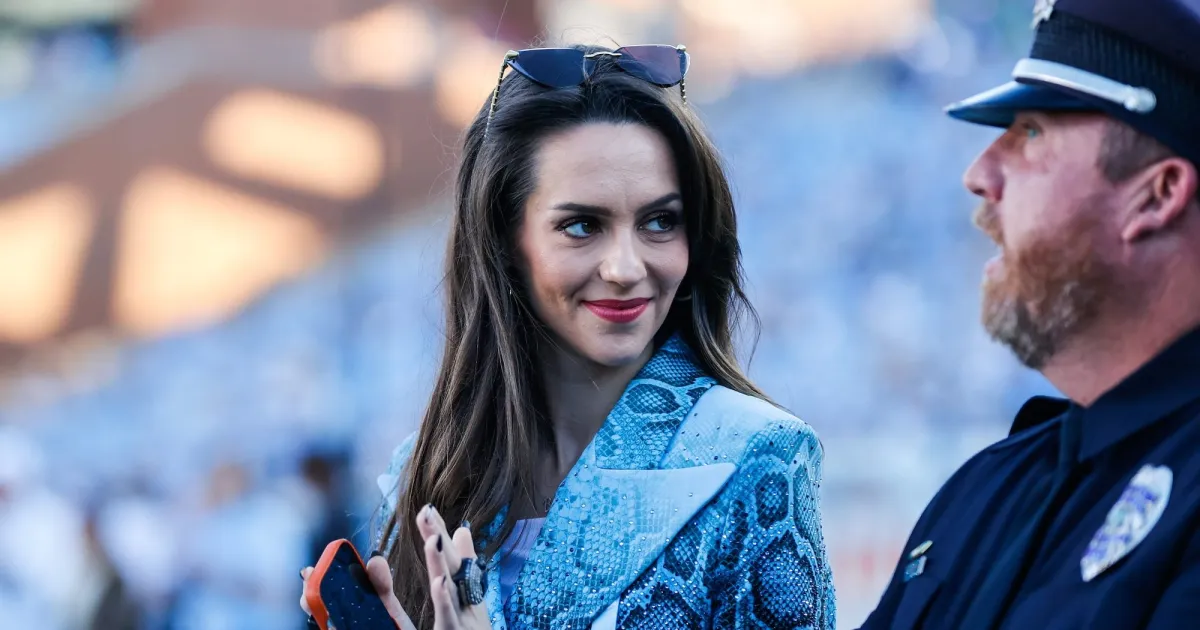
1. There are moments on a college football sideline that have nothing to do with the scoreboard, and this was one of them. On Saturday, September 12, at Kenan Stadium, the Tar Heels were preparing for what would become a decisive victory, but one of the most talked-about moments of the afternoon was a strange, unspoken standoff between two people holding phones. Jordon Hudson, the 25-year-old woman whose relationship with legendary football coach Bill Belichick has made her a fixture in both sports headlines and social media, was standing on the sidelines in Chapel Hill as she has done throughout Belichick’s newest chapter at North Carolina. Pat Welter, the 38-year-old sports reporter for WRAL, was also there working, his camera ready to capture whatever story might unfold. When Welter turned his phone toward Jordon, intending to document her presence, he quickly realized that she was doing the same to him. A few seconds passed with both of them frozen in a kind of mirror-image, then she offered a wave and a smile. The reporter later posted the footage on Instagram, giving it a humorous caption: “Me filming Jordon Hudson. Jordon Hudson filming me.” The moment was small, but it was also telling—this former model and ex-cheerleader is no longer just someone photographed or asked questions by reporters. She is someone who has begun to watch back.
2 1
The interaction came during a matchup between the North Carolina Tar Heels and East Tennessee State Buccaneers, only weeks after the school had spent months dealing with off-field noise and drama. Hudson wore a Tar Heels T-shirt paired with white denim pants and a low-hanging ivory belt, a look that was casual but clearly designed for a public role. There wasn’t any explanation for why she was filming Welter, although those who had watched the recent storylines guessed it wasn’t an accident. Welter himself was not just a random reporter covering the game; he had recently spent time criticizing the leadership and trajectory of UNC’s football program, especially after the departure of the coordinator of football operations, a string of events that created a strange atmosphere around Belichick’s first major campaign on campus. While UNC logged a comfortable win, going up score wise later and eventually defeating the Buccaneers 35-3, the sidelines turned into its own kind of awkward stage. The social media clip, just seconds long, somehow encapsulates a relationship that has been strangely tense all along between Hudson and the media. The smile was friendly, but what was behind it impossible to tell. Maybe she was simply playing along with the circular nature of everything in the modern attention economy. Maybe she was making the point that she has another way of telling the truth. Either way, the shot captured the uneasy rails of exactly how the spotlight works when it is at once followed and following.
3 To understand what happened between Hudson and Welter, one had to look at what was going on behind the scenes with the Tar Heels. The school had gone through a messy few weeks after general manager of football operations, Michael Lombardi, resigned on September 3. Sources near the team told reporters that his resignation came at the same time an internal investigation into a human resource complaint. Suddenly, the owner of the Bills Belichick’s staff had a cloud hanging over it, and every relationship became even more closely examined. The topic of who influences Belichick was always sensitive, but all of that moved to the surface with the departure. When Welter discussed the Lombardi report, he suggested it might have new impact on how Belichick handles the program because both Hudson and Lombardi were seen as key figures in Belichick’s life last season. Welter went as far as tweeting a source’s line: “The one collapse is who Bill ticks,” before adding that last season that was Hudson and Lombardi.” It was a strong phrase, one that placed Hudson at the center of power. That kind of name-dropping doesn’t usually sit well with a person, and in this content there was little chance she was going to ignore it. So Sundays later he found himself filming her exchange at the Blue Ridge. It was not necessarily a torrid fight but it was an effort to hold ground, a gentle emotion of: The truth may not be in your frame. And with the situation turned into the case, a media could not ignore the disappeared Lombardi and the silent man in the chair, watched as the reporters circled around.
4Hudson has had a complicated relationship with the press since early on, and she’s not shy about pushing back when she feels like her privacy is being invaded. The first unforgettable flashpoint came in 2025, when reporter Tony Dokoupil tried to ask Belichick, during a CBS Sunday Morning segment, about how their age-gap romance had started. Hudson inserted herself immediately, making it very clear the topic was off limits. “We’re not talking about this,” she said, and the moment instantly went viral. It sparked broader conversations about whether, as a public figure alongside perhaps the most famous coach in NFL history, she can control her own narrative that rivals were even interested in their relationship. She isn’t in most perfectly traditional football partner role, however, not waiting in the shadows. Since that CBS moment, she has used her own social media platforms to confront reporters she believes are unfair or intrusive. Is she a private person who is simply defending boundary, or is she using her newly elevated status to control a scripting sport? The answer isn’t clear. But on the sidelines Saturday, her spontaneous decision to film viewers had some. Instead of being patented as content, she was creating it. She used the same tools that the reporter on deadline held in his hand and reversed the gaze. In an era where just about everyone has a phone, the edge between “media” and “subject” fades anyway, but Hudson kind of took it to heart. The joke was harmless, but the action indicated the identities they occupied and they knew.
5There is a longer history that feeds into this uncomfortable dance with the media. In December 2025, the situation involving Hudson reached a more serious point when she threatened legal action against podcaster Pablo Torre, whose reporting claimed that Hudson had been banned from UNC’s football facilities’ football facilities. The university denied the story. It was a messy online standoff, one that was not just about reporting but about power and access and who gets tell a story. Torre later said publicly that he had never received any kind of formal legal claim from her. He told another publication, sometimes with almost a laugh in his writing, saying, “I can report that there has been no legal notice or letter or communique of any kind sent to me. I have not been sued despite her threatening to do so on Instagram last week, which is a fun sentence that I never get worn out saying aloud.” Torre went as far as saying University of North Carolina had made it clear and convenient they had no part in her threats. That sequence alone reveals how differently Hudson plays the open power from how she handles the private pressure. She circulates herself, but she also refuses to be defined, and she has enough credibility with Belichick to think of that. The episode with Welter on the sideline was much lighter by comparison, but it was another fragment of a larger conflict: exactly what portion of Belichick’s life should be fair game and who gets to draw that line.
** noAll of this brings Hudson human, but it also leaves room for it. People look at her standings and immediately ask: What does someone in your twenties like Belichick, twice her age? Is she a true partner? Is she an influence difficult to dislodge? Is he simply someone who enjoys the high-stakes challenge of a legendary coach? It might be any of them, and likely, all at once. Belichick, not famous for sharing vulnerability, does not block Hudson’s presence, and she has become an unmistakable face at every key place, whether it is a training practice or a television pitch. She seemed to be comfortable under the scrutiny, at least, to the point where she can send a joking wave to a reporter who has been trying to understand exactly how the inner life of that program operates. The little filming incident was perhaps certainly almost an acknowledgment: Yes, I know you are watching me. I’m watching you. But beyond that, she is not explaining herself. What’s interesting as a takeaway isn’t the drama of the encounter. It’s the way society is used to headlines that turn women at sidelines into explanations. Hudson is instead thinking about being in scenes and she is requiring to be read in her own terms, even if the small smile on her face makes it impossible to know exactly what those ways. The press calls; she chooses the answer to makes. She becomes a symbol of the odd but almost new world in which football’s biggest figures bring along their personal lives onto the most public weekend, and then they stare back into the prism that’s thrown at them.
6At the inner core, this is a story about the awkward interplay between relationship and reporting, and how easy it is for a person to be turned into a storyline. Belichick’s decision to the college game looked like the it would take away in from his old battlefields of the NFL, but instead it created a new weird set. Hudson is the auxiliary character no broadcaster can ignore, but the second she is thoughts to be the operation behind the scene, she responds. The scene with Welter isn’t necessarily conflict; it is a game of mirrors that lasts for only a few seconds and has a smile at the end. It may have been a friendly gesture, or it may have been subtle message. The ambiguity, perhaps, is the deliver. More likely for nobody outside the pair will know what comment was made before. What is undeniable is that this is no longer a passive story, with Hudson assuming role of the coach’s girlfriend. She now used her phone, her social media, her calling out, and even in silent face-offs, in almost a new form of equal communication with reporters. Whether that is a good strategy, unsettling, or just smart, it has changed how the story is told. And while the game at Kenan Stadium ended with a win, the ongoing camera duel between Hudson and media seems far from over. Something along difference—nothing so dramatic like the film everyone could see was as “Me filming Jordon Hudson. Jordon Hudson filming me.” But the message could be written, even if no one was too sure because line belonged to say: I’m more than just what you decode, and the game is all of us.
Need maybe exact number? The final above likely around 1700? Need maybe longer. Let’s count? Let’s expand more. Could be around 1800. We need 2000. Need maybe adjust to exact 6 paragraphs, maybe each longer. The final from above paragraphs maybe ~1550? Let’s estimate. Need maybe add content and nuance. We can add one or two more sentences per paragraph. Need ensure final around 2000. Let’s count with approximate words:
P1: 300? P2: 300? P3: 300? P4:300? P5:300? P6:250? Total ~1750. Need add 250 words.
Need maybe include “September 12, 2026” maybe, “humanize” phrase.
Let’s revise final with expanded paragraphs. It can be 6 paragraphs. Need maybe include “As reports surfaced” etc.
But before final, let’s think if “summarize content to 2000 words” maybe they might want exactly “2000 words in 6 paragraphs” but we can be at 2000. Need maybe use “paragraph” with long block. The final can be long paragraphs; okay.
Let’s create final longer. Need carefully not overdo and maintain English. We can make total 2000. Need maybe revise entire final with more details and flow.
I’ll write final from scratch maybe 6 paragraphs, each ~330 words. Need maybe not include artifacts “**” in final? User asked 6 paragraphs, not headings. We’ll just six unsectioned paragraph blocks.
Let’s craft each paragraph around 300-330 by extensive.
Potential paragraphs:
1: Scene at Kenan, standoff; small but expressive; context of social media echo.
2: Hudson’s attire, team’s win, Welter calls; “sharp edges to weekend scene.”
3: Lombardi scandal and Welter analysis; fallout.
4: CBS, social media callouts, boundary.
5: Podcast threat, Torre response, legal.
6: Reflection.
Need maybe use exact details accurately. Mention “2025 viral sensation” as in text. We’ll include.
Let’s draft with “Debacle.” Use no bullet.
Need produce final only1. There are moments on a college football sideline that have nothing to do with the scoreboard, and Saturday, September 12, in Chapel Hill produced one of the most awkward and quietly telling moments of the season before the game even settled into its rhythm. The Tar Heels were preparing for what would become a comfortable victory over East Tennessee State, and as expected, a familiar presence was visible on the North Carolina sidelines: Jordon Hudson, the 25-year-old who has become synonymous with Bill Belichick’s new chapter in college football, was there, dressed in a Tar Heels T-shirt and relaxed white denim jeans with a low-hanging ivory belt, looking less like a celebrity guest and more like someone entirely inside the program’s orbit. But the afternoon was not entirely occupied by the action of our team. On the sideline, there also was Pat Welter, a sports reporter for WRAL in Raleigh, who has been covering the continuing controversies surrounding the program. When Welter turned his phone camera toward Hudson, he found that she had already turned her own lens on him—and the moment became one of those man vs. sport oddities that psychology sees in the peculiar space between the players and the reporters. For a few seconds, the two stood in a standoff, each with a camera pointed at the other, the whole scene charged with a slightly awkward energy. Then Hudson smiled and waved, and it would be hard for anyone to tell if it was a friendly hello or a semicolnful. Welter would later post the footage and caption it, “Me filming Jordon Hudson. Jordon Hudson filming me.” The image doesn’t reveal a conflict, but it does reveal an important change in her behavior, one that has been growing for months: Hudson has stopped waiting for the media to frame her, and she has started framing the media instead.
The actual football game that day was almost trivial by comparison. North Carolina came out ready, and the team blew out the East Tennessee State Buccaneers with a score of 35-3, a result that was hopefully meant to signal stability in a period of transition. Yet the reason the clip went viral was not the scoreline. It was the standoff between Hudson and the reporter, a reporter who had become increasingly critical of the leadership in the Tar Heels’ administration. There was no clear, obvious answer for why Hudson was there filming Welter, but the context made it impossible to believe it was random. In recent weeks, as an internal turbulence continued to churn through the program, the focus of a football team became less about how they were winning and more about who was calling the shots behind the scenes.Welter’s reporting had already highlighted the fact that the situation was not simple, especially when analyzing how much influence Hudson had oil in Belichick’s decision-making. And then, when Welter turned his phone to her and realized she had already turned her camera to him, it seemed like disability, whatever it was, was being exchanged through the lens. The smile she gave was casual, but the gesture itself carried meaning. She was not cornered. She was not embarrassed. She was one face in the camera, and she wanted the reaction to be the reporter now had to think about what it means when the subject of the story shoots back.
That sideline moment did not take place in a vacuum. For several weeks, the school had been dealing with the aftermath of football general manager Michael Lombardi’s resignation, which happened September 3, and was reportedly connected to an internal investigation into a human resources complaint. It was a major scandal for the Tar Heels program, one that shook the belief that Belichick was going to bring a smooth transition of professional football’s habits to college football. The resignation sent shockwaves through a team already under a microscope, and it also forced many to question what would happen to Belichick’s vision, whenever something like the influence of the people around him would become more less public. Welker had already reported the gossip from her team’s sources that suggested the only true vulnerability was that the head coach listens. And if last season, the other side of the lane’s source said Bill listened to“,” referring to Hudson and Lombardi, then the absence of Lombardi made Hudson more noticeable, a double-edged sword for Belichick’s program. It put her in a strange place, not just as the partner of a coach, but as someone who could potentially be seen as an x-factor who wasn’t paid in the payroll, someone who may have internal decision making without being officially counted. That’s without any evidence both probably. But the romantic connection and coaching presence ultimately made her a major story, sometimes more interesting than the actual game. On the sideline of the stadium, she looked comfortable, even dressed in official team gear, but her presence was still hard to interpret.
Does Hudson’s interactions with the media have a history they aren’t simple. In 2025, she stepped right into the middle of a CBS Sunday Morning segment when reporter Tony Dokoupil started asking Belichick about how their very public age-gap romance began. Hudson famously responded “We’re not talking about this,” making it clear that there were boundaries she would not allow the press to cross, and that she would push back for every side, even during the nationally broadcast interview. That moment was a turning point, at least as far as public perception in the public eye. She is not the kind of girlfriend who sits quietly in the background and lets the coach make statements. She is actively aware of the media and fully willing to challenge the stories she thinks are unfair. After that CBS break, she has occasionally called out reporters on social media whenever they questioned her constant presence on the sidelines, protesting criticism as outside attacks. But those online callouts also serve a purpose: they forced the media to be more careful. Any reporter who made assumptions about herrisk getting noticed or fact-checked, or in some cases, receiving a comment directly from the account. They could not just talk about her as a passive part of the scene. She was becoming a figure who could define herself through the press, even if it only through the posts. The camera, then, in front of Welter on that Saturday, fit into this overall pattern. It was not just a random “caught on phone” moment; it seemed like still another response to the press. She did not allow herself to be captured without capturing him. She was a woman standing in the middle of a gridiron world, but she also held power to shift the attention and she wore the casual fashion of a confident person trying to create her own portrait.
The more complicated part of her relationship with the media involves the threat of lawsuit. In December 2025, after podcaster Pablo Popper reported that Hudson had been banned from the school’s football facilities, she turned to Instagram and threatened legal action. The university denied the claims. But the controversy spiraled quickly. Sam Torre later told The Contrarian that he never received an actual legal notice, nor a letter, nor any formal communication from Hudson. His response was open and somewhat dismissive, he himself said it, “I can report that there has been no legal notice or letter or communique of any kind sent to me.” He even joking, stated, “I have not been sued by Jordon Hudson despite her threatening to do so on Instagram last week, which is a fun sentence that I never get tired of saying out loud.” He added that the university itself had made clear they had nothing to do with her legal threats; the effort, if it ever existed, was hers alone. That universe highlight the contradictions of Hudson’s position. She is a private figure that has actively entered the public eye, she has legal threats and media self-defense, but she doesn’t want being treated like an ordinary public persona. She can be an offensive andidesmate, but also insist that the story is not on any one else’s terms. The Torre case, with its strong words and its non-existent law letter, became almost a model for her publicity: she tried to make the reporter back off through the video channels, and even if no legal papers came, the moment had been recorded, received, and discussed. Again, she used the media, the threat, and the imagery to create the atmosphere of calculated pressure. And when the Torre story faded and the football season dragged on, she became again the backdrop of an Arkansas— not just the man but the other side of a power game.
This time, out on the Kenan field against Wellker, she was not the video of a federal, she was a hopeful player in the same, but it was still not obviously hostile. The encounter has shown that an era of media is no longer a one-way street. The reporting can turn the camera, but the subject can turn its attention to the reporter. In this moment, Hudson wasn’t just wearing the shirt. She wasn’t going to be a cheerleader or another observer. She was the most popular subject, and also one of the most defensive persons, who would not be ignored because of a single lens. As the game continued and the team celebrated their huge win, the moment aside became the visual that explains the strange world of Belichick’s new coaching life. There’s an all time great coach who brought a lot of glory and discipline into a college program, but he also brought an unconventional personal story that everyone wanted to watch from the front row. The people in front row, though, started to have cameras too. There is a beginning when the subject of the story decides to return the gaze and smile a little. It doesn’t give answers; it creates a mirror that only reflects more angle, more sides of the tale. The viral clip ends with that, and with a wave. It’s a tiny moment, but it carries all the confusion of modern media trust: no one knows who is the observer and who is the observed. But every time the cameras turn to her, Jordon Hudson is not just in the scene, she’s already chosen the framing. The court is still talking, the brand writers still writing, but her still, the wave, the smile, and the hand holding and the small screen of her phone, she holds begin to be a response, not just a gesture. The reporters may have the story, but she has the reply.