

Paragraph 1: The Silent Mercy of the Sea
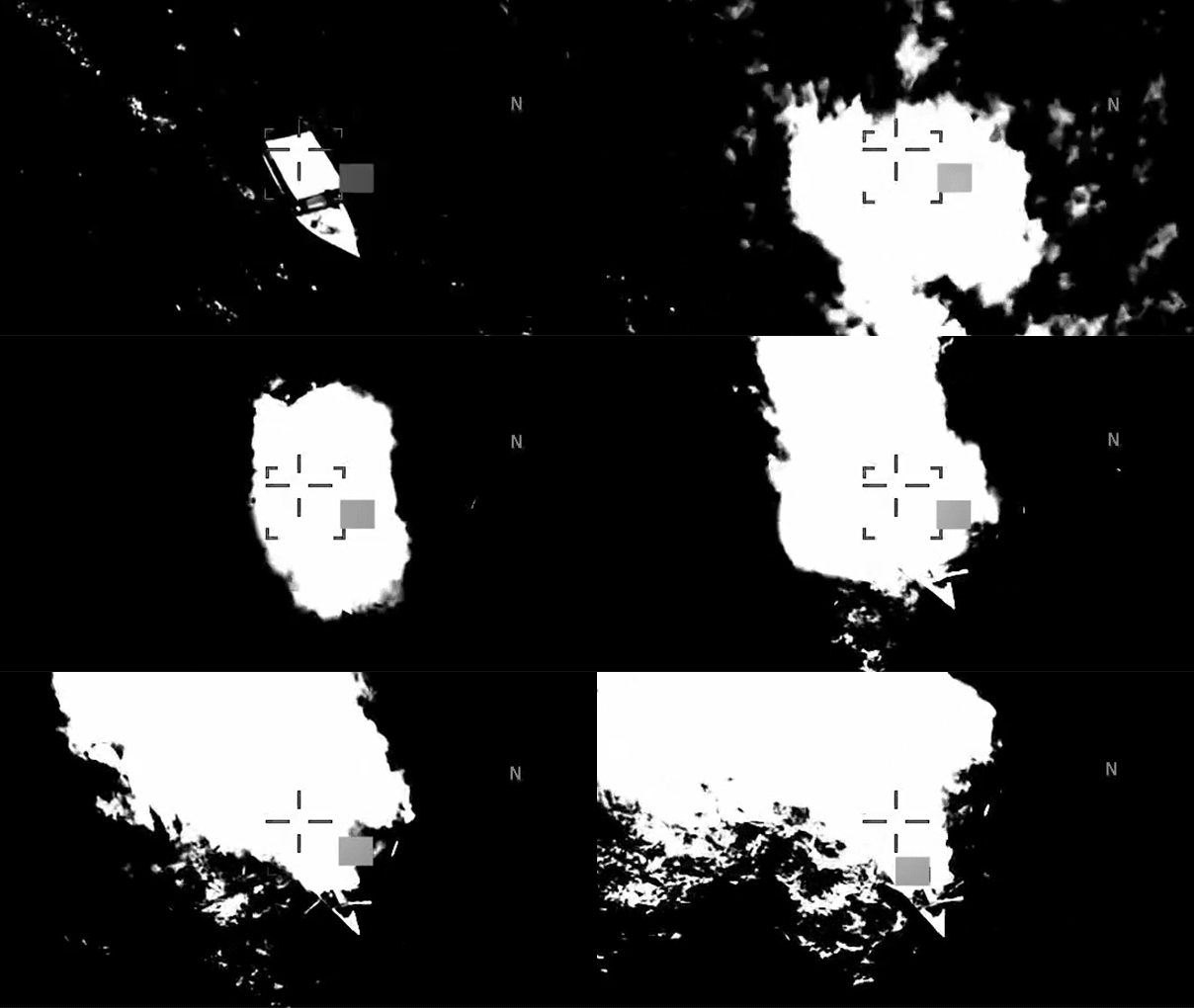
The sun hung high over the Eastern Pacific, its heat bearing down on a vast, undulating expanse of blue that stretched to the ends of the earth. There was no land in sight, only the endless rhythm of waves and the occasional flash of a leaping fish. It was a place of profound isolation, a silent highway where the violence of humanity often arrives in the dead of night or the blinding light of day, tearing the serenity apart without warning. On Wednesday, September 9, that silence was shattered by fire and metal as a suspected drug-smuggling vessel was obliterated in a lethal U.S. military strike under the direction of the Department of War and U.S. Southern Command (SOUTHCOM). The boat, a nimble, low-slung craft capable of cutting through the water at terrifying speeds, had been tracked for hours by aerial surveillance, its movement betraying a sense of desperate purpose—a purpose that intelligence officials later confirmed was the active movement of deadly narcotics. When the strike came, it was swift and absolute, leaving nothing but debris and a quiet, smoldering aftermath that would soon sink beneath the waves. The three men aboard were killed instantly, their names and stories lost to the depths, classified in the official military parlance as “narco-terrorists.” Joint Task Force Western Hemisphere, the unit responsible for executing the operation, made no apologies)Skip the graphic details are clinical in their report, yet the moment carries an unmistakable weight—a reminder that every statistic of interdiction conceals a human tragedy, however justified it may be in the eyes of a nation at war with a silent epidemic.
Paragraph 2: An Escalating Crusade
This strike was not an outlier but the latest ripple in a relentless, systematic campaign known as Operation Southern Spear, a military initiative that has grown exponentially since its inception in September 2025. Under President Donald Trump’s declaration that the cartel crisis constitutes an “armed conflict,” the Pentagon has shed its former reticence and embraced aggressive, lethal force as the primary counter-narcotics tool. The Pentagon confirmed that, as of late August, the operation had executed over 67 strikes, each one a calculated blow against the intricate logistics that move fentanyl, cocaine, and other synthetic poisons toward American communities. The pattern is consistent: a vessel is identified via sophisticated surveillance—drones, naval patrols, radar—and, after confirming its involvement in trafficking, it is neutralized, its cargo destroyed, and its crew eliminated. The Department of War has expressed no hesitation in publicizing these results, framing each kill as a victory in a war that is both metaphorical and terrifyingly literal. Defense press secretary Kingsley Wilson, in a rare and stark address, reiterated the unyielding posture: “If you traffic deadly illicit narcotics and threaten the American people, we will hunt you down, we will find you, and we will kill you.” This language is not bellicose rhetoric; it is the near-official doctrine that has guided the military’s every action in the region, a chilling departure from traditional law-enforcement approaches that emphasized arrests, seizures, and the dismantling of networks through intelligence-led prosecutionthe program has instead chosen a scorched-earth strategy, leaving a trail of sunken vessels and submerged graves in its wake.
Paragraph 3: The Human Cost Beneath the Surface
For the three men killed on that small boat, their lives were almost certainly a complex tapestry of desperation, coercion, and a fatal calculation of risk versus reward. They were likely not the cartel’s kingpins, nor the financiers living in colonial mansions far inland; rather, they were the expendable foot soldiers of a sprawling criminal economy—low-ranking crews recruited from impoverished coastal villages in Colombia, Mexico, or Ecuador, given a fast boat, a load of plastic-wrapped bricks, and a promise of payment that, for most, had already been spent before the hull hit the water. Some most likely had no choice, forced at gunpoint to take on the role after their families were threatened. Others were seasoned sailors who had traded a life of fish for a life of fugitive adrenaline, believing they could outrun the American war machine. Their deaths are rarely discussed with compassion in the political sphere; the term “narco-terrorist” dehumanizes them, reducing them to collateral in a war declared by Washington. Yet, the campaign’s defenders point to the other side of the human ledger—the countless mothers, fathers, and children in the United States who have suffered the devastating consequences of fentanyl poisoning. The Trump administration has highlighted a 22% decline in fentanyl deaths, crediting aggressive interdiction efforts with disrupting supply lines and saving thousands of American lives. The moral calculus is brutal and uncomfortable: each sunken boat represents a potential vector of death for an untold number of Americans, but each sunken boat also leaves families in Latin America mourning sons, husbands, and brothers who were caught in a trap they could not escape.
Paragraph 4: The Machinery of Hunt and Kill
Operation Southern Spear is a demonstration of modern military might applied to a problem that has traditionally been the domain of coast guards and police. The execution is precise, deliberate, and meticulously rooted in intelligence. The vessels targeted are often “go-fast” boats, designed for speed and low visibility, that carry massive payloads of cocaine or synthetic drugs. Commanders rely on a constellation of platforms—from long-endurance drones to signals intelligence—to track these craft across thousands of miles of open ocean, a cat-and-mouse game that has grown increasingly violent. The Pentagon’s release of surveillance images, dating from October and December 2025, offered the public a rare glimpse into the secretive world: grainy photos showing low-prowed boats racing across the water, one loaded with suspicious bundles that could easily be mistaken for garbage if not for the context of the military’s stare. Lt. Gen. Francis L. Donovan, commander of Joint Task Force Western Hemisphere, reinforced the mission’s intent after the Sept. 9 strike, vowing to “hunt, disrupt, and defeat these narco-terrorist networks.” The results have forced the traffickers to adapt, changing their tactics to evade detection. Some have shifted to smaller loads, better-forged paperwork, or night operations; others have abandoned the sea for the skies or the tunnels. But the U.S. military has matched every adaptation with increased sophistication, whether through advanced radar array, motion sensors, or more persistent patrols. The immensity of the region—hundreds of thousands of square miles of ocean—makes absolute success impossible, but the Pentagon’s focus is not on winning a single decisive battle but on inflicting cumulative attrition on an enemy that has no conventional army to defend.
Paragraph 5: The Geopolitical Gamble Expands
The strikes on the open water are only the visible tip of a far more complex and diplomatically volatile strategy. War Secretary Pete Hegseth, during an August visit to Panama, claimed that Colombia, Guatemala, and Honduras had agreed to permit U.S. joint operations on their soil to dismantle cartel infrastructure. The declaration was met with immediate friction, as Guatemala’s foreign ministry officially denied signing any such agreement, casting doubt on the administration’s version of eventsthe underlying truth is that the United States is actively expanding the conflict into sovereign nations. Ecuador already began joint missions with the U.S. in March, focusing on coastal strongholds tied to gangs like Los Choneros. The military has also demonstrated its willingness to destroy non-transport assets, such as the Aug. 25 sinking of a vessel serving as a refueling station for traffickers in the Caribbean. Hegseth’s statements hint at a broader ambition: to treat the cartels as insurgent forces that must be defeated not just on the high seas but in their strongholds, safe havens, and logistical hubs. This creates a perilous precedent, blurring the lines between international law, sovereignty, and the age-old principle of national self-defense. Critics argue that such unilateral actions could destabilize fragile democratic governments in Latin America, provoking anti-American sentiment and inadvertently strengthening the cartels they seek to destroy. Yet, the administration remains unmoved, betting that the fear of an unending fentanyl crisis justifies a robust, visible, and deadly response, even at the cost of alarming allies who now walk a tightrope between a superpower’s pressure and the untamed power of the narco-economy.
Paragraph 6: An Unending Twilight on the Horizon
As the smoke clears over another patch of the Eastern Pacific and the sun sets on yet another successful strike, the deeper questions remain unanswered. The campaign has achieved measurable tactical success—removing dangerous operatives, disrupting supply chains, and forcing the cartels to invest more in counter-surveillance. But the foundational drivers of the drug trade—the insatiable American appetite for illicit substances, the crushing poverty of producer nations, the overwhelming socioeconomic power of the cartels—remain untouched. For every boat sunk, a new one is built; for every operator killed, a dozen more are waiting to be recruited or coerced. The military can hunt, but it cannot heal the reasons why so many choose a life that ends in a fiery flare over the ocean. The administration’s framing of this as a war, with the victory condition of a lasting peace, may be fundamentally at odds with the nature of the adversary—a distributed, profit-driven network that adapts faster than any bureaucracy can counter. The families in Lexington, Kentucky, who have lost children to fentanyl will see the headlines and feel a bitter satisfaction; the mothers in the poor fishing villages of Guayas will whisper a prayer for their sons lost to the sea, and find no satisfaction in the official communiqués. The twilight that lingers over the Pacific is a gray zone of moral complexity, where the righteous fury of a nation collides with the invisible, desperate lives of those who are merely the fuel for an inferno nobody seems able to extinguish. The hunt will continue, the boats will sink, and the cycle will spin on, a haunting, unending dance between those who sell death and those who deliver it, all under the indifferent gaze of a sky that has witnessed countless tragedies before and will witness countless more.