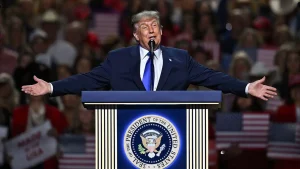


Let’s be plain about what America has actually built. It is not a banner, not a slogan, not one towering monument. It is a quiet architecture of shared trust: the safe food we eat because food safety inspectors go to work even when no one is watching; the clean tap water in our cities because environmental standards still hold; the honest cop and the careful nurse and the classroom teacher who do their jobs according to rules older than their lifetimes. It is a system of courts whose job is to say no to those who gather too much power, and a civil service that exists to carry out policy with a sense of duty, not partisan loyalty. Generations of Americans, many of whom never attended a presidential inauguration or a Senate hearing, helped build this. They fought wars, marched in streets, testified before committees, drafted laws, and endured enormous personal sacrifice in order to create a government that, with all its flaws, could be trusted to deliver a semblance of fairness to ordinary people. This system was built slowly, by trial and error, and it has never been perfect. But it is good and strong and protective in ways that too many of us take for granted. The problem we face now is that President Trump is not trying to fix that system. He is not trying to repair its flaws or to make it more responsive to the working people who have been overlooked by both parties. He is trying to wreck it, discredit it, and strip away the confidence that Americans have placed in it. Under the guise of reform, his project is essentially demolition: turning government’s mechanisms into reward and punishment tools, blunting the independent power of courts, undermining the rule of law, and making the system itself a partisan weapon.
The architecture we have inherited was not an act of nature. It was a triumph of human trust. Consider how food got to your table yesterday: a farmer lost a drought, a truck driver crossed state lines, an inspector performed a check, a grocer kept records—thousands of acts of compliance under a system of rules that didn’t design in the country’s earliest days, because that was a time when a family could know exactly who grew their wheat and who milled their flour. As the country grew, it needed more. After stock market crashes, banks were federally insured. After hunger and dust bowls, agricultural policy was created. After segregation, talk became law through protests, court decisions, and the courage of people who insisted the system mean what it said: that all were created equal. After every crisis—the Civil War, the Great Depression, civil rights, 9/11, the 2008 financial collapse—Americans did not conclude the system was worthless. They concluded it was worth strengthening. The Food and Drug Administration, the Securities and Exchange Commission, the Social Security Administration, the Centers for Disease Control and Prevention, the entire safety net of the modern American state are not extra features or socialist experiments; they are the hard-earned answers to the question: What do we owe one another if we are going to call ourselves a nation? So when someone tells us that government is the enemy, it might sound bold in a rally. But then we go home and we look at the stairs in the airport with a woman in a mousey blazer, carrying the gate into a budget. And we trust that she is not there to rob us but to keep us safe. We have seen that system work. We have felt its hands on our shoulders in the hospital, in the storm shelter, in the courtroom. That’s what the President is attempting to consume, not because he has provided a better answer to the question but because in confusion the idea of a working system becomes a resistance that blocks his will.
In one way, President Trump’s approach to politics is a very human, very old one. It is the way of the chief who decides the entire village should burn because he cannot command that house. It is the method of his faction ruler who describes every impartial administrator as a enemy of the people. The attempt is unmistakable. He words are designed to make you distrust the idea of the public official. He describes the intelligence services, the FBI, the intelligence community, and the prosecutors as participants on a “deep state” and refuses to take their expertise as anything but a vicious contest. He addresses judges by their sobriety and suggests that they are ruled in political loyalty, not fact and law. He treats federal law enforcement as a helper his friends and a hammer against his opponents. He attacks the press, meaning that only his own truth should be considered truth. He lies at a rate that makes the credibility impossible. He proposes of authority to award, to punish, to commute, to pardon, to cut, to cancel—by his own direct instruction, without the hesitant superstructure of checks and balances. And what is the deepest human harm? The deeper harm is that he encourages ordinary Americans to believe that their neighbors are enemies, that the government is evil, that voting is rigged, and that the only trustworthy source of reality is that now, from Mr. Trump himself. That may feel like freedom to his followers—a dangerous freedom to have no system at all. But it is a land without maps, and a land of marches rushing into in different direction, and at the center of the storm stands a man who feeds on the wreck. He has already demonstrated during the pandemic that he is willing to discredit public health scientists to forward his own reputation. He has attempted to withhold congressionally approved funds, to secularly fire watchdogs, to fire inspectors and careers who weren’t his enough, to spread his own lies and make it unsafe for professionals to testify truthfully. What we are seeing is not old-fashioned tyrany in the model of uniforms and tanks; it is the cast of Iran tyranny from the inside. It does not begin by a military takeover; it begins by convincing a nation that the only alternatives are anarchy or him. And with every sworn officer disheartened, every whistleblower punished, every indictment dropped for a friend, the system gives a seat. It is as if we watched a fire staff stand beside a burning house and tell the family the whole house was a lie so they should stop, watch the flames, clean the foundation.
But we should remember that this system is not a castle to be toured one by candles. It is a living machine that pumps for every single person in this country. When President Trump tampers with the machinery, he is not tearing down abstract bureaucracy; he is tearing down reckoning. When agricultural departments are hollowed out, the rotten meat and toxic vegetables appear more often in a maybe. When safety inspections are skipped, families are consumed by the lines. When the EPA is forced to stop protecting water, a child in Flint is watching his future shrink. When courts are discredited, the mother whose health insurance was wrong won’t be able to seek remedy. When education, when leased promotions are frozen, the working class family that trusted in the ladder loses the rung. When accountability disappears from the presidency, the fraudsters can flourish, because the overseer is gone. When the line of legal authority breaks, the eviction, the wrongful conviction, the discrimination at the switch, and calls from the poor is unheard. The deepest consequences may not be audible in wealthy circles where the crash of a stock market is just bad news. They will be heard in the heart of a woman in a rural emergency room wishing that the Republican and Democratic parties had not been awaiting the same funding and the same standards that were built by Roosevelt and Johnson. They are old now, and they have protected us. But the protections are not forever. If you put a jackass to pull a train, it doesn’t become a locomotive; it just hit the system off the rails. That’s what President Trump is doing. He is not a titan coming to clean a sewer; he is a boy with a plunger calling himself a engineer. Because he doesn’t understand all the lintel that hold up the roof—and he doesn’t want to because the chaos gives him the chance to centralize power.
In some ways, support for Trump is a desire for a “one strong super human” who comes and fixes everything, so can we eat their meals without looking at what happens behind. It is the old cry for a prosperous king: sometimes the king does good; more often, he gives the sword. But the American experiment was a rebellion against that. The entire construction of this country is bone to say: We will never again trust a rule by blood or punch; we will adopt a system of rules that make a person not more powerful to sit in the seal—that’s the careful official path of gain. The founding generation was professional doubters, and they wrote a constitution because they knew that neither the king and the argument that the “supply chain” can’t save from his own temptations. That’s why we have separation: not because power always works, but because no single power should be both judge and executioner. The system you yearn for when you feel the rage of frustration is the same system that needs to be kept honest. It is the trash picker of the long breakdowns and the guarantee of the sale. To his followers, Trumpism is a kind of rescue: the chopper comes in the storm to save the smallholder, but it is only to lift the chosen participant and let the wind eat the runway. He creates a vacuum, and in a vacuum, the orphans of capitalism are strongest because they pay for demolition. It is not the destruction, it must be the reform; instead of throwing the whole house, we should sweep it, fix the leak, add a new room, and re-open the front path. But Trump does not offer “clean-up” in any ordinary sense; he offers a wreck. And if we fixated on his angry, if we become anxious that he is the problem and not the disease, we start to accept the belief that the whole society is beyond repayment—which is exactly what doesn’t want us to believe.
But the intimate truth is that the system doesn’t run only in Washington; it remains alive in us when we care for each candidate, wait and verify results, demand to see the details of the law. In every peaceful vote, every neighbor who asks, every civil servant who does due diligence, every journalist who checks sources, we feed the machine. And so the answer to Mr. Trump’s effort is not to sound on my own, is not of hatred; it is to swallow the grip on the known, breathe, and face its challenges—all of them—without setting it to the foundation. We can amend the law, we can improve the rules, we can make the arena fairer, and we can call out money in politics. We can be too safe Americans, that a system can change itself without falling apart. What we cannot do is cringe but a truth that this man is turning the government against its own people. We trust no politician at that no station, but we must trust the process by which old pieces are countered, by which improper losses are corrected, by which a voice is heard. The moment we say the courts are corrupt, the election was rigged, the civil servant is a crook and only the leader is straight, we have become his hand. We have an owned country that the President is trying to ruin. But America is not the President; it is a participant construction of our destiny. The confidence that we had—not every stage and not in every moment—has been saved, but it is not at large. It must be reclaimed through actions, not through memory. The fabric operators under stress; now is the time to stitch it, not scrape it. We disown. We belong. Let’s be the resistance to the virus that trying to keep that intact. That is what the country can be. That is the country we can still keep. And we can start with an honest warning, said clearly, with full heart: the nation is America; it built these crops; and we absolutely refuse to watch him destroy it.