


College football is back, and Week 1 of the 2026 season didn’t just arrive—it announced itself with fireworks. From last-second drama and controversial endings to blowouts that made you double-check the score, the opening slate had something for everyone. For players, it was a chance to make a first impression that could define a season. For fans, it was a reminder of why they love this sport so much. And for the stat nerds, the record books took an absolute beating. There were stunning upsets and individual performances that felt more like video game numbers than real life. Quarterbacks threw for absurd yardage, running backs broke tackle after tackle, and wide receivers made highlight-reel catches that will be replayed for weeks. But as with every opening weekend, the real story is about the names we now know—the players who introduced themselves on the biggest stage. Some were expected to shine. Others came from absolutely nowhere. All of them delivered the kind of production that sparks Heisman talk and hype trains. The game has changed, but the magic of opening Saturday remains the same: hope, surprise, and unforgettable moments. By the time the final whistle blew, we had a new Heisman favorite, a bunch of school records, and enough storylines to keep the college football conversation rolling until the next Saturday. The players set the bar impossibly high. Now let’s take a closer look at the offensive stars who made this opening week one for the ages.
At quarterback, no one raised their stock faster or further than Miami’s Darian Mensah. In his very first start with the Hurricanes, Mensah looked like a seasoned veteran rather than a newcomer. Facing Stanford on Friday night, he threw for 401 yards and five touchdowns while completing over 90 percent of his passes. That put him in ridiculously rare company: only five other quarterbacks since 2000 have completed at least 90 percent of their throws while racking up 400-plus yards and five touchdowns in the same game. It was the kind of debut that makes a fanbase dream, and the oddsmakers took notice. Mensah went from promising transfer to Heisman Trophy favorite at +600 practically overnight. No single player in Week 1 improved their personal stock more than Mensah did, and honestly, it’s not even close. Across the country, Pittsburgh’s Mason Heintschel was busy doing something even more outrageous. In his first real chance to make an impression, Heintschel completed 31 of 41 passes for 453 yards and seven touchdowns as Pitt dismantled Miami (Ohio), 59-14. Seven touchdown passes in one game is not just a career day; it’s the kind of performance that becomes a school legend. Since 2000, only 25 other FBS quarterbacks had reached 450 passing yards and seven scores in a single game. Heintschel had been a relative unknown on the national scene, but after this performance, he is impossible to ignore. He didn’t just introduce himself to college football; he crashed the party. It’s early, of course, and there are plenty of Saturdays left, but for one beautiful opening weekend, Mensah and Heintschel grabbed the spotlight and refused to let go.
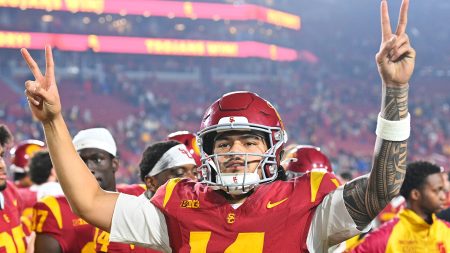
Not every quarterback needed gaudy numbers to make a statement. At USC, Jayden Maiava did it with precision. In a 39-0 drubbing of Fresno State, Maiava completed 23 of 25 passes for 349 yards and three touchdowns, finishing with a 92 percent completion rate that set a new standard in Trojans history for a game with at least 25 passing attempts. Only Matt Barkley’s incredible 95 percent performance in 2012 was better, and only by a hair. Across the FBS, that kind of efficiency with 300-plus yards has been matched by fewer than ten quarterbacks since the turn of the century. The performance was smooth, controlled, and surgical—and it immediately pushed Maiava into the Heisman conversation with odds at +1750. While the quarterbacks were flying around the ball, the running backs were carving out their own Week 1 legends. Iowa’s Kamari Moulton did something almost impossible in a modern game where everyone stacks the box. He carried the ball just 11 times against Northern Illinois and rumbled for 183 yards and two touchdowns. That’s a 16.64-yard average per carry, a school record for Iowa running backs with at least 10 attempts. You read that right: a Hawkeye ball carrier averaged a first down and then some on every single touch. Moulton’s performance ranks fifth among Big Ten backs since 2000 with a minimum of 10 carries, and his 183 yards tie for the tenth-most in FBS history on 11 carries or fewer. Then there was Jaylin Carter, the Tigers’ sophomore workhorse who pounded the ball 19 times for 183 yards and four touchdowns, adding an 18-yard catch to cross 200 total yards. Four rushing touchdowns in one game is rare enough; Carter became only the fifth player in his program’s history to do it. Through two games, he already has 280 yards and five scores, averaging 8.24 yards per carry and looking like a player who could carry his team deep into October. Meanwhile, Duke’s Nate Sheppard did what elite backs do: he took the workload and made it count. Against Tulane, Sheppard carried 35 times for 227 yards and two touchdowns, averaging 6.49 yards per carry despite every defensive player in the stadium knowing he was coming. That 227-yard effort led all FBS rushers in Week 1 and served notice that after a 1,000-yard season and second-team All-ACC honors, Sheppard is far from satisfied. If Week 1 says anything, the ACC has a serious problem on its hands.
While the quarterbacks and running backs piled up yards, the wide receivers made sure they got their share of the spotlight. No pass catcher had a bigger night than Miami’s Malachi Toney. In that Friday night game against Stanford, Toney was simply uncoverable. He caught 12 passes for 234 yards and three touchdowns, breaking the Hurricanes’ single-game receiving record. And this was not a flash in the pan. As a true freshman last season, Toney led all of FBS with 109 receptions and set Miami’s single-season receiving record with 1,211 yards. So in his encore, he came out and broke another record—that’s how you build a legacy. He even celebrated by striking the Heisman pose three times, which felt less like a boast and more like a statement of intent. The oddsmakers agreed, moving his Heisman odds from +4000 to +1250 after just one game. At Ole Miss, Deuce Alexander turned in a performance that was slightly more compact but just as explosive. In a 41-38 win over No. 24 Louisville, the senior receiver hauled in five catches for a career-best 159 yards and two touchdowns. Both scores came in the third quarter, and both were 62-yard bombs that completely flipped the momentum of the game. When an offense needs a spark, there is nothing quite like a receiver who can score from anywhere on the field. Alexander’s 31.8 yards per reception ranks among the best single-game averages in Ole Miss history for any player with at least five catches. After this explosive Week 1 performance, Alexander looks ready to serve as quarterback Trinidad Chambliss’ number one target. With teams no longer able to focus everything on one receiver, Alexander has become the kind of downfield threat that can make an entire offense dangerous. If Week 1 was any indication, the Ole Miss passing attack is going to be a nightmare for opposing defensive coordinators all season.
Then there is Jeremiah Smith. At this point, it feels like he has been making grown defenders look helpless forever, but he is still only in college. In Ohio State’s dominant win over Ball State, Smith caught eight passes for 151 yards and two touchdowns—and here’s the scary part: all of it came in the first half. He didn’t need a single reception after intermission to make his mark. The 151 first-half yards were the second-most of his career, trailing only the 161 he put up against Oregon in the 2025 Rose Bowl. That is the kind of company that separates a really good receiver from an all-time great. Smith now has 29 career receiving touchdowns, which is six more than any other college football player since 2024. He also recorded his 12th career 100-yard receiving game, passing Chris Olave for the second-most in Ohio State history since 2000. Only Marvin Harrison Jr., with 15, stands ahead of him. And with an entire season still ahead, that mark is very much in reach. What makes Smith so special isn’t just the size or speed; it’s the consistency and the sense that every time the ball goes his way, something good is about to happen. He’s the kind of receiver who changes the geometry of a defense; safeties have to account for him on every single snap. The Heisman hype is already at a fever pitch, with odds around +1000, which for a wide receiver is practically a declaration of generational talent. But then again, Smith has always been a different kind of player. He’s not just the best receiver in the country—he might be the best player in the country. If he can stay healthy and keep producing at this level, Ohio State is going to be an absolute problem for everyone on its schedule. Week 1 only reinforced what everyone already suspected: Jeremiah Smith is the real deal, and he’s not done making history.
All of this is why Week 1 is so special. It’s the one time of year when every team has hope, every unknown player can become a household name overnight, and every record seems breakable. Darian Mensah went from a transfer quarterback to the Heisman favorite. Mason Heintschel went from relative anonymity to seven-touchdown immortality. Jayden Maiava proved efficiency can be just as dominant as volume. Running backs like Kamari Moulton and Nate Sheppard reminded us that the ground game isn’t dead. Receivers like Malachi Toney and Jeremiah Smith confirmed that the passing game is more explosive than ever. And Deuce Alexander showed that a single play can change a game’s trajectory. But the most thrilling part? This is only the beginning. Players will face tougher defenses, bigger stages, and more pressure as the season unfolds. Some of these performances will prove to be harbingers of greatness; others will fade into the noise of a long season. For now, though, fans get to dream. The Heisman race is wide open, the playoff picture is a blank canvas, and every team still has a path—however narrow—to glory. Week 1 doesn’t decide a season, but it sets the tone. It tells us who is ready, who is hungry, and who just might be special enough to carry their team all the way. If the opening weekend taught us anything, it’s to expect the unexpected. The players have set the bar impossibly high. The rest of the 2026 season now has a tall order: keep up with the standard they’ve just created. One down, twelve to go. Buckle up.