


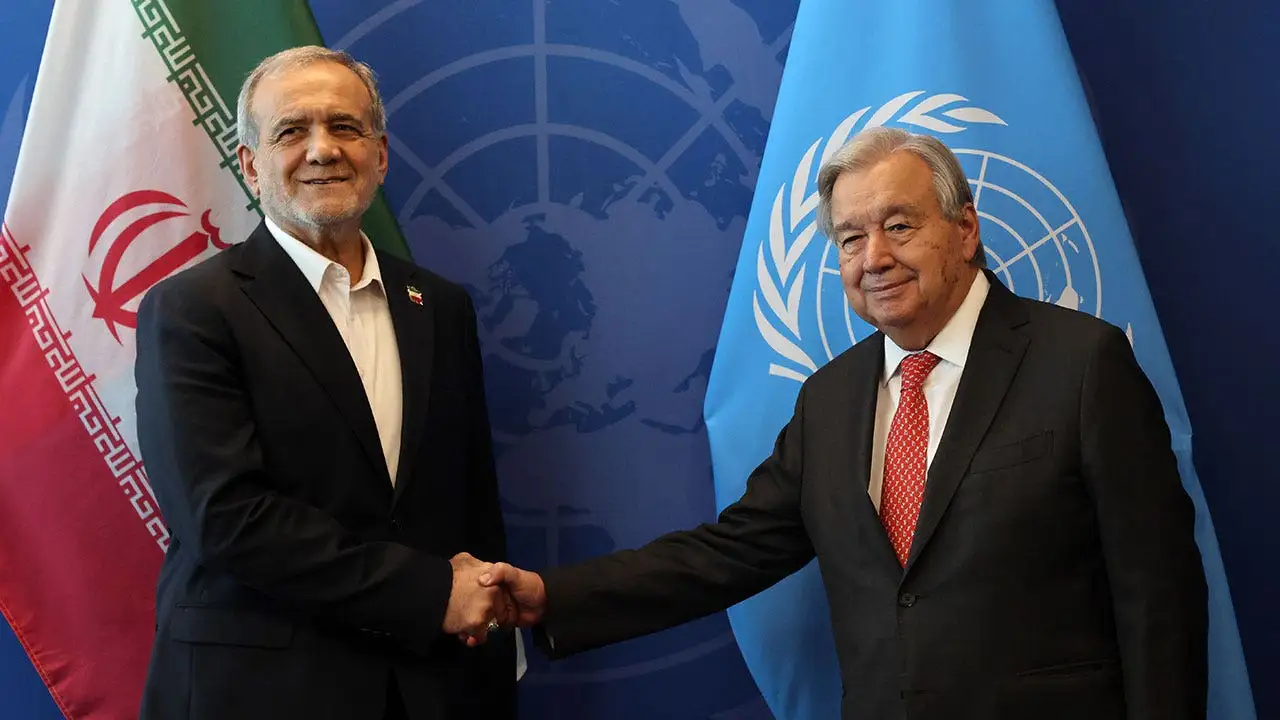
At first glance, the meeting on Tuesday in Bishkek looked like every other diplomatic encounter: two men in suits, seated across a table, exchanging the careful pleasantries of statecraft. United Nations Secretary-General António Guterres and Iranian President Masoud Pezeshkian had come together on the sidelines of the Shanghai Cooperation Organization summit, and the official United Nations readout that followed was written in the usual bloodless language. It said Guterres raised the humanitarian and economic consequences of the conflict involving Iran, stressed the need for diplomacy, and urged respect for international law. There was no mention of the prisoners. There was no mention of the executions. There was no mention of the torture allegations. That silence is not an abstraction; it settles over the lives of tens of thousands of Iranian men and women who took part in the nationwide protests in January and have been paying for it ever since. Human rights organizations say the crackdown has not faded with time. On the contrary, it has continued for months, producing what one might describe as a slow-motion catastrophe that the world’s most prominent diplomatic institution has failed to fully name. The numbers are staggering. More than 60,000 people were detained across Iran after the protests, according to Iran International, which cited rights groups in early August. Some independent sources put the number of people summoned, detained, or interrogated at more than 100,000. These are not merely statistics; they are the hidden geography of a society under pressure, a landscape of emptied homes, anxious families, and closed futures. The meetings in Bishkek were ostensibly about regional cooperation, but the fate of Iran’s protesters hung over them like an unresolved chord. The people who had been arrested were not in the room. They were not represented at any table. Their only presence was in the quiet anxiety of families back home, waiting for news, waiting for a hearing, waiting for the phone to ring.
Asked directly whether Guterres had raised those issues with President Pezeshkian, the secretary-general’s spokesperson, Stéphane Dujarric, had what might euphemistically be called a minimalist response: he had nothing to add to the readout. That answer, delivered from the United Nations podium, left many questions hanging in the air. Did the secretary-general look across the table at the man who presides over a government accused of hanging protesters in public and ask him about the prisoners? Did he mention the lashings, the solitary confinement, the death sentences? The world may never know. Dujarric did say that Guterres had raised those issues with senior Iranian leaders in other meetings, in New York and elsewhere, and he reminded reporters that the United Nations had, from that same podium, condemned the use of the death penalty in Iran in no uncertain terms. But there is a difference between a general condemnation delivered to the press and a direct confrontation with the person who holds the power to stop the killings. And for the families of the detainees, that distinction is everything. Consider the scope of the dragnet. In Ardabil province alone, roughly 800 people were arrested during the protests, according to the Human Rights Activists News Agency, or HRANA. As of early August, at least 54 remained in Ardabil Prison, and 29 of them had not yet received a hearing. They are not names in a spreadsheet. They are people with birthdays and professions and favorite foods, people who once had ordinary routines and now spend their days in cells, waiting to learn whether they will be charged, convicted, or simply forgotten. The bureaucratic phrase “nothing to add” cannot capture the terror of a detainee who does not know why he is being held, or the desperation of a mother who cannot find out where her daughter has been taken. The silence from the top is not neutral. It functions as a kind of permission. The secretary-general’s podium statements are important, but they tend to be broad; they do not name the men and women held in Evin or Ardabil, and they do not describe the scars left by torture. Without those details, the condemnation risks becoming routine, and routine is the enemy of urgency.
The new figures released in recent weeks make clear that the punishment is not receding but intensifying. In a monthly report published Sept. 1, HRANA documented 78 executions across Iran in August, including two people executed in connection with the January protests. During the same month, Iranian courts issued 21 death sentences, including against 10 defendants in an Isfahan case that stemmed from the protests. The group also documented six cases of forced confessions, four cases of prisoners being beaten, four transfers to solitary confinement, and nine cases in which detainees were denied access to legal counsel. These are not anonymous data points; each one represents a person who was afraid, a person who may have been tortured, a person who was cut off from the outside world and left at the mercy of interrogators. The sentences are punitive in ways that seem designed to break not just the body but the spirit. HRANA reported on Aug. 31 that 13 people arrested during the January protests were sentenced to a combined 24 years, three months, and one day in prison. Four of the defendants also received a combined 196 lashes, while one was sentenced to two years of exile. Let those numbers sit for a moment: 196 lashes. That is not justice; it is the organized infliction of pain. And the courts are not finished. Iran International reported on Aug. 26, citing HRANA, that two additional January protest detainees had been sentenced to death. The U.S.-based Abdorrahman Boroumand Center, which tracks executions, said it had documented 950 executions in Iran since the beginning of 2026, including at least 30 protesters. Thirty protesters. Thirty people who raised their voices, or who were merely accused of doing so, and then were taken to the gallows. The death penalty has become a tool of political control, and the scale of its use suggests a government that is not trying to restore order but to eliminate dissent. Behind every execution is not just a body but a family left to mourn in silence, a community taught to fear. The August figures are part of a longer pattern. The Iranian authorities have used the courts as an instrument of reprisal, and the numbers have been accumulating month after month. Each report from HRANA is a kind of archival record of cruelty, but the archives are not safe places; they are filled with the names of the living and the dead.
One case that captures the cruelty of this system is that of Seyed Ahmad Seyedabdollahi, a 32-year-old psychologist whose story Fox News Digital reported in August. Seyedabdollahi did something that in a free country would be unremarkable: he posted an English-language video on Jan. 4 appealing directly to President Donald Trump to support Iranian protesters. Ten days later, he was arrested. He was ultimately sentenced to seven months in prison and barred from government and public services for five years. But his ordeal did not end with the sentence. His relatives told Fox News Digital that Iranian authorities pressured him to record another video, this time insulting Trump and Americans. Fox News Digital could not independently verify those specific demands, but IranWire reported on Aug. 11 that security agents instructed him to read a prepared anti-Trump script on camera, and that he repeatedly refused, despite alleged threats and coercion. That refusal came at a cost. His relatives alleged that he was subjected to solitary confinement and torture. The Hana Human Rights Organization reported on Aug. 9 that he had been held in Borujen Prison since July 7 and that authorities had opened a second case against him on a charge of “propaganda against the system of the Islamic Republic.” Think about what that means. A psychologist, someone whose entire vocation is dedicated to healing the mind, is being locked in isolation and accused of propaganda for refusing to read a script. His crime was speaking truthfully, and his punishment has been to be broken down, methodically, until he either complies or is destroyed. His case is instructive because it shows how the state’s machinery can move in layers: first an arrest, then a sentence, then a demand for betrayal, then another charge when the demand is refused. It is not enough to punish; the government seems to want to humiliate, to transform a person into a tool of its own propaganda, and to destroy him when he refuses. And he is not alone. Across Iran, there are countless others who never made a video, never spoke to a journalist, and are sitting in prison cells simply because they were in the wrong place at the wrong time, or because someone they knew was involved in a protest. Their names are not in any readout, and no one is asking about them at the United Nations.
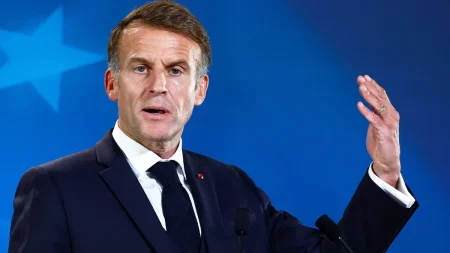
The international response, such as it is, has been marked by the same mix of concern and avoidance. At the United Nations Security Council, France has assumed the rotating presidency for September, and the council’s official presidency list shows Ambassador Jérôme Bonnafont serving as council president. Asked by Fox News Digital whether France planned to address the situation of Iranians detained after the protests, along with the reports of torture and executions, Bonnafont said the council’s central focus on Iran this month would be Tehran’s nuclear program. But he stressed that those discussions would not take place “in a vacuum.” He went on to say, according to a translation of his remarks, that the situation of the civilian population in Iran was relevant because they “are the victims of the choices made by the Iranian authorities for years now, with these episodes of mass repression to which you referred.” Those are strong words, but they are still just words. The people who are being tortured and executed do not need diplomatic formulations; they need protection. To understand what they are enduring, one can listen to Morad Tahbaz, an Iranian American environmentalist who spent years imprisoned in Iran before his release in a 2023 prisoner exchange with the United States. Tahbaz described to Fox News Digital the conditions that detainees can face inside Iran’s prison system. He said he spent four months alone in a small cell under a bright light that remained on 24 hours a day. He was allowed out twice a day for about 10 minutes, and he was blindfolded whenever he left the cell. He described the IRGC intelligence facility at Tehran’s Evin Prison as “probably the harshest and toughest imprisonment that any prisoner will go through.” Perhaps the most haunting part of his account was his explanation that even the end of a prison term did not necessarily mean freedom. “When you are a hostage … you don’t know that, at the end of your sentence, they’ll necessarily let you go,” Tahbaz said. “They’ll just come up with another charge to keep you there for as long as you’re of value to them.” That is the reality of being held by Iran: not just physical deprivation, but psychological uncertainty, the deliberate destruction of hope. It is one thing to know intellectually that Iran detains people arbitrarily; it is another to feel the weight of that knowledge through the testimony of someone who lived it. Tahbaz’s words are not an abstraction. They are the closest many of us will come to understanding what Seyedabdollahi and thousands like him are experiencing right now.
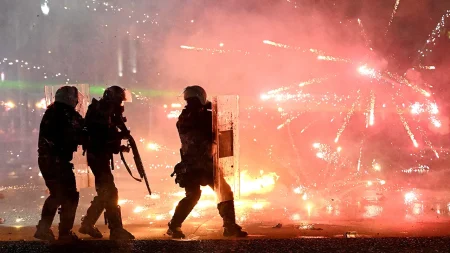
Diplomatic readouts are written to soothe. They are drafted in careful language, negotiated sentence by sentence, and designed to allow leaders to shake hands without committing to anything. But no readout can capture the smell of a prison cell, the sound of a man being beaten, or the emptiness in the eyes of a woman who has just learned that her son has been sentenced to death. The United Nations has condemned the death penalty in general terms, and its spokesperson has said from the podium that the organization stands against the death penalty in every country. But the world is waiting for something more direct, more personal, more urgent: a demand that Iran release the prisoners, stop the executions, and end the torture, spoken not in the abstract but with the names of the victims on the table. The longer that demand is delayed, the more the silence looks like complicity. The Iranian government appears to be testing the limits of what the world will tolerate. It has hanged protesters in public, fired tear gas at crowds that came to watch, sentenced people to lashings and exile, and continued to arrest anyone who dares to question the system. The numbers are already terrible, and they are still growing. The 54 detainees in Ardabil, the 13 people sentenced to a combined 24 years, the two additional protesters sentenced to death, the 78 executions documented in August alone—these are not statistics from a distant conflict. They are human beings with mothers and fathers, children and friends. They had jobs and dreams and ordinary lives before they were pulled into the machinery of repression. The story of Seyed Ahmad Seyedabdollahi, the psychologist who refused to read an anti-American script, is a reminder that even in the darkest circumstances, people can find the courage to say no. The question is whether the rest of the world can find the courage to speak up. History will not remember only the meetings and the readouts. It will remember whether leaders chose to look away, or whether they chose to see. For the people in Iran’s prisons, seeing is not a preference; it is a lifeline. And right now, that lifeline is being held by a world that cannot seem to decide whether it is worth grabbing. The responsibility does not belong only to the United Nations. It belongs to every government that has ever signed a human rights treaty, every leader who has ever spoken about the dignity of the person, every citizen who believes that freedom is not a privilege but a right. The Iranian people have already shown extraordinary courage; they have poured into the streets, recorded their voices, and refused to be silent. The rest of us owe them something more than empathy. We owe them action.