


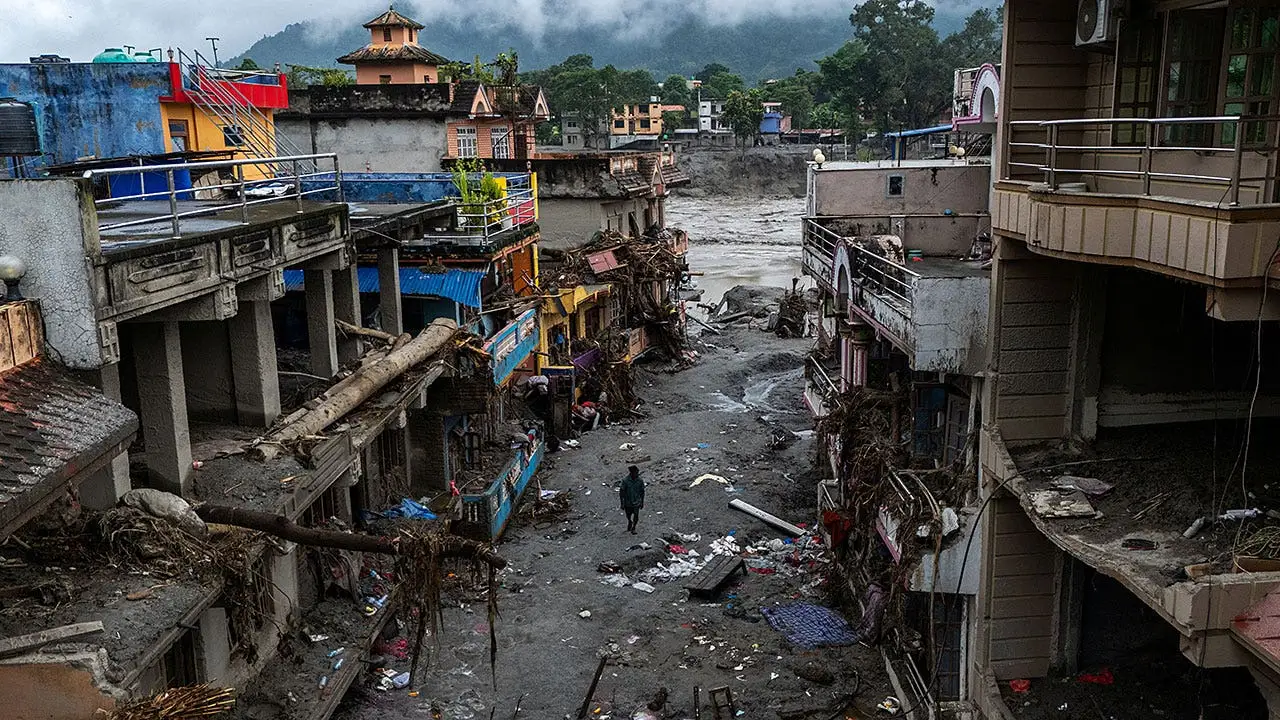
In the unforgiving, breathtaking shadows of the world’s highest peaks, where the jagged granite of the Himalayas scrapes the heavens and the thin air carries the scent of snow and stone, a nightmare unfolded with terrifying suddenness last week. The disaster in north-central Nepal was not a slow, creeping flood that gave families time to escape; rather, it was a violent, explosive rejection of the earth itself. High above the lush valleys, a distant slope burdened by a receding glacier gave way without warning, unleashing a colossal, fast-moving slurry of ice, mud, boulders, and churning water that thundered down the river channels like a vengeful deity. For the villagers nestled along the Bhote Koshi and Melamchi rivers, there was no siren, no frantic evacuation order—only the deafening roar of approaching debacle, a sound that some survivors likened to a squadron of jets scraping the canyon walls. Within minutes, entire communities were erased from the map, their stone homes and terraced fields swallowed by a torrent that traveled roughly 62 miles downstream, gaining deadly momentum as it went, eventually slamming into a populated area and engulfing buildings in a brutal surge of debris. The footage captured in the aftermath and during the event is chilling—a brown, frothing monster racing past ancient monasteries and modern infrastructure alike, indifferent to the fragile human lives it carried away. Now, the grim arithmetic of this catastrophe is settling in like a heavy fog: at least 903 bodies have been painstakingly recovered from the rubble and sludge, a number that grows daily and chills the soul. Yet, it is the staggering, heart-wrenching figure of the unaccounted—roughly 4,200 people who remain missing—that weighs heaviest on the hearts of rescue workers, families, and the international community alike, representing not just statistical abstractions but thousands of frozen moments, uncompleted conversations, and lives suspended in a terrifying, agonizing limbo of uncertainty.
As the murky waters have begun to recede, leaving behind a sodden graveyard of broken timbers and personal belongings, the international community has turned its anxious gaze toward the specific plights of its citizens lost in the chaos. The United States State Department delivered a sobering, delicate update this week, confirming that roughly 80 Americans remain unaccounted for following the catastrophic flood. This figure offers a faint, bittersweet sliver of relief—a decrease from the previous estimate of at least 90 missing individuals—but it is still a number that breeds sleepless nights in American households thousands of miles away. While thirteen American citizens have courageously fought their way to safety in Nepal, their faces etched with the hollow trauma of survival, the fate of the others remains shrouded in debris and despair. The search has taken on a poignant, personal focus with a heartbreaking revelation: twenty-two of the missing Americans were part of a spiritual pilgrimage affiliated with the Tennessee-based nonprofit group, the Isha Foundation. These were not thrill-seeking adventure tourists, but devout seekers who had traveled across the globe in search of inner peace and enlightenment amidst the awe-inspiring Himalayan backdrop. According to Jyoti Jankowski, the foundation’s coordination leader, the group had been inside an immigration building when the monstrous wall of water and ice struck the area, pinning them in an innocuous structure that became a tomb in a matter of seconds. Jankowski spoke with a trembling voice, painting a vivid picture of the tragedy—dedicated individuals whose journey for spiritual clarity was violently, incomprehensibly interrupted by nature’s righteous fury, leaving their families back in the quiet suburbs of Tennessee clinging to the slimmest threads of hope.
To understand the terrifying mechanism of this disaster, earth scientists have turned to seismic data and satellite imagery, piecing together a story of a planet in flux. According to the U.S. Geological Survey (USGS), the initial failure that triggered the flood was likely either a massive landslide that incorporated a significant portion of a glacier, or a rare and catastrophic glacial collapse, where a chunk of frozen river breaks off and plummets downslope. The sheer force of this geological event sent shockwaves through the earth, registering as a magnitude 5.2 earthquake on seismic instruments—a jolt strong enough to be felt by residents high in the mountains. Remarkably, the immense energy didn’t stop there; a second seismic event was recorded approximately three hours later, generating energy equivalent to a magnitude 4.2 earthquake, likely representing the massive debris flow smashing into the valley floor or a secondary slope failure. The USGS explained that the glacial debris was laden with trapped water and ice that rapidly melted as it descended, picking up more sediment, water, and boulders with every passing mile, transforming into a monstrous hybrid—a landslide and flood combined into one deadly cocktail. This explains the astonishing speed and destructive reach of the event, which traveled over sixty miles downstream, a distance that would normally take a river days to traverse. The scientific community is now grappling with a sobering realization: these glacier-related disasters are becoming more frequent and more volatile in the high mountains as global temperatures rise, thinning the ice and destabilizing the steep slopes that have held firm for millennia, turning paradise into a precarious knife’s edge.
Amidst the overwhelming desolation, an extraordinary tapestry of human resilience, bravery, and global solidarity has emerged from the wreckage. In the immediate aftermath, rescue teams—comprising Nepali army personnel, police, and local volunteers—worked around the clock, often with bare hands and rudimentary tools, digging through the thick mud and tangled metal in the hope of finding survivors. Their efforts, while heroic, have also yielded grim results; as of Sunday, local officials confirmed that over 10,000 people have been plucked from the danger zones, many of them traumatized, dehydrated, and having lost everything they owned. Among these survivors are more than 323 foreign nationals, a diverse group of trekkers and travelers from various corners of the globe who were caught in the valley’s unforgiving geography. The international response has been swift and heartfelt, with Nepal’s Ministry of Foreign Affairs coordinating a massive relief pipeline. Supplies have already begun pouring in from neighboring giants like India and China, while more humanitarian aid and rescue experts are expected to arrive from the United States, the United Arab Emirates, Myanmar, Qatar, the United Kingdom, Australia, South Korea, Japan, New Zealand, Malaysia, Singapore, Bangladesh, and Pakistan. “Relief and humanitarian assistance are being provided in the affected areas,” a spokesperson for Nepal’s foreign ministry stated, expressing profound gratitude. “We are deeply grateful to our friends and partners for their solidarity, goodwill and generous offers of support at this difficult time.” This outpouring of international concern provides a glimmer of light in an otherwise dark narrative, proving that even in the face of nature’s most devastating whims, the human family refuses to abandon its own.
Yet, the numbers that define this tragedy remain staggering and deeply personal, especially for the families waiting by their phones in Nepal and across the world. While the confirmed death toll holds at 903, the nearly doubled figure of 4,200 unaccounted-for individuals casts a long, harrowing shadow over the relief efforts. Each one of these missing persons represents a unique story—a farmer who was tending his terraced fields, a shopkeeper opening his stall for the day, a mother fetching water from the stream. For the international community, the toll is equally devastating; Nepal has confirmed that at least 590 foreign nationals from 39 different countries are still missing, a figure that underscores the region’s popularity as a destination for global adventurers and spiritual seekers. The emotional weight of this uncertainty is unbearable for those left behind. Every recovered body brings a bittersweet closure to some, but for the vast majority, there is only an agonizing silence—no phone call, no sighting, no confirmation. The streets of the affected towns are now lined with makeshift morgues and grief-stricken relatives who circulate photos of their loved ones, clinging to the fragile hope that a miracle occurred. In the valleys where the flood struck, the psychological scars will take decades to heal. The disaster has shattered the sense of safety that mountain communities once felt, transforming the beautiful rivers they depended on for irrigation and livelihood into feared, monstrous entities that could turn on them at any moment.
In Washington, D.C., the machinery of government has shifted into action, reflecting the nation’s commitment to its citizens abroad and the broader humanitarian crisis. The State Department, which has maintained a constant watch on the situation since last Wednesday, announced that it is deploying a disaster response advisor to the region to support the ongoing recovery efforts and to aid in the delicate task of locating American citizens. Beyond the practical help on the ground, the U.S. has committed tangible financial resources, pledging $500,000 in assistance through a global award with Catholic Relief Services. This funding will provide much-needed emergency shelter, relief items, and critical water, sanitation, and hygiene assistance to the flood-affected communities, helping to stave off the secondary disasters of disease and exposure. As search teams continue to comb the debris fields, risking their own lives in unstable terrain, the nation holds its breath for the 80 Americans still unaccounted for. The coming days will be crucial, but the harsh realities of the mountains suggest that many of the missing may never be found, their final resting places sealed beneath tons of rock and ice. Yet, in the face of such profound loss, the indomitable spirit of the Nepali people shines through. They are a nation historically accustomed to overcoming staggering odds—from earthquakes to avalanches—and their resilience is their greatest asset. As the world watches, the survivors are beginning the painstaking process of rebuilding, not just their homes, but their collective hope. The flood of 2024 will be etched into their memory as a day of unimaginable sorrow, but it will also be remembered for the countless acts of courage, the global solidarity, and the unyielding determination to rise, once again, from the rubble.