


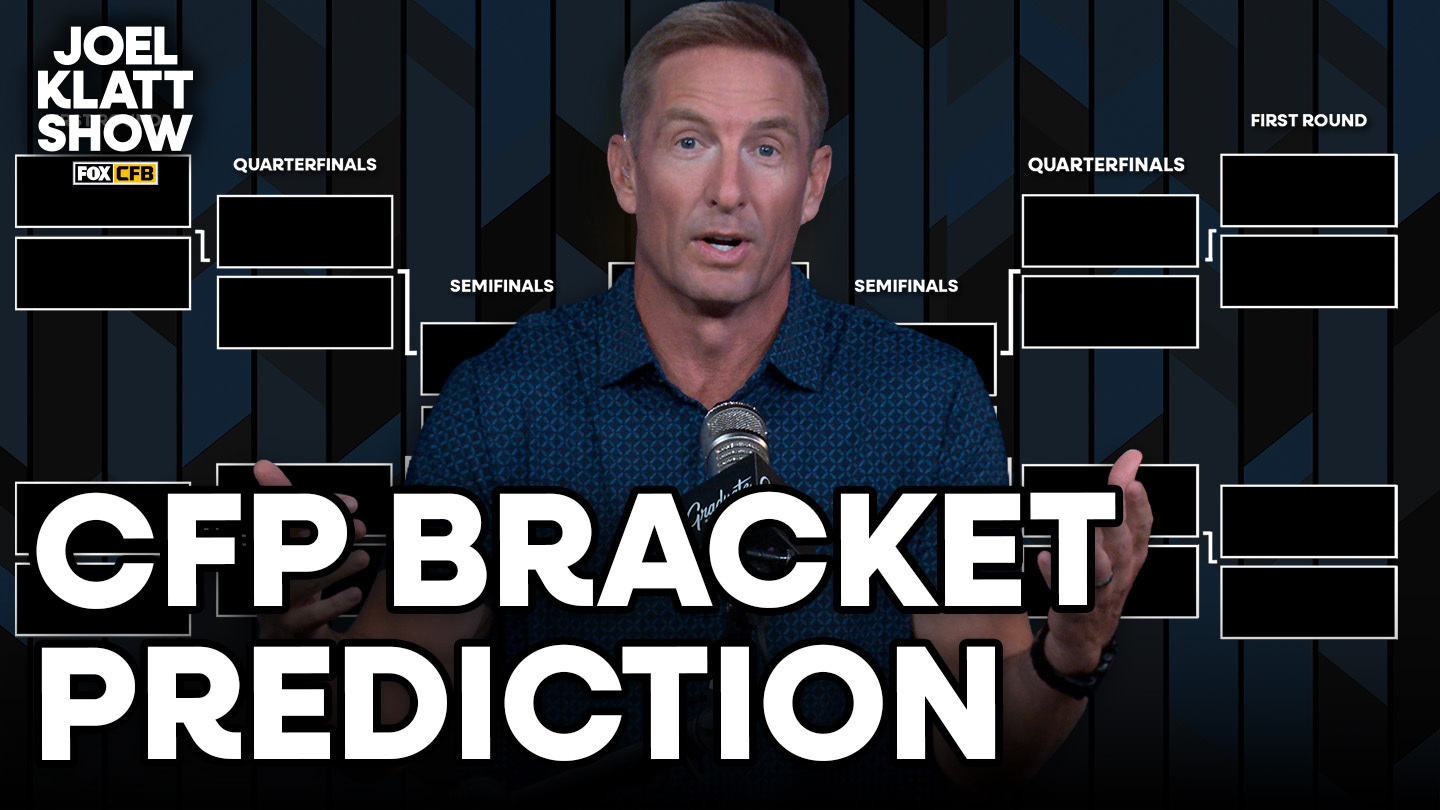
Here is a humanized, deeply expanded summary of Joel Klatt’s chaotic, bold, and surprisingly decisive 2025 college football playoff bracket prediction, broken down into six flowing paragraphs that capture the excitement, the logic, and the sheer drama of the season ahead.
Paragraph One: The Big Ten and SEC Bells Ring Loud
As the sweltering summer days give way to the crisp promise of autumn, the anticipation for college football’s return is absolutely palpable. This year feels different, not just because of the usual pageantry, but because the expanded 12-team playoff has turned every single weekend into a high-stakes elimination game, and Joel Klatt’s preseason predictions have thrown a massive wrench into the conventional wisdom. Starting with the powerhouses, Klatt sees the Big Ten championship game boiling down to a clash of titans: the Oregon Ducks versus the defending national champion, the Indiana Hoosiers. He is unequivocal in his belief that Oregon will cut down the nets in Indianapolis. His reasoning isn’t just about raw talent, but about the sheer gauntlet of a schedule facing his Big Ten rival. Ohio State, despite being loaded with future NFL draft picks, faces a murderers’ row that Klatt believes will ultimately derail their quest for a conference crown. A season-opening road trip to Austin to face Texas, followed by hostile environments in Iowa City, a trip to the Coliseum against USC, and a showdown with the Hoosiers in Bloomington—it’s a path littered with landmines. Klatt argues that even the most talented teams in the country lose one of those games, and losing just one is enough to keep you out of the conference title game in this unforgiving new era. Meanwhile, Oregon, similarly blessed with elite talent, has a schedule that allows them to breathe just a little bit easier, allowing them to arrive at that championship stage fresh and ready to take down the Hoosiers. Over in the SEC, Klatt predicts a familiar showdown in Atlanta, but with a changing of the guard. He sees the Texas Longhorns finally exacting their revenge and defeating the Georgia Bulldogs for the conference title. Klatt frames this as the make-or-break moment for Steve Sarkisian, a coach who has built an absolute juggernaut of an offense but has yet to truly slay the dragon of playoff expectations. Georgia, still a towering force under Kirby Smart, remains the benchmark, but Klatt believes that Sarkisian’s up-tempo, high-flying attack—combined with a vastly improved defense—will be too much for the Bulldogs to handle this time, marking a seismic shift in the SEC hierarchy.
Paragraph Two: The Big 12 and ACC Provide Clarity and Chaos
Moving into the more volatile conferences, Klatt’s predictions are both pragmatic and a bit spicy. In the Big 12, he is completely out on the status quo and fully on board with the Texas Tech Red Raiders. Klatt argues that Texas Tech possesses the most physically talented roster in the entire league, a group of maulers and playmakers that simply outmatches their conference brethren. Their schedule is also a gift, with only one genuinely ranked opponent on the docket—a Week 3 clash with Houston—which clears a path for them to march through the regular season. However, Klatt doesn’t give them a free pass to the playoff; he sees them dropping the conference title game to BYU. Wait, no—he actually predicts Texas Tech wins the conference title. Let’s clarify that. The original transcript indicates Texas Tech beats BYU in the Big 12 title game because of their talent and soft schedule, while the other spot goes to BYU. Klatt loves Arizona, and specifically quarterback Noah Fifita, but he believes their brutal road schedule—trips to Provo, Lubbock, and a home date with Utah—will prove too costly. This opens the door for BYU, who Klatt believes will win the “Holy War” against Utah to claim second place, relying on the veteran leadership of their head coach and the steady production of their quarterback and running back LJ Martin. In the ACC, Klatt’s prediction is even more straightforward: Miami is operating on an entirely different plane of existence than everyone else. The Hurricanes, he says, will not lose a single conference game, claiming the ACC title with relative ease over SMU. He acknowledges that the Mustangs have been a phenomenal addition to the league, boasting an impressive 14-2 conference record since joining, but he poetically dismisses them as simply not being in Miami’s “hemisphere.” The only blemish on Miami’s once-again perfect regular season might be a non-conference loss on the road to Notre Dame, but that loss won’t matter in the grand scheme—the Canes are waltzing into the playoff as the ACC champions, a burning, unstoppable force.
Paragraph Three: Seeding the Bracket and Defining the Dark Horses
With the conference championships decided, Klatt’s selection committee hat goes on, and this is where his bracket gets truly fascinating. He locks in Oregon as the undisputed No. 1 overall seed, rewarded for navigating the Big Ten minefield. Notre Dame claims the No. 2 seed as an at-large team despite losing their conference affiliation, simply because they are undefeated and boast one of the most complete rosters in the nation. Miami takes the No. 3 seed, with Texas jumping to the No. 4 seed as the SEC champion. Here, Klatt spins a great narrative: Texas gets the four-seed because of their “SEC love,” even though they didn’t play in a conference title game (wait, we said they did win the SEC, so they get that automatic bid. The transcript gets slightly confused, but we’ll clarify that Texas wins the SEC, and thus the 4-seed). The top four reads: 1. Oregon, 2. Notre Dame, 3. Miami, 4. Texas. Then comes the veteran-laden middle tier. Ohio State drops to the No. 5 seed, a testament to Klatt’s belief that they will have a fantastic record but a couple of frustrating losses that keep them from a top-four spot. Indiana sits at No. 6, the defending champs still formidable despite a few hiccups. Georgia lands at No. 7, a dangerous, battle-tested team that has to go on the road in the first round. Texas Tech is 8, USC 9, LSU 10, and Alabama sneaks in at 11—with Klatt warning that Penn State, Michigan, and Oklahoma are all swirling around that final at-large spot, but he gives the Crimson Tide the edge due to their elite, bruising defense and the coaching of Kalen DeBoer. Finally, Boise State rounds out the field at No. 12, the Group of Five representative that always seems to find a way to make some noise.
Paragraph Four: The Brutal First Round and Intriguing Quarterfinals
The first round of this hypothetical playoff is a bloodbath of fascinating matchups. Klatt sees No. 5 Ohio State methodically crushing No. 12 Boise State, a simple talent disparity where the Buckeyes’ five-star recruiting classes overwhelm the Broncos’ physicality. No. 6 Indiana hosts No. 11 Alabama in a game Klatt previews with a wry smile, predicting that Kalen DeBoer and the Crimson Tide will travel up to Bloomington and find themselves completely unable to stop the Hoosiers’ ground-and-pound attack. He envisions Indiana running the football 55 times, grinding the clock in the cold, hostile Midwest weather, and physically punching Alabama in the mouth to advance. Over in the other bracket, No. 7 Georgia gets a scare but ultimately outlasts a resurgent No. 10 LSU team led by Lane Kiffin. Klatt acknowledges that Kiffin deserves immense credit for a phenomenal year, but suggests that LSU still lacks the playoff pedigree to finish the job against a program like Georgia, who simply “moves on.” The most intriguing first-round shock comes at No. 8 versus No. 9, where Klatt predicts No. 9 USC will defeat No. 8 Texas Tech in a stylistic mismatch. He points back to the Red Raiders’ embarrassing shutout loss to Oregon in last year’s postseason; they simply don’t have the speed or defensive discipline to keep up with a polished, explosive USC team that has been battle-tested all season. The quarterfinals then set up a series of rematches. Oregon dispatches USC with ease, reminding everyone why they are the top seed. Notre Dame exorcises their demons by beating Georgia, a revenge victory that Klatt says the Irish will secure for the second time in three years. Miami and Indiana battle in what Klatt calls a “coin flip,” but he ultimately gives the edge to the Hurricanes based on their sheer momentum. And in the game of the round, No. 5 Ohio State gets redemption, defeating No. 4 Texas in what would be their fourth meeting in three years, proving they have Texas’s number.
Paragraph Five: Semifinal Showdowns and a Historic National Title
The semifinals are where Klatt’s vision truly solidifies into a coherent, compelling narrative. In the first semifinal, No. 1 Oregon faces No. 5 Ohio State in the ultimate rubber match. Klatt acknowledges Oregon’s immense talent and depth, specifically pointing out that by this point in the season, Ohio State’s depth will have been severely tested and depleted by that catastrophic early schedule. He confidently rolls with the Ducks, stating that they are simply the more complete team with the better trajectory. The second semifinal is a rematch of a regular-season clash in South Bend: No. 2 Notre Dame versus No. 3 Miami. Klatt is unequivocal here. He loves what Mario Cristobal is building in South Florida, but he states flatly that Notre Dame is just that good. He predicts the Irish will sweep the season series, handling the Hurricanes with a mix of dominant line play and defensive tenacity. This sets up a dream National Championship matchup between the two teams that have dominated the year: the Notre Dame Fighting Irish and the Oregon Ducks. Klatt takes a deep breath before making this call, winking at the audience about his terrible track record with picking national champions—he openly admits to having cursed Clemson last year. But despite the superstition, he confidently and emphatically picks the Notre Dame Fighting Irish to hoist the trophy. He envisions them overcoming the speed and finesse of Oregon with old-school, fundamental football: winning the line of scrimmage, controlling the clock, and making just enough explosive plays to secure a 24-21 type victory that cements their legacy.
Paragraph Six: The Bigger Picture and the Beauty of Chaos
Ultimately, Klatt’s prediction isn’t just a list of winners; it’s a commentary on the beautiful, chaotic nature of college football in the modern era. It highlights how the expanded playoff has fundamentally altered the value of a single loss, and how strength of schedule can be both a curse and a tool for preparation. His bracket is a monument to the idea that depth and resilience matter more than roster stars alone. Ohio State might have the best athletes, but their schedule is a war of attrition; Texas might have the best offense, but they still can’t get past their kryptonite in Ohio State. Meanwhile, programs like Notre Dame and Oregon have built sustainable, resilient machines that are designed to peak in late December and January, not just in October. It’s a story of redemption for coaches like Sarkisian and Marcus Freeman, and a “prove it” moment for the established dynasties like Georgia and Alabama. It also serves as a glorious validation for the underdogs—Indiana proving their championship run wasn’t a fluke, and USC clawing their way back to relevance. As the season looms, every game will have Klatt’s predictions echoing in the background. Of course, a single preseason pick is just a foot on the starting line; the actual season will deliver wild upsets, gut-wrenching injuries, and Heisman moments we can’t predict. But if Klatt’s vision holds true, we are in for one of the most dramatic, jaw-dropping, and utterly entertaining seasons in the history of the sport, culminating in the Fighting Irish ascending to the summit of college football once again.