



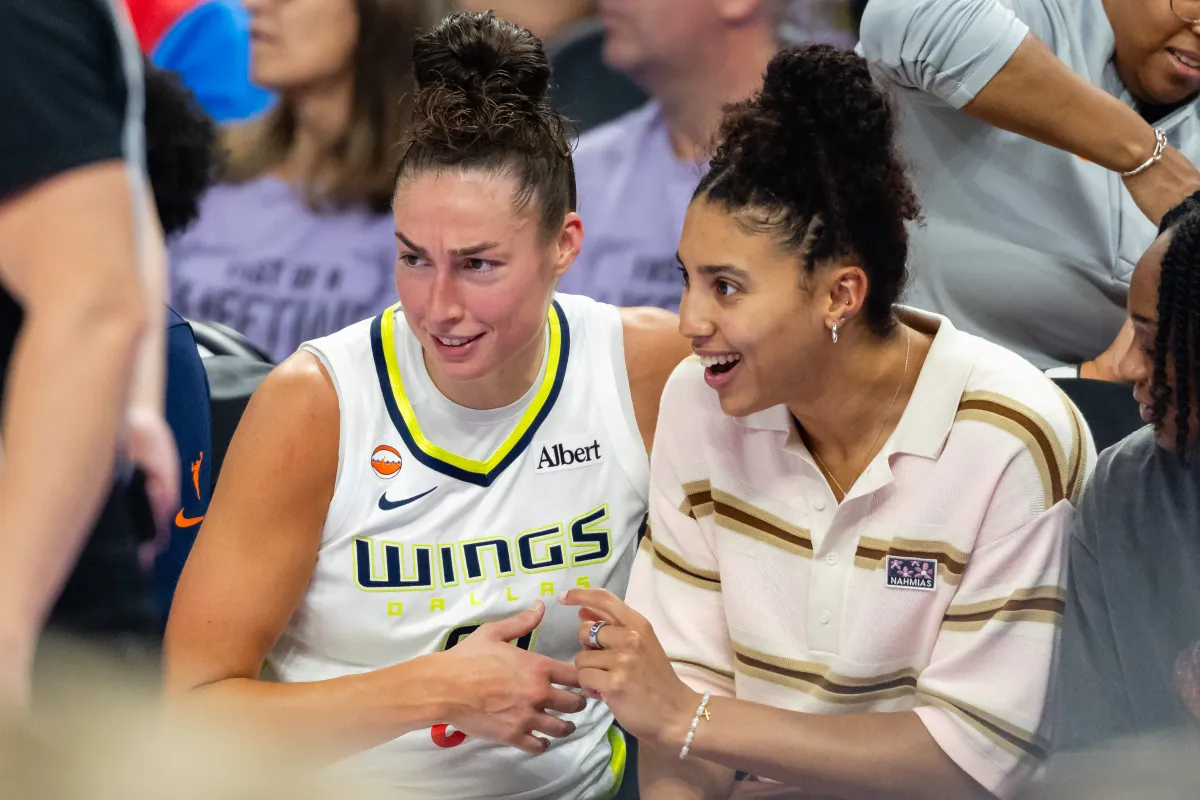
The final horn echoed through the rafters, a sound that felt like a lifetime in the making for a franchise that had grown accustomed to heartbreak. The Dallas Wings had just dismantled the visiting Portland Fire, 96-78, but the scoreboard, almost secondary to the emotions spilling onto the court, merely confirmed what the entire arena already knew: the Wings were going back to the playoffs. The confetti, though modest, felt like gold to a team that had spent the last two Octobers watching from home, their seasons ending in quiet disappointment rather than jubilant celebration. At the center of the celebration stood Paige Bueckers, the rookie sensation, her jersey soaked in sweat and her eyes glistening with tears that she didn’t bother to hide. For Bueckers, this wasn’t just another win; it was the culmination of a dream she had whispered to herself in the quiet dorm rooms at UConn—the dream of playing on the biggest stage in women’s basketball. Drafted first overall with immense hype, she had shouldered the weight of an entire franchise, carrying the expectations of a fanbase starving for relevance. Tonight, she delivered, dropping a game-high 24 points and dishing out 8 assists, her court vision slicing through Portland’s defense like a hot knife through butter. As she embraced her teammates, the moment felt surreal. The journey from December’s grueling training camp to this scorching September night had been a rollercoaster of highs and lows, but the destination was finally here. For the first time in her young professional career, the calendar would be extended into the postseason, and the Wings, for the first time since their relocation struggles, looked like a team built to do some damage.
With the victory, the Wings officially sealed their place in the eight-team playoff bracket, joining a stacked field that reads like a who’s who of the league’s elite: the Minnesota Lynx, the Golden State Valkyries, the Atlanta Dream, the Las Vegas Aces, the Indiana Fever, the New York Liberty, and the Washington Mystics. It’s a brutal gauntlet, but for Dallas, simply being part of the conversation represents a seismic shift in the organization’s trajectory. Just twelve months ago, the Wings were languishing at the bottom of the standings, a team in search of an identity, picking high in the lottery and wondering when the losing would end. The arrival of head coach Jose Fernandez changed everything. In his first year at the helm, Fernandez, a coaching lifer known for his fiery sideline demeanor, tactical flexibility, and an uncanny ability to connect with players on a personal level, has completely altered the DNA of the franchise. He inherited a roster that was young but raw, talented but unrefined. Through a mixture of intense film sessions, relentless defensive drills, and a player-centric approach that emphasizes emotional intelligence as much as basketball IQ, Fernandez molded this group into a cohesive unit. General Manager Curt Miller deserves credit too, for surrounding Bueckers with a supporting cast of veterans and high-upside projects, ensuring that the rookie never had to carry the load alone. The two-year playoff drought was a stain on the franchise’s proud history, a legacy that included championships in the old Detroit Shock days under different banners. Now, with Fernandez driving the bus and Bueckers as the engine, the Wings have not only snapped the drought but have positioned themselves as a dark-horse contender that no top seed wants to face in the first round. They are playing with a swagger and a defensive intensity that has become their calling card.
However, the jubilation of clinching a playoff berth comes with an undeniable undercurrent of grief, a bittersweet ache that the roster will carry into the postseason like a heavy weight on their shoulders. Earlier this week, the Wings received devastating news: Azzi Fudd, the team’s No. 1 overall draft pick, had suffered a season-ending knee injury. It happened during a routine practice session, a collision on a fast-break drill that on any other day would have been brushed off as a minor bump. But the collective groan in the facility was audible; you could hear the air leave the building. Fudd, who had been blossoming into one of the league’s most promising two-way players, has been the defensive anchor on the perimeter. Standing at 5’11”, she uses her length, anticipation, and lateral quickness to hound opposing guards, often drawing the toughest assignment on the floor—whether it’s a shifty point guard or a scoring wing. Offensively, she provides the spacing that allows Bueckers to operate in the paint, her consistent 38% three-point shooting forcing defenders to respect the corners and opening up driving lanes for her teammates. Without her, the Wings have to reimagine their entire scheme. Coach Fernandez addressed the media after the Portland game, his voice thick with empathy but resolute in his mission. “We’re missing Azzi, who was our best perimeter defender and how she stretched the floor. So, we’re just a little different now in the way we’re playing,” he said. His words acknowledged the void, but they also carried a promise—a promise to adapt, to fight, and to win one for their fallen teammate. The loss is not just a basketball setback; it’s an emotional gut punch for a locker room that had grown incredibly close, with Fudd serving as the group’s quiet spirit and moral compass.
Fernandez’s statement, though brief, speaks volumes about the team’s strategic pivot. “We’re just a little different now in the way we’re playing,” is coach-speak for a complete overhaul of their offensive and defensive principles. Without Fudd’s elite perimeter defense, the Wings have had to abandon their aggressive full-court press, a staple of their early-season success, opting instead for a more conservative drop-coverage in the half-court to protect the paint. They are banking on the idea that forcing contested jumpers is better than allowing easy drives to the rim, a shift that puts more pressure on their bigs to protect the rim rather than their guards to harass the ball. Offensively, the spacing has changed drastically. Fudd’s absence means defenses can now sag an extra defender into the paint to clog Bueckers’ driving lanes, making her life significantly harder. To counteract this, the Wings have inserted a larger lineup, with the towering presence inside dominating the glass and creating second-chance opportunities. The burden has fallen on role players to stretch the floor, and they have answered the call, knocking down crucial threes in the recent winning streak. But Fernandez also hinted at the emotional side of the equation when he mentioned Fudd watching the game from afar. “I know Azzi was watching this, having the procedure that she [underwent],” he said, his voice trailing off with a mix of concern and pride. The imagery is poignant: Fudd, recovering from surgery, glued to her television or phone screen as her teammates fought tooth and nail for her. It added an extra layer of motivation, a rallying cry that transcended X’s and O’s. Fernandez went on, “After the World Cup break, she’ll be back with the team and will enjoy the type of season that we’ve had.” This showcases the long-term vision. The FIBA World Cup break offers a two-week respite where rookies and injured players can rehab and reset. Fernandez is keeping the door open for Fudd to return as a presence in the locker room, even if it’s just as a cheerleader on the bench, pumping energy into a group that needs all the juice it can get during the grind of the playoffs.
The path to this clinching moment was anything but smooth, a classic story of a team hitting rock bottom before rising from the ashes like a phoenix. After the All-Star break in late July, the Wings hit a severe rough patch, losing seven of nine games between July 29 and August 17. During that stretch, the offense sputtered, turnovers mounted at an alarming rate, and the defense—which had been a pillar early on—collapsed under the weight of fatigue and injuries. They blew a 15-point lead against the Las Vegas Aces in a devastating fourth-quarter collapse and were blown out by the New York Liberty twice in the span of a week, looking completely outmatched against the league’s elite. Doubt crept into the locker room like a poison; critics began to question whether Fernandez’s system was sustainable, and whispers of the dreaded “rookie wall” plagued Bueckers, whose shooting percentage dipped noticeably. It was a moment of truth for the franchise. But true to their newfound identity, the Wings responded with grit and determination. Over the past week, they have ripped off three consecutive victories, culminating in the biggest one yet: a nail-biting 91-85 triumph over the Caitlin Clark-led Indiana Fever. In that game, the Wings showed their resilience and championship mettle. They trailed by nine points entering the fourth quarter, looking tired and beaten, but a ferocious 15-2 run, sparked by consecutive triples and a chase-down block by Bueckers that brought the crowd to its feet, turned the tide completely. The victory over Clark and the Fever wasn’t just a confidence booster; it was a statement to the entire league that Dallas is not just participating in the postseason—they are gunning for a specific seed and a favorable path. With only five games remaining in the regular season, every contest matters immensely. The Wings are currently locked in a tight battle for the sixth, seventh, or eighth seed, jockeying for position with the Mystics and the Dream. Each win moves them closer to avoiding the formidable Liberty or Lynx in the first round, potentially setting up a more favorable matchup against the Aces or the Fever. The schedule isn’t forgiving—they face a grueling back-to-back against the Sun and the Sky, followed by another bout with the Fever—but the team’s swagger has returned, and they are playing with a desperate, hungry energy.
As the Wings celebrate their hard-fought playoff berth, the rest of the WNBA continues to churn with its own brand of intrigue and controversy, a constant reminder that the league is as entertaining off the court as it is on it. In the aftermath of the clinching victory, the digital sports world has been buzzing with another headline: a WNBA star’s “concerning” reaction to a recent Sophie Cunningham controversy. Cunningham, a well-known agitator and physical presence on the court, found herself in the crosshairs of social media after an incident during a recent game, and a prominent league star’s post-game comments were interpreted by many as a thinly veiled critique, sparking a viral debate about sportsmanship and player conduct. While the Wings are understandably focused on their own preparations—scouting opponents, reviewing endless film, and carefully managing the minutes of their starters to keep them fresh—the broader league narrative serves as a backdrop to their journey. For Dallas, however, the focus remains laser-sharp. Coach Fernandez has been preaching a one-game-at-a-time mantra, emphasizing that while the playoff ticket is punched, the ultimate destination is still miles away. The Wings’ resilience in the face of Fudd’s injury, the early-season inconsistency, and the grueling travel schedule has forged an unbreakable bond within the ranks. They enter the final stretch with a massive chip on their shoulder, playing for a fallen comrade, playing for a new coach who believed in them when few did, and playing for a city that has yearned for a winner for far too long. The road to a championship will likely go through the powerhouse Lynx or the star-studded Liberty, but this Dallas team has already proven it can weather the storm. Whether they can conjure enough magic to sustain it through the high-stakes, single-elimination format of the opening rounds remains to be seen, but with Paige Bueckers leading the charge, anything feels possible. The postseason is here, and for the first time in a long time, the Dallas Wings are not just happy to be invited; they are ready to spoil the party and write a story that no one saw coming.