


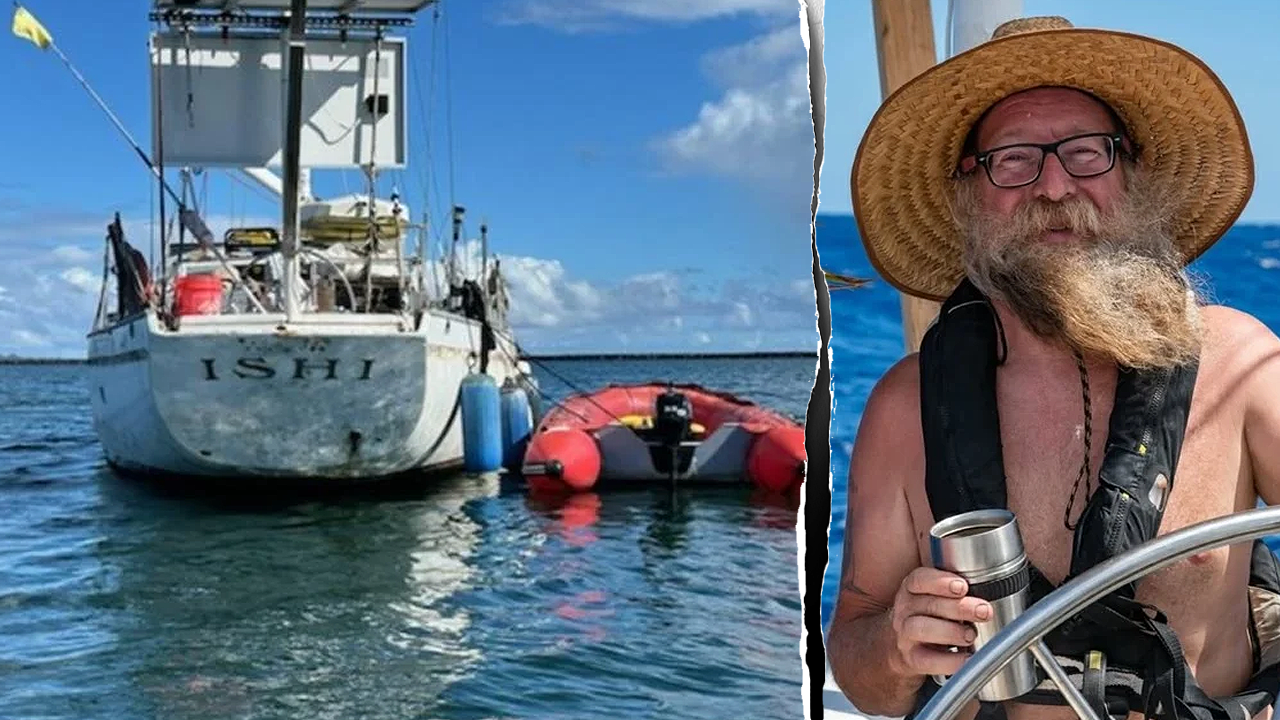
It begins quietly: a 62-year-old man, familiar with the rhythms of wind and tide, often seen along the dock at his sailboat, Ishi, preparing for the kind of ocean wanderings that most people only dream about at retirement age. But for Donald Steven Lang, the dreamlike image of a solitary sailor heading toward the blue horizon carried a darker reality in the eyes of the FBI. Federal authorities say this man, with his long experience navigating some of the most challenging seas on Earth, was not just living an adventurous life—he was desperately trying to escape from what investigators describe as the sexual exploitation of a child. This month, the search came to an end not on the open water, but on Canadian soil, where Lang, 62, a dual U.S. and Canadian citizen, was taken into custody over the weekend at the request of the United States. The arrest quietly closed a far-reaching chapter of investigation and worry, one that had spanned Pacific islands, distant countries, and a chilling set of accusations. For anyone following the story, the image of the 55-foot, 1985 Taylor Hatfield oceangoing sailboat, once a symbol of personal freedom, has become inseparable from the case that drew law enforcement attention to a tiny and painful crime.
Behind this international arrest, the indictment in Hawaii alleges something very specific. Prosecutors state that between September and December 2024, Lang knowingly used, persuaded, induced, enticed, and coerced a minor to participate in sexually explicit conduct for the purpose of creating visual representations. It is an unusually blunt legal description that points to images, video, and digital records that can never be erased—a permanent and cruel effect on the child involved. The U.S. Department of Justice says the FBI’s reach goes far beyond the islands where the Ishi was docked, and the suspect is best known for having sailed across the world, frequently setting harbor in Hawaii. The sailboat was not just any craft; it was his home base, and prosecutors are now seeking to confiscate the boat itself, along with a number of digital devices and storage media, including a Samsung Galaxy S22 Ultra phone. The goal is to take away every tool that could allegedly be used to harm another child. Lang was already facing separate charges in Idaho, where authorities had charged him in April 2025 with three counts of lewd conduct toward a minor under 16 and one count of sexual abuse of a minor. That case concerned allegations of sexual assault that allegedly took place between 2003 and 2007. To see both accusations together is more than a story of humanitarianism; it is a reminder that what appears to be perfectly free movement across borders often leaves a very long shadow of unfinished justice.
For months, the FBI put broad energy into thinking about where a man with a sailboat could go, and how far he could get. Lang was last seen in January 2025 on board the Ishi, in Hawaii, but by the time the indictment was unsealed in August, he was nowhere to be found. The ocean is not a locked vault; it is an open, eight-degree wind, and whoever speaks of a sailing boat can, with enough provisions and courage in the face of the storm, head for the other side of the earth. The FBI publicly warned that Lang could cross the Pacific, heading from Hawaii to Fiji or Mexico, then on toward Papua New Guinea, and possibly Indonesia. Each of these places has a special relationship to the imagination of a sailor, but it also suggests immense difficulty for the investigation. He had ties to several places: Hawaii, Idaho, Washington, California, Fiji, the Marquesas Islands, Mexico and Canada. These were not random points on a map; they were the places of his personal life, where his past was known, where he could find into the neighborhoods, and where there was a community to blend in. The human need to find a familiar ground and a sailboat, one that is small but large in safety, is a huge contrast. Searching for one person in that kind of world is a reality that many do not realize: there is no address, no single hometown, no place that makes you stop, only a series of possibilities that are scattered across the ocean.
Then there is a very important law enforcement cooperation that finally ended with Lang’s capture. The arrest was not a scene of high seas, but a coordinated, quiet, convinced effort between the FBI and the Royal Canadian Mounted Police’s Pacific Region. In this dimension the RCMP’s General Duty, forced Island District GIS, Nanaimo Emergency Response Team, and Island District ERT worked together in a precise operation. The Justice Department’s Office of International Affairs was also involved, sending that across the border to every security, and returning to the U.S. to complete the warrant. With each organization, the need to move carefully was great; because the public had been warned that Lang wanted to keep his escape risk. At a certain point, endless partnership can feel like a victory in the form of justice. For the victims and their families, the news of the capture carried an enormous emotional weight; they may not literally watched the handcuffs close, but they have seen their fears and the possibility of closure take the shape of a real hand. In every child abuse case, the memory of the perpetrator matters as much as the memory of the abuse. That memory was now no longer on the sea.
The words of federal officials in the Baltimore case have echoed with strength. Assistant Attorney General A. Tysen Duva emphasized that keeping children safe from sexual predators is a top priority. These were not empty words, but an FBI official does not forget the victims. He said that “the FBI remains committed to identifying, investigating, and bringing offenders to justice who prey on some of the most vulnerable members of our communities.” These phrases are not formality. To the families who have waited hours, days, and years, these voices have been held up by a world that sometimes seems to have no eyes for the sea. Yet we also know that when an alleged predator is arrested after having had the opportunity to vanish, the outcome is never a complete closure, but a step into the unknown. For a victim, even the best arrest cannot undo the memories. The legal system will go from here, with charges and evidence. The FBI had offered a reward up to $5,000 for any leads, and repeatedly warned that Lang should not be underestimated. That expectation and the tension, in the end, might be, “He was found.” It is one thing to be a globe-trotting sailor in the eye of the romantic imagination, but it is another thing altogether to be a person who must answer at an adult court for something that happen to a child.
In part, the law, he rarely gives the end a romantic. If convicted in the Hawaii case, Lang faces the justice in two numbers: a mandatory minimum of 15 years in prison, and the maximum of 30 years. On top of these days there would be a possible fine of up to $250,000 and a period of supervised release that could length between five years, entire life. These penalties are the measure of how deeply a society cares about the protection of its children, especially in the always digital age. Yet the most important issue is not the final sentence, from the perspective of a future that is not only about what a defendant will lose. The real hurt is the one a child has lived with, in a time when abuse takes the shape of memory and, in many cases, permanent visual forms. The adults who discovered it, who reported it, perhaps many years after, had to swim through a current of intelligence, denial, and fear. Many survivors, even in the shadow of an arrest, look at a life that has changed because of a person who got known so little, but from a boat.
What will happen now is not the story of the open ocean, but the story of a courtroom, a bound in evidence. The prosecution will ask for the forfeiture of the sailing vessel, those digital storage, the phone, and will try to unmount the boat of the man’s past and about it into the evidence of the case. Lang will have the opportunity to deny the charges, and under the law he is presumed innocent until he is proven guilty. But reading this article is also a reminder of the terrible human reality: those who have not yet seen the disease of the old world, while the daily fiction of the ocean became a ship and an ocean, may have allowed the perpetrator to blend into the concept of the sailor’s soul. The deep loneliness and peace of the seascape, the sea, the search for a meaning, and the skill to hold a coast, cannot, and should not, outweigh the quiet fact of a child’s testimony. This arrest is the beginning of the ending, not just for a twisted, but for the person who found herself at the other end of the crossing: a survivor, a witness, a child—and only now, at this final dock, a free survivor of every legal verdict, all of us remains his humanity.