


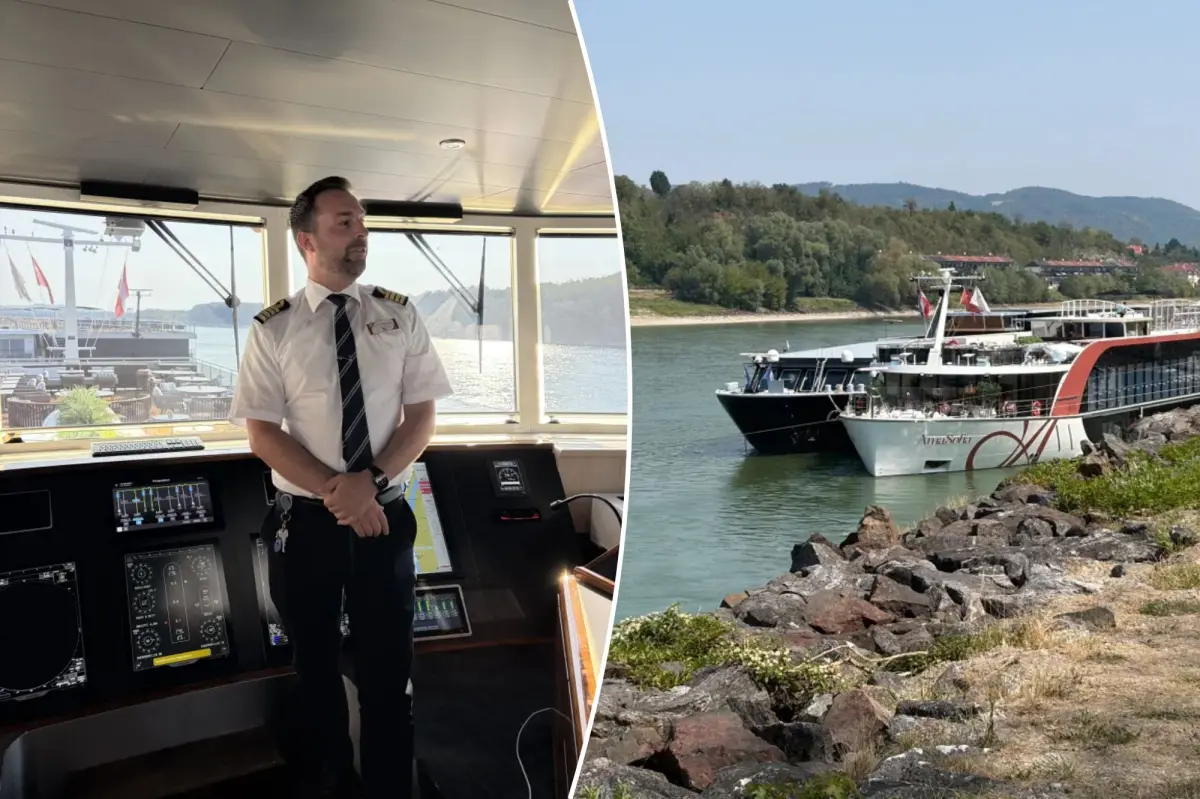
Bad luck has cursed European river cruisers this summer, and we found ourselves literally stuck between a rock and a hard place. The Rhine and Danube, usually reliable ribbons of scenic water, were reduced by a brutal combination of thin Alpine snowmelt and relentless summer heat. In Budapest, the Danube fell so low that the riverbed became a grim museum: a sunken World War II boat, an army motorcycle, the remains of two German soldiers, and anti-tank mines that forced authorities to close the riverbank. The famous Ínség-szikla, or Rock of Starvation, stood fully exposed—an old warning that water mills can’t grind grain and crops are failing. We were supposed to dock in that very city at the end of a week-long AmaWaterways “Romantic Danube” cruise aboard the brand-new AmaSofia, and as we gathered in pretty Vilshofen, Bavaria, the omens were not good. But hope is a stubborn thing. The embarkation party—local beer, lederhosen, dancers, laughter—lifted everyone’s spirits. We boarded with our carry-ons and expectations intact, convinced that the river would somehow deliver the postcard journey we’d imagined. The ship itself helped. Sienna-and-white, with a welcoming bar and lounge, panoramic windows, a small outdoor bow seating area, and a roof-deck pool where drinks arrived as you bobbed in the heat, AmaSofia felt like a floating sanctuary. Our cabin was compact but clever, with decent storage and a balcony just big enough for two chairs and a small table. There were 76 cabins in all, with room for 154 guests, and two dining rooms serving fresh, locally inspired food. That first evening, we watched castles, medieval villages, and ancient forests slip past, a cold glass of wine beading in the golden light. It was exactly what we’d hoped for. We didn’t know yet that the river had other plans.
Waking up in Passau, in lower Bavaria, we felt lucky. A morning hike through the forest to the 13th-century Veste Oberhaus fortress gave us sweeping views of the town where the Danube, Inn, and Ilz rivers meet, and we returned to the ship hungry and happy. That night we crossed into Austria and woke in Linz, where the first crack in the fantasy appeared. Our ship was double-parked against another longboat, so one side of our balcony stared directly into the windows of a neighboring vessel. One morning, still in pajamas, we opened the curtains and found ourselves face-to-face with the crowded lobby of a Viking ship. It was intimate in all the wrong ways. Our captain, Niels Springer, later explained that port stops are booked up to two years in advance, and with so many boats squeezed into the shorter navigable stretches of water, “we’re playing the biggest game of musical chairs possible.” We spent most of that day in Linz, walking the cobbled streets where Hitler once basked in adoration; he made his Anschluss speech from the Rathaus balcony in 1938, right by the public toilet, which felt like small cosmic justice. The modern Lentos Art Museum, with its glass facade, drew us in for Warhol, Man Ray, and Keith Haring. Other passengers boarded buses for Salzburg, especially the Sound of Music devotees, or for the spectacular 13th-century UNESCO village of Český Krumlov in Czechia. We skipped those because we don’t love long bus rides. That decision would come back to haunt us.
From Linz, the plan was to sail to Vienna, then Bratislava, then Budapest. Instead, at the daily afternoon briefing, our cruise manager delivered bad news with practiced calm: none of those stops would happen. We would sail only as far as Melk, a small Austrian town, and park there for three nights. A bus would take us to Vienna for a day, and on the penultimate day we’d ride a coach to Budapest with a short stop in Bratislava. A hotel would cover the final night. Because two meals that should have been served on the ship would no longer be available, each passenger received a 50-euro onboard credit—which, as we discovered, didn’t stretch far and had to be spent on the ship. A low rumble of disappointment moved through the lounge. A few tempers flared. The river cruise had essentially morphed into a city bus tour operating from a floating hotel. That night, the ship powered through the darkness for some eight hours to reach Melk, a mad dash that sacrificed the daytime scenic cruising through the Wachau Valley we’d been promised—vineyard-covered hillsides, historic riverside villages, sweeping panoramic views. We woke up in Melk instead, feeling cheated. The town itself was a consolation prize: a lovely main street lined with ice cream shops, cafes, bars, and arty boutiques, all overlooked by an imposing Benedictine baroque abbey that also houses an interfaith school. A tour of the abbey was arranged, and on the free day we could visit Schloss Artstetten, the summer castle of Franz Ferdinand, whose assassination in 1914 started World War I. We tried a guided bike ride along the river, using the complimentary bikes kept on board, but after a few unshaded miles in 97-degree heat, I gave up, slumping like a tennis player who’d lost a five-setter. We couldn’t help thinking that on the original itinerary, we’d have been on a cooler morning ride through the vineyards of Weißenkirchen.
The bus to Vienna took about two hours each way, and the reward was a short walking tour in the heat. We ducked into the Spanish School of Riding to admire the beautiful Lipizzaner horses, then spent the rest of the day in cafes, hiding from the sun. The optional evening classical concert in Vienna, which past guests had called a highlight, was simply off the table. Saying goodbye to the ship a day early, we boarded the coach for Budapest—a brutal, back-aching six hours. A quick pitstop in Bratislava served two purposes: ticking the destination box and offering a pay-as-you-go comfort stop, since the bus toilet was locked. The Slovakian capital revealed a quirky, historic city with a gritty edge; alongside cafes and nods to Mozart, who performed there as a child prodigy, we found a grim executioner’s visage marking where accused witches were burned. Lunch featured the local hearty dish, bryndzové halušky—potato dumplings with bacon and sheep cheese—which earned mixed reviews from our group. We reached the Al Habtoor Palace hotel in Budapest around 5 p.m., too late for any tours. An adequate buffet dinner was served in a windowless basement room, but we salvaged the evening with a glass of fizz at the charming bar, after walking across the bridge to Buda as the iconic castle lit up. The lights were still on, though the city was struggling with issues at its nuclear station, which is usually cooled by the Danube. It was a strange, beautiful, melancholy end to a journey that had stopped being a river cruise somewhere around Melk.
According to Jon Burrows, COO of AmaWaterways, we were simply unlucky. Last year and in 2020, he said, “We saw nearly ideal navigation conditions across much of Europe’s river system.” But conditions are no longer predictable. “While we’re seeing more frequent weather extremes than in the past—including periods of low water, heavy rainfall and heat waves—these conditions are not cyclical and can occur at different times of year,” he explained. Captain Springer agreed, noting that the Danube “can be low in winter and high in summer.” The river, we learned, is a cruel mistress. AmaWaterways has invested in new shallow-draft ships like AmaSofia to cope, but even so, 16 ships across six itineraries were impacted on the Rhine and Danube at the time of our sailing. When water levels drop, the company sometimes switches passengers to a sister ship mid-voyage to avoid low or high stretches—the latter prevents ships from passing under bridges. These maneuvers are reportedly handled well and keep the skeleton of the tour intact, but they undermine the “only unpack once” promise. Other times, destinations and routes are simply changed. Burrows said the focus is on “creating a well-rounded guest experience by adding tours and excursions or securing coaches for full-day shore experiences in originally scheduled ports.” To their credit, the AmaWaterways team was professional throughout; luggage, logistics, and tour changes were communicated clearly and executed seamlessly. They’ve built a sophisticated system for crisis management. But no amount of polish can change the fact that your holiday may be radically different from the one you booked. If you don’t mind coach tours to reach the main attractions, with a floating hotel as your base, you might be fine. If you wanted to moor in the heart of a city and drift down the river with wine in hand, not so much. In the UK, consumer laws require compensation or cancellation rights when a holiday is substantially different from what was booked. In the US, force majeure clauses let companies off the hook for situations beyond their control, and regular travel insurance may not cover disruption-related cancellations. A travel advisor from Nashville, traveling with 15 friends, said she received only an email saying the company was “reviewing everything.” She’d been told onboard that there were no disruptions, which wasn’t true, since boats were already unable to sail past Melk. As of her last update, no credit or compensation had been offered.
Would I cruise AmaWaterways again? Maybe. The ship experience was lovely—the crew, the food, the Chef’s Table with its eight courses of tiger prawn and apple crudo, miso-marinated cod, vanilla bean mousse, and passionfruit macaron, all of it memorable. But next time I’d look further afield. AmaWaterways also cruises the Nile in Egypt, the Mekong in Vietnam, the Chobe in Botswana, and the Magdalena River in Colombia, and they’re expanding from 31 ships to more than 50 by 2032. If you’re set on Europe, though—and there are plenty of scenic and historic reasons to want those waterways—the best advice might be to take out “cancel for any reason” insurance. It’s pricey, but it gives you options if your cruise is impacted. AmaWaterways boasts on its website that “adapting takes more work than stepping back, but we believe it’s what our guests deserve, and it’s why we haven’t canceled a single departure due to this summer’s conditions.” Viking has taken a similar stance, while Avalon has offered guests on the Rhine and Danube the chance to rebook or take a full refund. AmaWaterways counters that conditions can improve quickly; recent rainfall in parts of the Danube helped, and a sailing departing in the coming weeks might operate with little impact. But that also means a bad-news email may arrive close to departure. Burrows said teams typically reach out two weeks before departure when an itinerary adjustment is needed, but because river conditions change quickly, sometimes they need to decide closer. Guests are contacted directly and may proceed with the cruise, receive future cruise credit, or, if they prefer not to travel, credit toward a future booking. He wouldn’t say what passengers on our cruise received as compensation—we were guests of AmaWaterways, so full disclosure—and the Nashville advisor’s group was still waiting. In the end, the river is a living thing, and drought is its latest mood. We made the best of it, saw beautiful places, and learned that a cruise is not a promise. But if you want to keep your options open, buy the insurance, pack your patience, and maybe keep a bus schedule handy.