


This weekend, the roar of engines will echo through the marble halls of American democracy as INDYCAR descends upon Washington, D.C., for an unprecedented celebration of speed, history, and national pride. The Freedom 250 is no ordinary race; it is a once-in-a-lifetime spectacle designed to honor the 250th birthday of the United States, transforming the nation’s capital into a high-octane playground. Imagine race cars screaming past the Washington Monument, sweeping around the National Mall, and barreling through the shadow of the U.S. Capitol—this is not a scene from a movie, but a real, 250-mile street race unfolding on a 1.7-mile circuit carved through some of the most recognizable landmarks on Earth. While the race itself is a monumental feat of logistics and daring, the trophy that awaits its champions is equally extraordinary, a bespoke work of art that fuses two iconic symbols of American governance into a single, gleaming tribute. Designed to reflect the unique character of the event, the trophy is not just a prize; it is a narrative piece, a crystalline story of the venue that frames the race between the towering obelisk of the Washington Monument and the majestic dome of the U.S. Capitol. For the drivers, this is more than another stop on the calendar—it is a chance to etch their names into history in a city where every street corner holds the weight of a nation’s past.
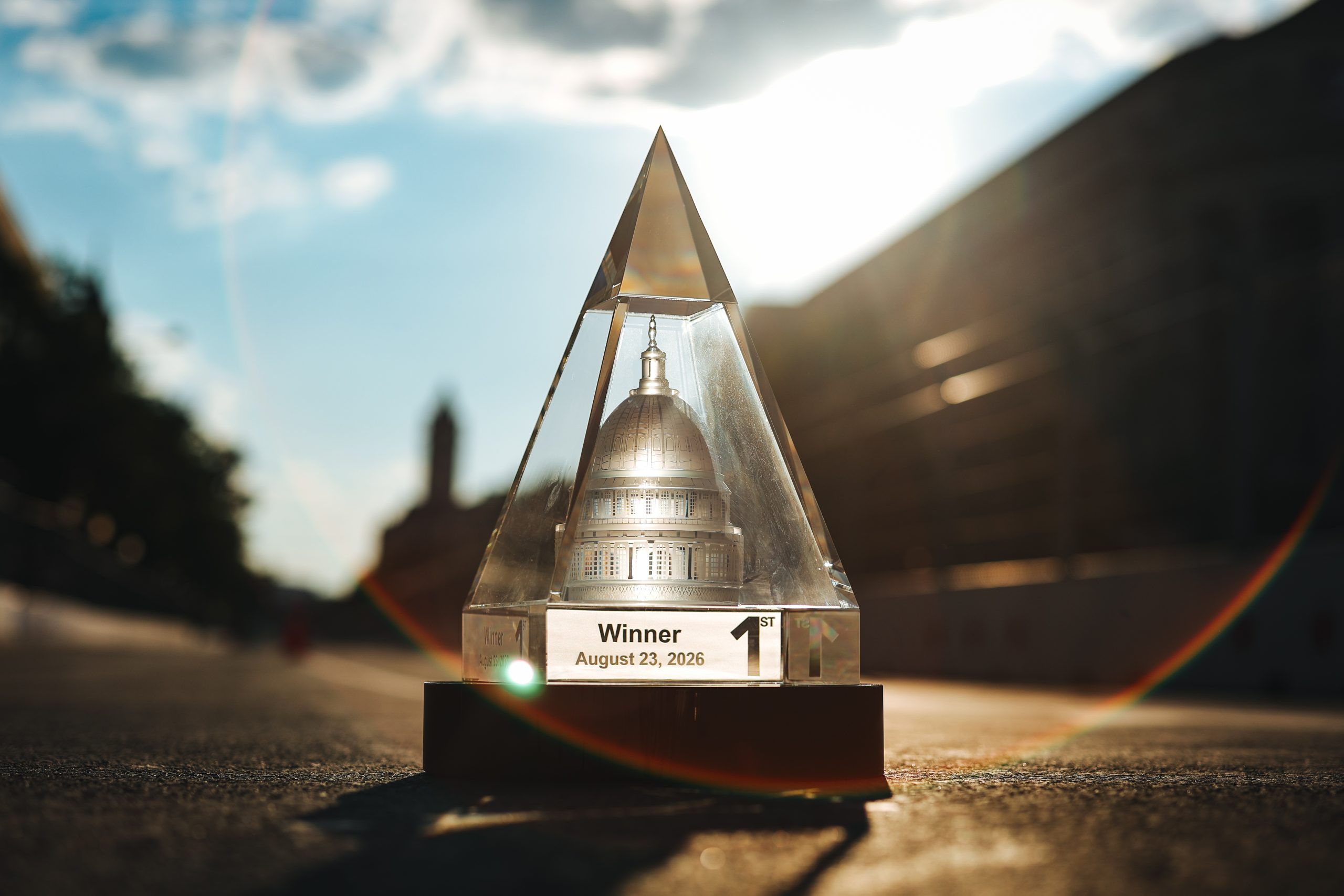
The trophy’s design is a masterclass in symbolic architecture, blending proportion, perspective, and patriotic resonance into a single object that captures the soul of the Freedom 250. According to designer Michael Montri, the trophy’s appearance is meant to reflect the breathtaking view from behind and through the Washington Monument while gazing toward the Capitol Building across the National Mall—a viewpoint that encapsulates the entire course in one sweeping glance. The upper shaft of the trophy is no random ornament; it is a proportionally scaled tribute to the Washington Monument itself, rendered in solid clear crystal. The crystal pyramid rises with a 72.6-degree face angle and a 1,600 height-to-base ratio, meticulously matching the exact proportions of the physical monument that anchors the western end of the National Mall. This attention to detail is staggering: the crystal shaft then continues downward from the pyramid at the same 72.6-degree angle in a smooth, hollow line, terminating at the plinth. It is as if the trophy were a miniature replica of the monument, but infused with a modern, celebratory sparkle. The choice of crystal is deliberate—it catches the sunlight, the floodlights of victory lane, and the flashes of cameras, making the trophy itself feel alive. For the winning team owners, this means lifting a piece of D.C.’s skyline, a portable monument that will forever remind them of the day their driver conquered not just a racetrack, but the very heart of American history.
Scale and hierarchy play a crucial role in the trophy’s design, with each podium finisher receiving a version that is meticulously proportioned to reflect their place in the race’s legacy. The first-place trophy stands at an impressive 22.5 inches total height, with a 15.5-inch base diameter and a 10.0-inch Capitol dome crowning the crystal shaft. Second place is slightly more restrained, coming in at 20.25 inches tall with a 13.95-inch base and a 9.0-inch dome, while third place measures 18.0 inches in height, with a 12.4-inch base and an 8.0-inch dome. This careful scaling ensures that each trophy maintains the same visual impact and structural harmony, regardless of size, making the entire podium look like a family of monuments—each one distinct, yet clearly belonging together. The crowning element, a detailed model of the U.S. Capitol dome, is the most recognizable feature of the trophy, serving as the triumphant top to a column of crystal and history. It is a fitting metaphor for the race itself: the Washington Monument represents the foundational values of the nation, while the Capitol dome represents the culmination of those values in governance, democracy, and collective action. In between lies the crystal shaft, much like the course itself, a path that connects the two icons through speed, skill, and sheer determination. When the drivers stand on the podium, they will be holding not just a trophy, but a miniature timeline of the United States, from its founding principles to its enduring republic.
Beneath the visible splendour lies a clever optical secret that transforms the trophy from a static ornament into a dynamic source of light. Tucked right beneath the plinth is a mirror-finish polish applied to the underside where it meets the black base, creating a reflective deck that directs light upward into the hollow shaft of the crystal. This ingenious feature means that during victory lane celebrations, when the flashing lights of photographers and the bright track lights illuminate the trophy, the crystal pyramid and Capitol dome will seem to glow from within, as if powered by the energy of the race itself. The effect is subtle but magical, turning the trophy into a lantern of victory, a beacon of achievement that radiates the hard work and triumph of the winning team. This attention to internal light is matched by equally careful fabrication techniques on the exterior. The circular black base, which contrasts sharply with the clear crystal above, is assembled from a cylindrical wall ring and a top deck disk, brought together using 45-degree miter cuts along the slope. This engineering precision hides the bond line seam completely inside the corner, giving the base a monolithic, seamless appearance that appears to be carved from a single piece of dark stone. It is this kind of obsessive craftsmanship that elevates the Freedom 250 trophy beyond mere sports hardware; it is a functional sculpture, designed to be admired from every angle, whether in the bright daylight of pre-race ceremonies or the dim, electric atmosphere of victory lane.
Part of what makes this trophy so special is the certainty that it will never be awarded again. The Freedom 250 is a one-time event, a singular celebration of a national milestone that will never recur. While INDYCAR could return to Washington, D.C., or the broader mid-Atlantic region in future seasons, this particular race is a one-off, and the trophy that comes with it is equally unique. Only one driver in the history of INDYCAR will ever be able to claim victory on the U.S. Capitol course, and although three versions of the trophy exist—one for each podium finisher—there is only one first-place trophy, and it will forever belong to that inaugural champion. This scarcity adds a layer of historical weight to the weekend. The winner will not just be celebrated for their speed and strategy; they will be remembered as the first and only person to conquer this extraordinary circuit. As Bob Pockrass of Fox Sports noted, racing through the streets of the nation’s capital is a rare and historic occasion, one that tests every facet of a racing team’s capability. The heat, the strength of the drivers, the precision of pit crews—all of these elements will come into play on a course that offers no room for error, surrounded by the solemn grandeur of America’s most important landmarks. The trophy, with its blend of monument and dome, will be the permanent symbol of that monumental achievement, a reminder that for one blazing weekend, the focus of the racing world and the heart of American democracy were one and the same.
As the countdown to the green flag begins, the anticipation is palpable. The Freedom 250 is scheduled to start on Sunday at 11:30 a.m. ET, with the main race’s green flag expected to wave around 1:13 p.m. ET, giving fans just enough time to soak in the atmosphere, the crowds, and the sheer novelty of hearing INDYCAR engines bounce off the walls of the National Mall. For the drivers, this race offers a unique blend of challenge and honor—the heat will be brutal, the corners unforgiving, and the pit strategy likely to involve at least four stops, but the prize is something no other racing event can offer. The trophy that awaits them is a conversation starter, a piece of art that will live in the halls of racing history, and a symbol of a nation’s birthday celebrated at breakneck speed. When the winner hoists that crystal column high above their head, with the Washington Monument shining in the background and the Capitol dome watching silently from the other end of the track, the moment will transcend sport. It will be a snapshot of America itself: bold, innovative, and always pushing forward, honoring the past while racing into the future. The Freedom 250 trophy, with its intricate proportions, hidden light, and eternal symbolism, is more than just a prize—it is a time capsule, a tribute to the enduring spirit of a country that has always found joy in the pursuit of greatness, and a reminder that even in the midst of grand history, there is always room for the thrill of the race.