



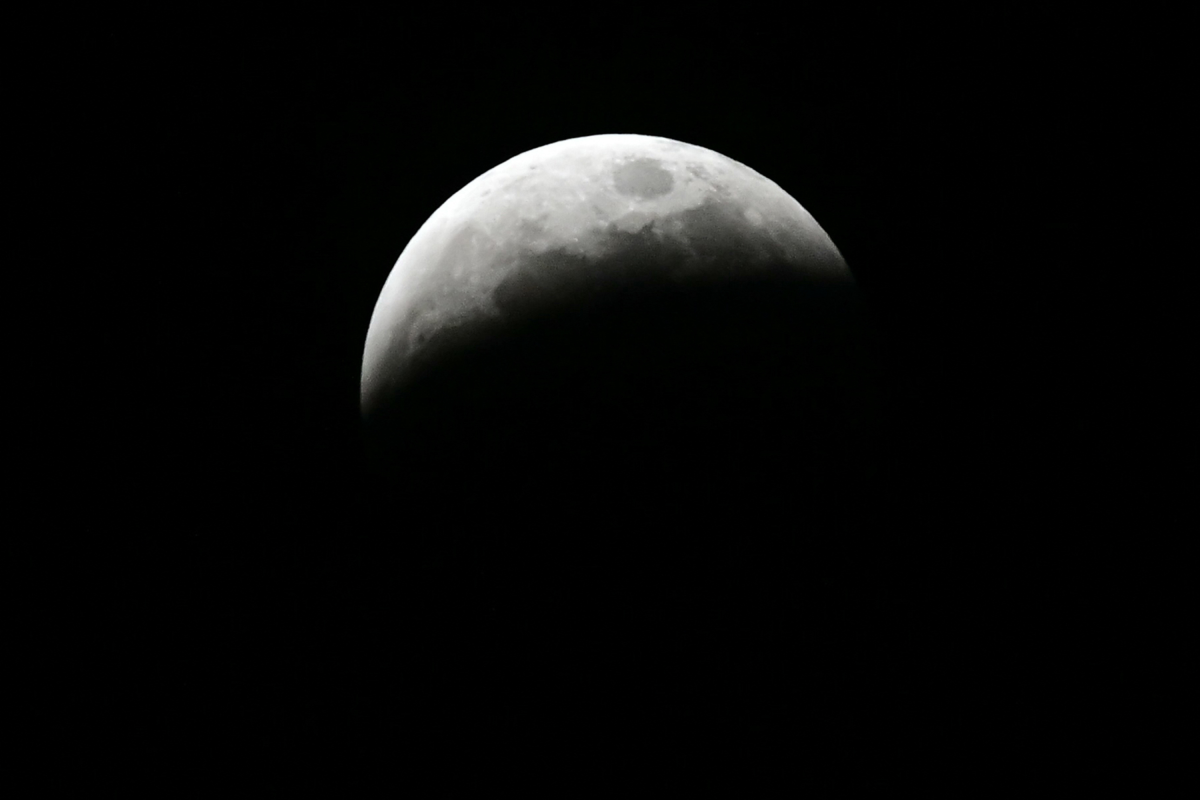
For skywatchers across the United States, this week presents a celestial spectacle that marries rarity with breathtaking beauty. As darkness falls on the nights of August 27th and 28th, the familiar face of the full moon will undergo a dramatic transformation, slowly being enveloped by Earth’s shadow. This isn’t just any lunar event; it’s a deep partial lunar eclipse, a phenomenon so profoundly close to a total eclipse that it promises a view usually reserved for the most dramatic occurrences in our sky. According to NASA, at the moment of greatest alignment, a staggering 96.3 percent of the moon’s visible disk will be swallowed by the dark, central part of Earth’s shadow, known as the umbra. Only a whisper of a sliver, a mere 3.7 percent, will remain to catch the sun’s direct rays. The result will be a moon almost entirely transformed, a celestial performance that blurs the line between a partial and a total eclipse. Viewers should look up during the night of August 27th and into the early hours of August 28th, when the moon, normally bright and dominant, will become a dramatic, shadowed object in the night sky, a spectacle of cosmic alignment that won’t be repeated with such intensity for many years to come.
To truly appreciate this event, one might wonder what makes this partial eclipse so exceptional. Lunar eclipses themselves are not uncommon, with the Earth, moon, and sun falling into alignment into a line, but the sheer depth of this eclipse places it in a special category. This magnificent event is part of a long-running celestial cycle known as Saros 138, a family of eclipses that repeats roughly every eighteen years, eleven days, and eight hours. This cosmic rhythm is a dance of celestial geometry where the Earth, moon, and sun nearly return to the same relative positions, creating consistent patterns of eclipses. The previous member of this particular family occurred way back in August 2008, and the next chapter in this series is as distant as September 2044. This immense gap underscores just how special this current eclipse is. Astronomers are of course fascinated by the event. They highlight this eclipse as a rare chance to witness a lunar eclipse that – while not officially. total – presents the visual drama of one. In many regular partial eclipses, only a segment of the moon gets taken up by Earth’s shadow, like a minor bite out of a cookie. But this time, the moon will be almost completely swallowed up, with only a thin crescent remaining in direct sunlight. This degree of immersion allows for the widespread, spectacular copper or reddish hues on the lunar surface, transforming the night into a scene of dramatic tonalities, a rare cosmic drama that has astronomers so eagerly awaiting.
Imagining the actual sight is like watching a story slowly unfold in the cosmos. The eclipse will be a slow, almost poet-worthy process. It begins with a subtle – almost imperceptible – darkening as the moon first glides into the outer, faint shadow. Known as the penumbra, this phase is just a hint of the drama to come. Then, the real show begins. Earth’s darker, central umbral shadow will begin to take a bite out of the moon, and that bite will grow impressively larger and larger. As the minutes and hours pass, that dark shadow appears as if it’s taking an ever growing, ever-presenta slice from the bright lunar disk. At maximum eclipse, only a narrow, bright crescent remains against the dark umbral shadow. It’s in this state that the entire moon transforms. The shadowed section will not just be a dark voidmaine, but rather it will glow with shades of red, orange, and copper. This occurs because of the very same physics that creates red sunrises and sunsets on our own planet Earth. As sunlight passes through Earth’s atmosphere, it’s filtered and bent, and only redder wavelengths are able to pass through the Earth’s atmosphere and refracted toward the moon, painting the shadowed lunar surface in ” its dramatic, fiery light. As your eyes acclimate to the darkness, this coppery hue can become even more pronounced, making this eclipse feel like a deep, raw stain in the dark night.
For ease and curiosity, the timing of the peak of this eclipse is friendly to many across the United States, but the exact moment differs by time zone. The moment of maximum eclipse is set for 4:13 a.m. Universal Time (UTC). Converted to local times, that means on the East Coast: at 12:13 a.m. EDT on August 28th, a spectacle unfolding. At the Central time zone, it will be 11:13 p.m. CDT on the 27th. The Mountain time zone will witness the peak at 10:13 p.m. MDT, and the Pacific time zone will get the best view early at 9:13 p.m. PDT on the 27th. The Western half of the country is positioned perfectly for an evening view, making it an accessible event for a wide audience. Observers from California to Florida will be able to see this show. Cities from Los Angeles to Portland, with New York and Jacksonville in between, will all have front-row seats, as long as the skies are clear. The event reaches far beyond the United States, though, with the eclipse casting its shadow across all of North America, and also visible in most of South America, and parts of western Europe and western Africa as well.
One of the most comforting aspects of a lunar eclipse is the safety and ease of viewing it. Unlike a solar eclipse, which demands the use of special protective eyewear to protect the eyes, a lunar eclipse is completely safe to observe with the naked eye. There is absolutely no need for special glasses or any filters to watch this event, unlike the eclipses of the sun. The best advice from experts is to find a location with a clear, unobstructed view of the night sky, ideally away from the glare and light pollution of urban centers that can diminish the overall experience. While it’s visible without any extra help, the true magic can be amplified with the simplest tools, making the most of the experience. A pair of binoculars or a simple to moderate telescope will reveal an impressive level of detail, allowing you to witness Earth’s shadow creep across the moon’s craters and maria. Part of the deep and intricate surface of the moon is its obvious character, like the “seas” of the Moon, a testament to a rugged landscape. The greatest variable in all of this, as always, will be the weather. A clear, cloud-free sky is your best friend, and will dictate the ultimate viewing quality. For those who are challenged by unfavorable local weather or for those who just want to see the eclipse from multiple points, Time and Date offers an internet webcast of the eclipse from multiple locations around the globe, so everyone can be a witness. This eclipse is not just an exercise in astronomical mechanics. It is a natural invitation to wonder, a chance for connection with the vastness of space, a reminder of the dance that governs our cosmic existence. It’s an event that not only amateurs and experts can enjoy, but truly anyone who has ever been touched by the magic of looking upward. So look up. On the night of August 27 and early August 28, the sky offers us a rare and unique happening that is both a scientific wonder and a almost magnificent, magical display in the world. Don’t have this opportunity to have a visual story of Earth passing in front of the sun, of staring directly into the shadow of our own planet.