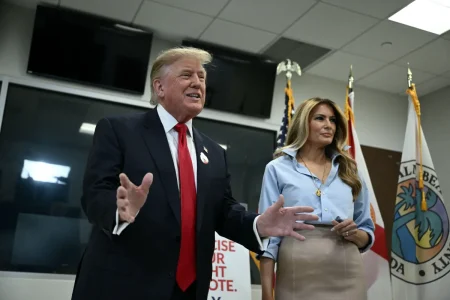


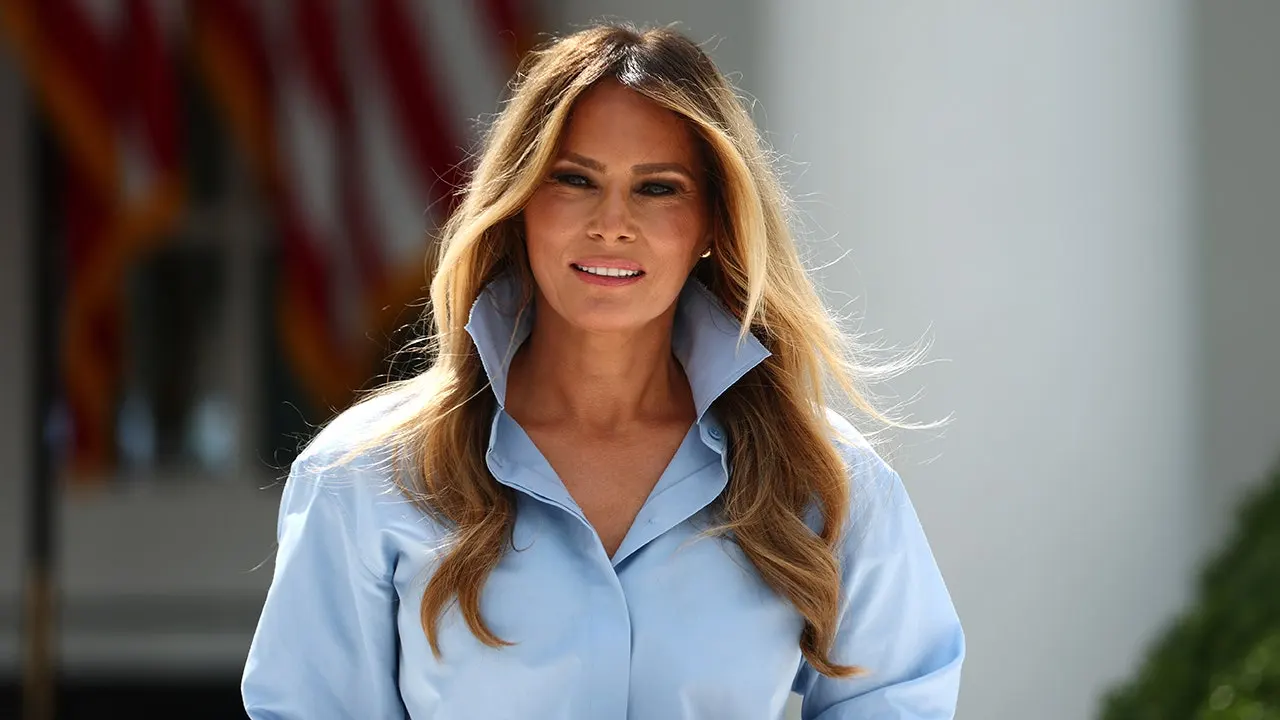
The White House Rose Garden, a stage that has hosted some of the nation’s most consequential diplomatic moments and presidential addresses, offered a different kind of spectacle on that crisp, sunlit Thursday afternoon. The air was charged with a palpable sense of anticipation, a buzz that rippled through the gathered crowd long before the First Lady made her entrance. When Melania Trump finally stepped up to the podium, flanked by the imposing architecture of the Executive Mansion and a wall of brilliant American flags snapping in the gentle breeze, she didn’t open with a formal policy address or a rehearsed political salute. Instead, she looked out at the sea of familiar faces, absorbed the thunderous applause that greeted her arrival, and delivered what would become the defining line of the day with an impeccable sense of timing and charm. “I heard you missed me. Here I am,” she declared, the five simple words landing with the weight of a triumphant return. The laughter that erupted from the audience, which visibly included her husband, President Donald Trump, echoed brightly against the stately columns of the White House. It was a masterclass in understated elegance and playful confidence—a subtle acknowledgment of her time away and a victorious declaration of her presence, all wrapped up in a quip that instantly connected her with the spectators. Standing there, she was the image of tailored perfection, wearing a crisp sky-blue oversized Michael Kors shirt with the collar confidently popped, paired effortlessly with a vivid red Dior pencil skirt that cinched her silhouette. The choice of attire was no accident; the sky blue mimicked the clear openness above the capital while the vibrant red echoed the patriotic backdrop of the flags behind her. Completing the ensemble with classic red Manolo Blahnik suede pumps, Melania Trump didn’t just attend this event; she commanded it with quiet authority, offering a striking visual prologue to an afternoon that promised to blend the raw, thunderous power of American automotive innovation with the deeply personal, soulful mission of nurturing its most vulnerable citizens.
Turning heads almost as much as the First Lady herself was the gleaming, roaring spectacle parked just a few feet away on the pristine Rose Garden lawn, a breathtaking IndyCar draped in a patriotic cascade of red, white, and blue. This was no mere showpiece; it was a moving emblem of the day’s dual purpose, carrying the branding of the First Lady’s “BE BEST” initiative alongside her “Fostering the Future” program, visually welding the concept of national power to the cause of child welfare. The juxtaposition was striking: the sleek, hyper-aerodynamic machine designed for blistering speeds rested quietly beside the delicate flowers and manicured hedges, a testament to human engineering resting in the lap of natural beauty. Melania Trump, with her characteristic flair for the dramatic, didn’t shy away from offering her own appraisal of the machine. “Look at this incredible race car,” she told the gathering, her voice carrying a hint of genuine admiration that cut through the diplomatic formality. “Gorgeous and powerful.” Her review was spot-on, as the vehicle served as the official herald for the upcoming Freedom 250 Grand Prix of Washington, D.C., an unprecedented event set to blast through the nation’s capital. This wasn’t a distant race tucked away in the heartland; this was a high-octane, once-in-a-lifetime spectacle designed to celebrate America’s 250th birthday. Legendary drivers including six-time IndyCar Series champion Scott Dixon, alongside Alexander Rossi, Graham Rahal, and Scott McLaughlin, stood proudly next to the First Lady, embodying the spirit of competition and American ingenuity. IndyCar President Doug Boles painted a vivid picture of the sheer audacity of the plan, describing how these cars would tear through the streets of Washington at speeds exceeding 180 miles per hour, racing past the hallowed steps of the U.S. Capitol, soaring alongside the towering Washington Monument, and navigating a course carved meticulously around the National Mall. It was, as Boles aptly described it, a “massive and very fast spectacle,” a thunderous celebration of two and a half centuries of freedom, where the roar of the engines would serve as a modern-day fireworks display to honor the nation’s enduring legacy and its unyielding drive for greatness.
Yet, for all the jubilant talk of horsepower, speed records, and the visceral thrill of watching machines defy physics, the true beating heart of the Rose Garden gathering was considerably quieter, far more tender, and infinitely more impactful. Melania Trump, ever the master of elegant juxtaposition, used the breathtakingly fast machinery behind her as a springboard to pivot the conversation to a cause that has become a defining pillar of her time in the White House: the well-being of America’s youth, specifically those navigating the treacherous and often lonely transition out of the foster care system. With the sleek IndyCar gleaming in the background, serving as a metaphor for the acceleration of opportunity she hopes to provide, she announced a significant expansion of her “Fostering the Future” initiative. This program is dedicated to providing tangible, life-altering opportunities for young adults who age out of the foster system, often with no safety net, no familial support, and no clear roadmap for the future. The announcement brought together the private sector and public purpose in a powerful display of corporate philanthropy. Fox Corporation and IndyCar each stepped up to the plate, contributing a substantial $1 million to fund new scholarships, with the combined $2 million investment earmarked for Indiana University and Purdue University. This generous contribution was far more than a simple check-writing exercise; it was a strategic expansion that brought the “Fostering the Future” network to a formidable total of 26 colleges and universities across the United States. The message resonated loudly: while the nation was gearing up to celebrate its monumental 250th anniversary with rockets’ red glare and engines’ echoing roar, the most important investment for the next 250 years lies in the minds and hearts of its children. These scholarships represent far more than tuition assistance; they are ladders out of systemic disadvantage, offering stability, mentorship, and the hope of a dignified, self-determined trajectory for those who have faced the profound instability of the foster system without ever having chosen it.
To ground this massive announcement in tangible, visceral reality, Melania Trump shared a story that brought the statistics to life and filled the room with an emotional gravity that no race car could possibly match. With a quiet sense of pride that softened her usually reserved demeanor, she revealed that this spring, a young man who had once been a recipient of a “Fostering the Future” scholarship achieved an extraordinary milestone: he became the program’s very first licensed medical doctor. The sheer magnitude of this achievement cannot be overstated. For a child raised in the foster care system, the odds are staggeringly stacked against them; the completion of a medical degree, one of the most demanding and rigorous academic paths in existence, is a testament not only to his own remarkable resilience but also to the transformative power of opportunity when it is graciously provided. As the First Lady spoke of this remarkable graduate, her voice carried a palpable pride that silenced the background hum of the crowd. “He will change the lives of so many people,” she said, her gaze sweeping across the audience, encompassing both the dignitaries present and the millions of Americans watching from afar. She painted a vivid picture of the ripple effect of this single success story, extending far beyond the operating room. “Graduates will build new companies, launch new industries and redefine what is possible for all Americans.” Her words transcended the specific case of the doctor, becoming a sweeping declaration of faith in human potential. In a world that often fixates on the macro—GDP growth, stock market indices, global power dynamics—she was reminding everyone that the micro is where true transformation begins. The scholarship recipient didn’t just earn a diploma; he shattered a generational ceiling, becoming a beacon of hope for the tens of thousands of other young people in foster care who are currently watching to see if there is a seat at the table of American opportunity for them. The intentional juxtaposition of this deeply noble achievement with the roaring, raw speed of the adjacent race car served as a powerful metaphor for the accelerating career of a previously marginalized individual who can now navigate the fast lanes of life with confidence, skill, and purpose.
Stripping away the glitter of the spectacle and the glamour of the Rose Garden backdrop, Melania Trump articulated a philosophy on that afternoon that was both timeless and urgently relevant. In an era dominated by frantic debates over technological disruption, infrastructure spending, and the volatility of capital markets, the First Lady offered a refreshing recalibration of national priorities. “The greatest investment America can make is not in technology, infrastructure or capital markets. It’s our children,” she asserted, her statement resonating deeply with the assembled guests and echoing far beyond the manicured hedges of the Presidential retreat. She elaborated, drawing a clear and deliberate distinction between the mechanical horsepower sitting idly beside her and the intellectual horsepower she seeks to cultivate in the nation’s youth. “Education is the one asset that can never be taken away,” she declared, her tone firm and resolute, carrying the weight of someone who understands the fragility of material wealth and the permanence of knowledge. “It is the foundation upon which confidence is built, opportunities created and the future is invented.” This core belief serves as the unwavering compass guiding her philanthropic efforts and her public platform. While the 250th anniversary celebration would rightly honor the bravery of the Founding Fathers, the sacrifices of generations of soldiers, and the ingenuity of industrialists and inventors, Trump was making a powerful argument that the true legacy of the nation will be written by the hands of its children. The sleek chassis of the IndyCar, with its cutting-edge engineering and capability for 180-mph bursts, represents the absolute peak of current innovation. But the mind of a foster child, given the tools to learn, heal, and grow, represents the boundless, undefined future. Her words challenged the audience to look past the fleeting thrill of the race and gaze instead at the long, arduous, yet ultimately rewarding track of human development, urging a collective investment in potential that has yet to be unlocked—potential that stubbornly refuses to remain dormant if merely offered a scholarship and a chance.
As the afternoon sun cast long, golden shadows across the Rose Garden, the event drew to a close, leaving behind a complex tapestry of imagery that was both visceral and cerebral. On one hand, there was the gleaming, impossibly fast race car, a monument to the sheer, unadulterated speed of American achievement, scheduled to tear through the streets of Washington in a thunderous ballet of asphalt and adrenaline for the Freedom 250. On the other hand, there was the quiet, steady dignity of the First Lady’s mission—the commitment to nurturing the fragile, yet indomitable, spirits of children aging out of the foster care system. The connection between these two elements was not lost on Melania Trump, who masterfully wove these divergent threads into a single, cohesive narrative for the nation’s 250th birthday. The horsepower of an engine is a temporary spectacle, here today and gone with the checkered flag; the horsepower of a well-educated, confident, and purpose-driven human being is an eternal legacy that compounds over generations. Her triumphant return to the Rose Garden—announced with the playful, disarming “I heard you missed me”—was more than just a welcome-back moment for the cameras; it was a reassertion of her role as a matriarchal figure for vulnerable youth, a champion of practical kindness, and a symbol of unwavering American optimism. The day provided a potent reminder that the most powerful engines in our society are not fueled by gasoline or electricity, but by hope, opportunity, and the collective belief that every child deserves a future worth racing toward. While the professional drivers would go on to chase checkered flags on the streets of the capital, the true victory lap belonged to the young doctor and the future scholars whose lives are being forever altered by the millions of dollars in scholarship funds announced alongside the rush of the Indy car. In that single, memorable afternoon, the White House managed to successfully celebrate the brawn of American might alongside the heart of American compassion, and at the center of it all stood the First Lady—elegant, resolute, and reminding us all that our nation’s greatest race is the one we run together to lift up the next generation.