


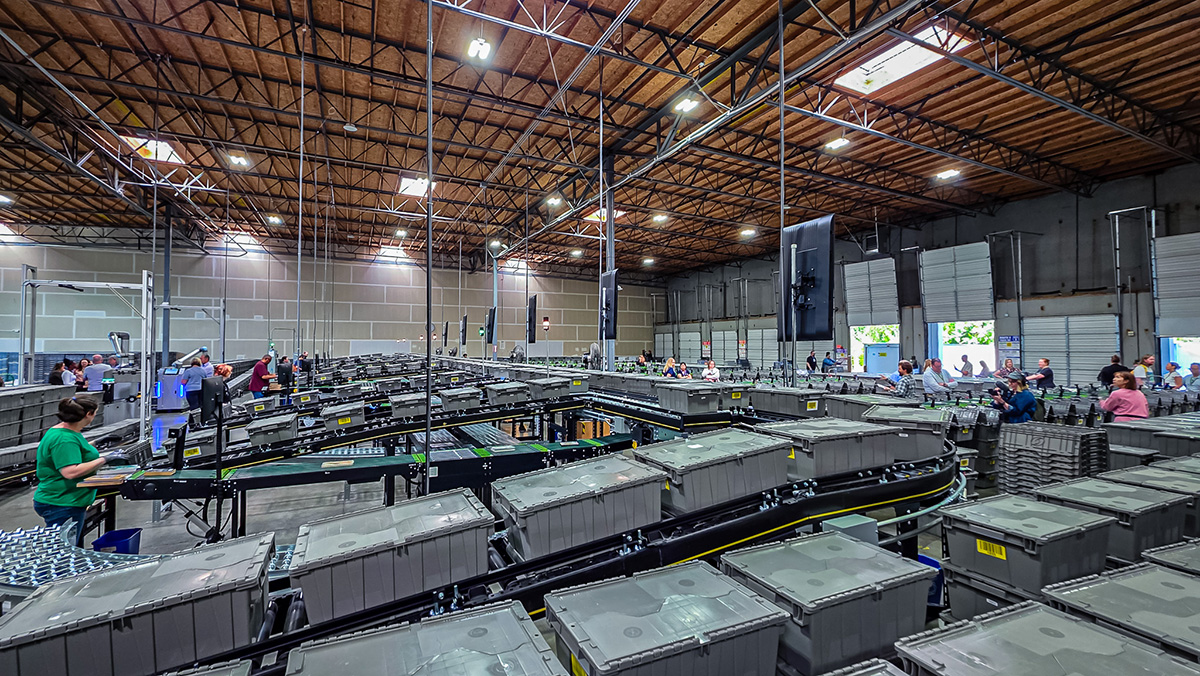
Washington has a way of collecting landmarks. There is Mount Rainier, the glaciated giant that peers down on the Puget Sound region. There is the Space Needle, a futuristic tower from the 1962 World’s Fair that still feels like tomorrow. There are the Seattle Seahawks, Super Bowl champions, whose fans once shook the earth so hard that seismographs noticed. But as of this week, there is also a new kind of Washington icon, one that doesn’t appear in travel guides: a $5.2 million library book sorter in Renton, tucked inside a 25,000-square-foot warehouse that looks less like a temple of literature and more like an airport baggage claim for hardcovers, paperbacks, DVDs, and audiobooks. The King County Library System officially opened the facility on Wednesday, calling it the largest library materials sorter in North America. In one day, it can route the roughly 25,000 items that move through KCLS’s 50 libraries—books requested by one patron at one branch, returned at another, then whisked to the person waiting for them somewhere else. The machine has actually been running since June 14, quietly proving itself before the ribbon-cutting, but the formal opening was a chance for the library system to celebrate something genuinely transformative. It’s the kind of project that doesn’t make headlines in most cities, but for the people who love libraries, it matters enormously. For anyone who has ever waited impatiently for a hold to arrive, or driven across town to pick up a book that was supposed to be there but wasn’t, this machine is a quiet hero.
The new facility represents the culmination of more than three years of planning, and it replaces a distribution center in Preston that had served KCLS for nearly 25 years. During that quarter-century, the world changed dramatically, and so did King County. The region grew, the population became more diverse, and the demand for library materials exploded. Today, KCLS serves roughly 1.6 million residents across a service area that spans urban, suburban, and rural communities. More than 700,000 active cardholders walked through its doors, real or virtual, in 2025. In that single year, they checked out more than 11 million physical items—books, movies, music, and other tangible treasures—and another 12 million digital items, from e-books to streaming media. That kind of volume is a triumph, but it also creates enormous logistical pressure. The old sorter, Heidi Daniel, KCLS’s executive director, explained, simply couldn’t keep up. “It couldn’t keep pace with our growing community,” she said. The previous system had served the library faithfully for years, but by the end it was struggling. Breakdowns were frequent, maintenance costs kept climbing, and the staff found themselves doing whatever was necessary to keep it alive. “We were literally ordering parts off of eBay,” Daniel said. It’s a wonderfully human detail, and it captures the strange reality of running a modern library system: you can be an institution of learning and culture, and still find yourself desperately hunting for obsolete machinery on a secondhand marketplace. The new sorter is designed to eliminate that desperation, but the story of how KCLS got here is as much about people as it is about technology.
Inside the new facility, the system works with a kind of choreographed efficiency that is almost mesmerizing. Drivers returning from branch pickups pull up to a loading area and unload totes filled with returned materials. Those totes move onto one of two conveyor belts, and at the far end, a pair of robotic arms destacks them with startling precision, one every 15 seconds. On an average day, warehouse operations manager Charlie Mitchell estimated, the facility receives between 800 and 900 totes. After the destacking robots do their job, a human worker scans each item individually. That scan is the moment when the machine learns the book’s identity and destination. It then sends the item onto a second belt, where it is carried through a maze of tracks and switches until it arrives at one of 186 chutes. Each chute corresponds to a delivery route, and each chute funnels the item into a freshly prepared tote that will be loaded onto a truck and driven to a branch. The system is capable of processing up to 8,000 items per hour at full tilt. It took KCLS nearly four months to set up and install everything, and the operation is now run by a small team of 13 people: six who do the scanning work and seven who manage the back end, making sure totes are filled, labeled, and lined up for the next round of deliveries. At the opening event, Renton Mayor Armondo Pavone tested the machine himself, placing a book into the system and watching it disappear into the labyrinth. It’s a satisfying moment, the kind that makes adults feel like kids on a factory tour. But the real wonder isn’t just the machinery—it’s the fact that a library system considered this investment essential to its mission of getting books into people’s hands.
For the people who work around the machine every day, the improvements are more than a matter of efficiency. They are a matter of dignity, safety, and comfort. Mitchell, the warehouse operations manager, was quick to downplay the difficulty of learning to operate the new equipment. “It’s a good job to pick up on,” he said. But his description of the old system made it clear just how much has changed. Totes used to be stacked 14 levels high, which meant workers had to climb ladders to reach the items at the top. It was slow, physically demanding work, and it carried an inherent risk of slips, strains, and falls. The new setup tops out at five levels, and instead of forcing workers to push heavy totes down a line by hand, the system lets them pull items off onto a hand truck with far less effort. Even the sound of the workplace has changed. “The old system ran at about 89 decibels,” Mitchell said. “This one runs at 67 decibels. It’s about the same as a vacuum cleaner.” That is a remarkable difference. Ninety decibels is the kind of noise that makes you have to shout to be heard; it is physically exhausting after eight hours. Sixty-seven decibels is conversational background noise, the hum of a household appliance. For the staff who spend their entire shifts in that space, the reduction in noise alone is a major quality-of-life upgrade. It may not be the kind of thing that shows up in a budget report, but it is exactly the kind of thing that tells workers they are valued. The message embedded in this new facility is that the people who make the library system work deserve a workplace that works for them.
The benefits also ripple outward to library patrons, who will feel the difference in their holds, their wait times, and their trust in the system. The old sorter ran at just two to three miles per hour—slow by any standard—and it put books in the wrong bin one to two percent of the time. That percentage might sound small, but in a system moving millions of items, it meant thousands of mistakes. It led to uncomfortable moments for patrons who received an email saying their book was available for pickup, only to arrive at the library and find that the book wasn’t there. It led to phone calls, frustrations, and a quiet erosion of confidence in a system people rely on. The new machine, by contrast, features automated tracking and destination redundancy support, which is a computer-seeming phrase with a very human meaning: if something goes wrong, the system has backup options. It can reroute items, flag problems, and reduce the odds of a book ending up in the wrong place. That matters to people like King County Councilmember Steffanie Fain, who said the new facility solves a major flaw in the library system—at least according to her two young children. “I’m not sure my kids have ever had an opinion about a distribution center before, but this one definitely has their full support,” she said. The kids, of course, aren’t thinking about operational efficiency or mis-sort rates. They’re thinking about getting the books they want, when they want them. And in that simple wish, they speak for everyone.
Ultimately, this new sorting facility is not just a warehouse full of conveyor belts and robotic arms. It is a statement about the future of public libraries. In an age when so much discourse is about digital replacing physical, King County Library System is investing millions of dollars in the physical infrastructure of sharing. That investment says that books are still important, that libraries are still relevant, and that access to materials should not depend on whether you live near a big branch or a tiny one. Heidi Daniel captured that vision beautifully in her remarks at the opening. “Today isn’t just about unveiling a remarkable piece of technology,” she said. “It’s about investing in the future of KCLS, and most importantly, it makes a promise to the 1.6 million residents we are proud to serve: No matter where you live or which library you visit, you get the same selection, the same service, and the same speed.” That promise is the heart of the whole project. The sorter is a machine, but what it does is deeply human: it connects a person with a story, a student with a resource, a kid with a picture book, a commuter with an audiobook. In a state known for towering mountains, iconic towers, and championship football, this industrial building in Renton may not look like much. But for the people who love libraries, it is a monument to something just as important—the simple, stubborn belief that everyone should be able to get the book they want, wherever they live. And that is a landmark worth celebrating.