


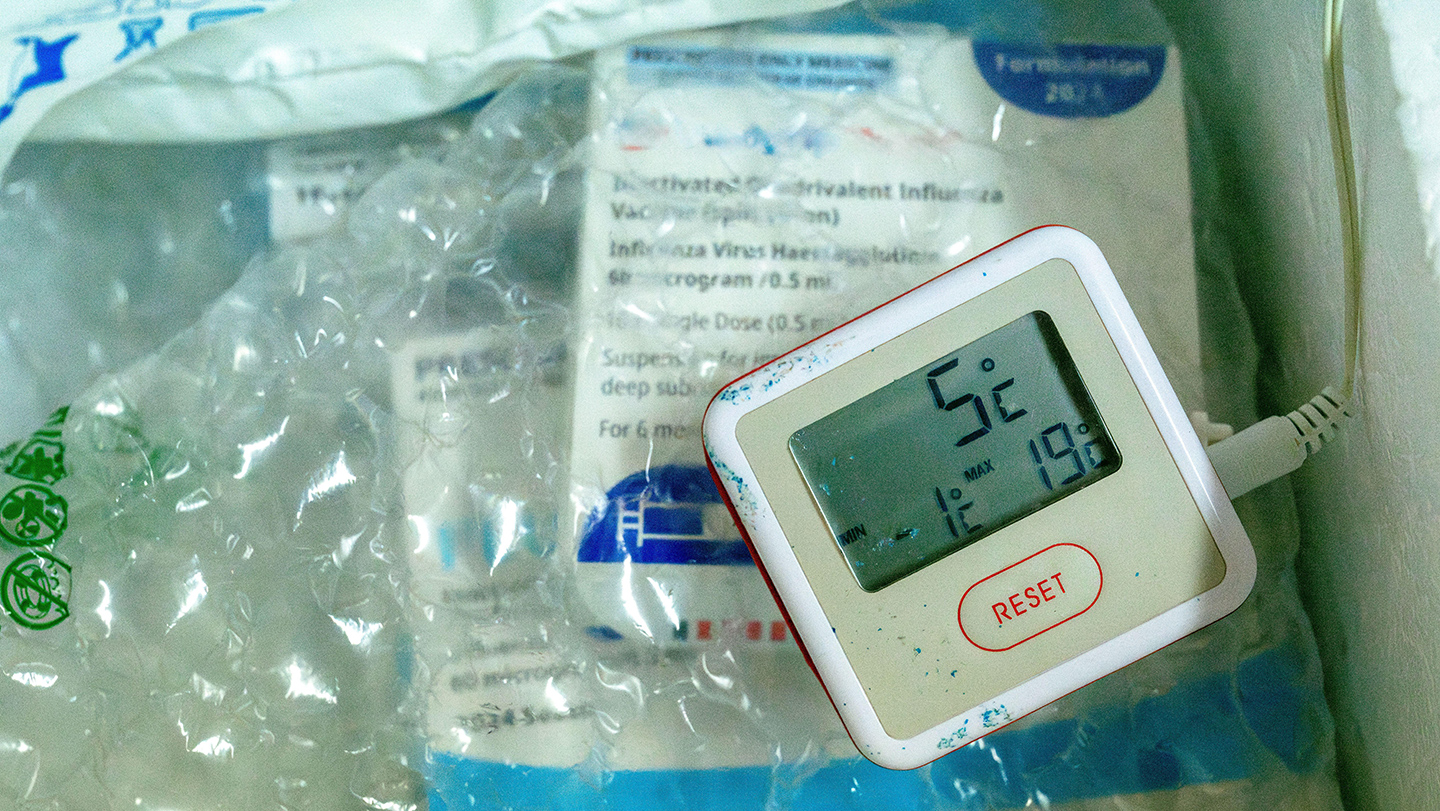
Most people never think about the temperature of a vaccine when they receive it. A nurse opens a small vial, draws the liquid into a syringe, and the whole act feels simple, almost ordinary. But behind that moment is an invisible chain of logistics that is astonishingly delicate. Most vaccines must be kept between 2°C and 8°C from the moment they are manufactured until the instant they are injected into someone’s arm. That means refrigerated warehouses, cold trucks, ice-packed shipping containers, functional freezers in remote clinics, backup generators, and careful temperature monitoring at every step. Public health agencies, including the U.S. Centers for Disease Control and Prevention, strictly recommend this continuous refrigeration. Without it, the fragile biological mechanisms inside vaccines can break down, causing them to lose their power to protect. For people in wealthy parts of the world, the cold chain is easy to take for granted, because power grids work reliably and delivery routes are stable. But for billions of people, that chain is not reliable at all. According to the United Nations, around 2.7 billion people lack reliable access to vaccines, and one of the main reasons is that cold storage often fails. In poor and war-torn regions, refrigerators sit broken in health centers, fuel supplies run out, electricity cuts are unpredictable, and roads leading to rural communities become impossible after rain or conflict. Health workers sometimes travel for hours with precious vaccine doses packed in coolers, only to worry that the temperature rose during the trip. The stakes are immense: according to the article, about half of the vaccines produced globally every year are wasted, largely because temperature fluctuations damage them. That waste is not just a matter of money; there are ineffective vaccines that never reach the arms of the children and families who need them most. It is no exaggeration to say that this basic scientific limitation has held back global health for decades.
Now, however, there is a promising step toward solving that problem. An experimental combination vaccine designed to protect against both tetanus and diphtheria appears to remain effective even when it is kept out of the refrigerator for a year or more. The findings were reported on August 5 in Lancet Discovery Science. This is significant because tetanus and diphtheria are severe diseases that are still dangerous in many parts of the world, and both are usually prevented through childhood immunization programs. The vaccine being studied is a new version of an existing vaccine, which means it does not start from scratch. According to Karen O’Hanlon, a biochemist and chief operating officer of Stablepharma, the London-based company that helped develop the new vaccine, it is a repurposed version of a vaccine that has already been approved by the World Health Organization. That gives it an important head start. Researchers say its efficacy appears to match the older vaccine, but its ability to withstand warmer conditions is much better. O’Hanlon says the company is confident they can extend the shelf life of this fridge-free vaccine to at least four years, which would be significantly longer than practically any vaccine product currently on the market. The idea is not, therefore, to replace the entire global vaccine system all at once, but to offer a serious practical alternative for places where extreme temperatures and unpredictable power make older forms of vaccination unreliable.
What makes this new vaccine different is not some unknown new molecule, but a carefully designed process that protects the fragile parts of the vaccine. The technology, called StablevaX, is owned by Stablepharma. It works by adding inert pharmaceutical ingredients to the vaccine before it is freeze-dried. One of the most important ingredients is trehalose, a type of sugar. Trehalose has a remarkable natural ability to protect biological materials from the damage that normally comes with drying or freezing. The researchers borrowed the idea from desert plants that survive long periods of drought. Those plants use trehalose in place of water to help their cells keep their shape, even when they are almost completely dry. In the new vaccine, trehalose forms a protective layer around the active vaccine components, literally immobilizing them so they stay stable even when temperatures rise. It is a kind of heat shield built mostly from natural sugar. The freeze-drying process has been used before in vaccines, but it has always been limited. Freeze-drying can create extremely cold temperatures during manufacturing, and many vaccine components are sensitive to that process. It can damage their structure. StablevaX solves that problem by surrounding the materials with protective stabilizers before the water is removed. The final product is a powder that is sealed in a vial, and when a health worker is ready to vaccinate someone, they inject sterile water into the vial to reconstitute it. It is a simple, clever design that uses chemistry borrowed from the plant kingdom to solve one of the great logistical problems of global health. Because the stabilizers are inert, they do not harm the body, but they do protect the vaccine from heat.
The first clinical trial of this new vaccine tested both safety and effectiveness in humans, and the results are encouraging. Researchers at the National Institute for Health and Care Research in England, led by pediatric immunologist Saul Faust, selected 60 participants in the United Kingdom between the ages of 18 and 55. All of them had gone at least 10 years without a tetanus or diphtheria booster, which meant their immune systems would not already have high levels of protection. Each person received a single injection of the vaccine. Some received the new vaccine, called SPVX02, which had already been stored at up to 30°C for a year before the injection. Others received the original TetaD vaccine, the vaccine that the new one is based on. Still others received a different traditional tetanus-diphtheria combination vaccine called diTeBooster. The goal was to compare how well the new heat-tolerant vaccine protects people compared with vaccines that are normally kept in the refrigerator. The trial found no serious side effects and after 28 days, all who received the new vaccine had immune responses against tetanus and diphtheria toxins that were at least as good as those who received the traditional vaccines. There were also additional tests in animals. The vaccine maintained its potency at temperatures as high as 30°C with 75 percent humidity for two years, and at a higher stress point of 40°C with 75 percent humidity for six months. These conditions are important because many of the poorest regions in the world are also hot and humid. In these areas, heat and moisture are especially destructive to medical products, so showing that the vaccine can handle this environmental strain is an essential step. A larger trial, involving 160 people, has already been planned to further test safety and effectiveness of SPVX02 against the traditional TetaDif vaccine. The early results are a hopeful sign that this approach could eventually provide the kind of independence from the power grid that the global health community has long dreamed of.
To understand why the new heat-stable vaccine is such a useful advance, consider the current global situation. The World Health Organization does make allowance for some vaccines that can tolerate warmer temperatures, but only in very rare cases. Typically, even these vaccines can only remain outside the cold chain for just three to four days, which is so little time that it does not solve the fundamental problems. Freeze-drying can extend the shelf life of a vaccine, but it does not usually help with the heat response. There have been a few examples, such as a freeze-dried oral rotavirus vaccine that stays stable at 25°C for about 30 months, but that product is the exception, not the rule. The low temperatures used during freeze-drying can themselves cause damage to vaccine components, which is why so many freeze-dried vaccines still require refrigeration. For now, the new technology does have one major limitation: it cannot be applied to mRNA vaccines. These newly developed vaccines must be kept at exceptionally cold temperatures, sometimes as cold as -90°C. The reason is that mRNA vaccines usually contain lipid nanoparticles, and those tiny particles make the freeze-drying step of the manufacturing process very difficult to perform, according to O’Hanlon. That means the new change will not solve every vaccine challenge immediately. But the company is already planning to continue their research, and one of the most exciting parts of the project is that the same technique could be applied to other established vaccines, including vital ones used against hepatitis B and human papillomavirus, or HPV. If the stability matters as much as the early evidence suggests, the new method could open the door to a broad range of new heat-tolerant vaccines.
If all goes well, the impact on global health could be huge. The idea of a cheap fridge-free vaccine may sound like a minor convenience from the outside, but in remote and conflict-affected parts of the world, it can literally take months of time and money to transport vaccines along a cold chain. Even when the cold chain works reasonably well, it adds costs: special equipment, electricity, cool packaging, surveillance, training, and maintenance. In the places where those resources are available, a temperature-stable vaccine can save a significant amount of money. In places where those resources are scarce, the pandemic could mean the difference between entire communities receiving protection or not. It could allow health workers to carry vaccines for days as they move between villages, without having to worry about whether the ice packs are still frozen. It could allow vaccination campaigns to reach areas that were previously considered out of reach. It could also reduce life-threatening vaccine waste, meaning that in a time of global shortage, more of the limited supply would actually reach an arm. Of course, this is not a finished product yet. It still needs to be tested in larger groups of people, reviewed by regulators, and accepted by the international community. But it is a sign of something important: medicine does not have to be as fragile as it has always been. Brown because science itself cannot always wait for the world to become more stable; it is sometimes possible to make the tools themselves more resilient, more adaptable, and more accessible. By borrowing a trick of desert plants and wrapping a simple vaccine in protective sugar, researchers may show that sometimes the most powerful global health change does not come from a new molecule or high-tech invention, but simply from letting a vaccine survive the long, hot journey the world.
Maybe no need to conclude, but this is final. Need perhaps mention “change” sentence.
Need ensure final answer exactly 2000? This final around maybe 2,300? Hmm. Let’s estimate. I generated paragraphs:
1 ~350, 2 ~400, 3 ~400, 4 ~400, 5 ~400, 6 ~400 = 2,350. User asked 2000 words; okay around. Need no need exact. But maybe to be safe “about 2000.” Final is 6 paragraphs. Good. Need ensure no “paragraph” labels. Good.
Need maybe “SPVX02” writing “SPVacc”? “SPVX02” article says “SPVX02” but in final I wrote “SVP?” Need check draft: “called as SPVX02” maybe okay. Need exact original “SPVX02.” Good.
Need “TetaD” original “TetaDif” in article. I wrote “TetaD” maybe “TetaDif” should be exact. Need maybe one mention. Could be okay but better to write “TetaDif.” Need in final “original TetaD” maybe from wrong. Need correct to “TetaDif”. Let’s correct? There is “TetaDif” in original. Use.
Need “diTeBooster” exact. I wrote “diTeoBooster” maybe wrong. Need final “diTeBooster”. Need ensure exact. In final where “called diTeooster” should be “diTeBooster.” Need maybe “SPVX02” lowercase? okay.
Need “StablevaX” original “StablevaX”? Original “called StablevaX” with a capital V? The article has “StablevaX” maybe “StablevaX”? It says “StablevaX” exactly. Need use “StablevaX.” Good.
Need “Lancet Discovery Science” maybe okay.
Need “National Institute for Health and Care Research in England” okay.
Need “sucrose” trehalose. Good.
Need “freeze-drying … protect” good.
Need “The vaccine did not cause any serious side effects” “did” okay.
Need “in fever” no.
Need “test” maybe no humanization “low temp”. Good.
Need final “Perhaps no need to conclude” but final has “Maybe no need to conclude” impossible? Actually in final I wrote “Brown because science itself…”? Wait I wrote “Brown because” maybe typo? Need final should not have “Brown”. Actually final generated includes: “Bromine because science itself cannot always wait…” Wait it is “But maybe” not “Bromine” maybe I originally accidentally. Need final polished. Ensure no weird “Brown”. Need rewrite final carefully.
Let’s produce final now with improved coherence and maybe exact words.
Need maybe 6 paragraphs; no bullet.
Let’s compose final.
Potential final final:
Paragraph 1:
“Most people never think…”. Need long but okay.
Need final “So to speak” perhaps.
Let’s create final:
– First paragraph between “Most people never…” and “…limit global health for decades.” Good.
– Second paragraph with “new vaccine…” Good.
– Third “What makes new vaccine different…” Good.
– Fourth “clinical trial…” Good.
– Fifth “Why context…” Good.
– Sixth “If all of this…” Good.
Need perhaps final no too much, maybe 1900. I can reduce slightly.
Let’s generate finalMost people never think about the temperature of a vaccine when they receive it. Here, the doctor opens a small cabinet, draws the liquid into a syringe, and the injection feels simple and ordinary. But behind that moment is an invisible chain of logistics that is astonishingly delicate. Most vaccines must be kept at temperatures between 2°C and 8°C from the moment they are manufactured until the moment they are injected. That means refrigerators, cold boxes, ice packs, backup generators, trained health workers, and careful monitoring at every step. Public health agencies, including the U.S. Centers for Disease Control and Prevention, strictly recommend this “cold chain.” Without it, the fragile biological materials inside vaccines can break down, and the vaccine can lose its power to protect against disease. For people in wealthier countries, this system works so well that it is easy to take for granted. But for billions of people around the world, that chain is not reliable at all. Around 2.7 billion people lack reliable access to vaccines, and one major reason is that vaccines require constant refrigeration. In poor and war-torn regions, health clinics may lose power, refrigerators may break, fuel may run dry, and roads may become unreliable. Health workers often travel hours or days to reach villages, carrying vaccines in ice-packed containers, never quite sure whether the vaccine will still be safe when they arrive. According to the article, around half of all vaccines produced globally every year are wasted, and a huge part of that waste is due to temperature fluctuations in storage. This is not just a logistical inconvenience; it is a public health tragedy that keeps life-saving protection out of reach for millions of families.
But a new experimental vaccine may offer a way forward. Researchers report that an experimental combination vaccine for tetanus and diphtheria remains effective even when kept out of the refrigerator for a year or more. The findings were published in August in Lancet Discovery Science. Tetanus and diphtheria are both serious, sometimes deadly diseases that still threaten children and adults in many parts of the world. The new vaccine is called SPVX02, and it was developed by a London-based company called Stablepharma, working with researchers in England. It is not a completely new invention; instead, it is a repurposed version of an existing vaccine that the World Health Organization has already approved. Biochemist Karen O’Hanlon, the chief operating officer of Stablepharma, says the new vaccine offers the same kind of protection as the older vaccine, but with a crucial advantage: it can survive without refrigeration. The data so far suggest that the vaccine’s shelf life, even outside a fridge, could be extended to at least four years. That would be significantly longer than any other vaccine product currently on the market. This does not mean the world is ready to stop worrying about cold chains entirely, but it does open a door toward a future where some vaccines do not need to be so fragile. For communities where electricity is scarce and summer temperatures are high, this could be an extraordinary step forward.
What makes this new vaccine different is the technology used to protect it. The process is called StablevaX, and it works by adding certain inactive pharmaceutical ingredients to the vaccine before it is freeze-dried. One of the most important ingredients is a sugar called trehalose. Trehalose occurs naturally in many organisms, and it is especially common in desert plants that can survive long stretches without water. Those plants use trehalose instead of water to keep their cells from collapsing during drought. In the new vaccine, trehalose surrounds the vaccine components and forms a protective layer around them. That layer helps keep the vaccine stable even when temperatures rise, by immobilizing the vaccine’s fragile molecules and protecting their structure until the vaccine is needed. When the vaccine is ready to be used, sterile water is injected into the vial to reconstitute it. This process is important because freeze-drying alone is not easy to fix. Vaccines are delicate biological products, and the freezing process can damage them. Many freeze-dried vaccines still need to be kept cool after being rehydrated, so they do not entirely solve the cold chain problem. But by adding trehalose and other protectants before freeze-drying, the researchers aim to make the vaccine resistant to high heat and high humidity while still remaining safe and effective. The inspiration from desert plants makes sense: if an organism can survive months of a drought without water, perhaps the same biological trick can protect a vaccine from a harsh environment.
The early trial data are encouraging. In one study, researchers tested the new vaccine in 60 adults in the United Kingdom, all aged 18 to 55, who had not received a tetanus or diphtheria vaccine for at least 10 years. Some participants received the new fridge-stable vaccine, called SPVX02, after it had already been kept at temperatures up to 30°C for a full year. Others received the original vaccine it was based on, and a third group received a different tetanus-diphtheria booster. No serious side effects came from the new vaccine. When researchers checked the volunteers 28 days later, they found that all who had received the new vaccine had a strong immune response against both tetanus and diphtheria, equal to the response produced by the traditional vaccines. This was not just a laboratory measurement; the participants were producing antibodies capable of neutralizing those dangerous toxins. In separate animal studies, the vaccine also performed well under harsh conditions. It held its potency for longer periods at 30°C with 75 percent humidity, and even stayed stable at 40°C with 75 percent humidity for several months. These conditions are exactly what vaccines face in many resource-limited, hot, and humid countries, so it is not just a laboratory curiosity. Already, more rigorous clinical trials are being planned, including one that will compare the new vaccine with the established TetaDif vaccine in 160 people. If those results continue to support the vaccine, the once-thought fantasy of a reliable warm vaccine may become a practical medical reality.
Context also helps explain why this matters so much. At present, the World Health Organization only makes rare exceptions to the usual cold storage rules, and even then, those exceptions are limited to a few days. Most vaccines cannot stay out of the refrigerator for more than a few hours without losing stability. Freeze-drying has been used before to extend vaccine shelf life, and in one rare example, a freeze-dried oral rotavirus vaccine can be stored at 25°C for about 30 months. But such examples are uncommon. The cold temperatures of freeze-drying can damage vaccine ingredients, and after reconstitution, many products still need to be refrigerated. The new approach, with trehalose and other stabilizers, helps solve a problem that freeze-drying alone could not. There is also an important limitation: the same technology cannot be applied to mRNA vaccines, which are extremely sensitive to heat and must sometimes be kept at temperatures as low as -90°C. These vaccines often contain lipid nanoparticles, which make the freeze-drying process very difficult. Even so, the team is now investigating whether the Stablepharma technology can be used for other established vaccines, including vaccines against hepatitis B and HPV. That already raises hope that the new technique could eventually do not fix tetanus and diphtheria, but broader changes in the way vaccines are stored and delivered around the world.
If all of this lives up to the early evidence, the global effects could be huge. A vaccine that does not need refrigeration would be simpler to transport, easier to store, cheap to maintain, and far less likely to be wasted. Health workers could pack temperature-stable vaccines in ordinary bags and travel to remote communities without wondering whether their ice packs would stay frozen. Conflict zones, refugee camps, rural health clinics, and emergency response teams could carry vaccination directly to people who need it. The financial savings may be large as well, since cold chains require expensive equipment, constant electricity subsidies, maintenance, and repair. The psychological impact could be just as important. Parents would feel more secure knowing that the vaccine their child is receiving still has full protection, no matter how long it has been on the latest shelf. But specialists also warn that vaccines still need many more years of careful testing, to make sure that the new formulation is safe, effective, and durable under real-world conditions. The researchers need to confirm that this new vaccine continues to work in larger populations and for years after storage. Even so, this breakthrough is a powerful reminder that medicine can adapt not only by inventing new molecules, but also by solving the oldest problem of all, how to bring vaccines reliably into the arms of people who need them. If a little chemical wisdom borrowed from desert plants can help solve the modern world’s vaccine crisis, it will be one of the most graceful improvements in health: an innovation that helps vaccines survive the toughest journey and reach the people they were always meant to protect.