

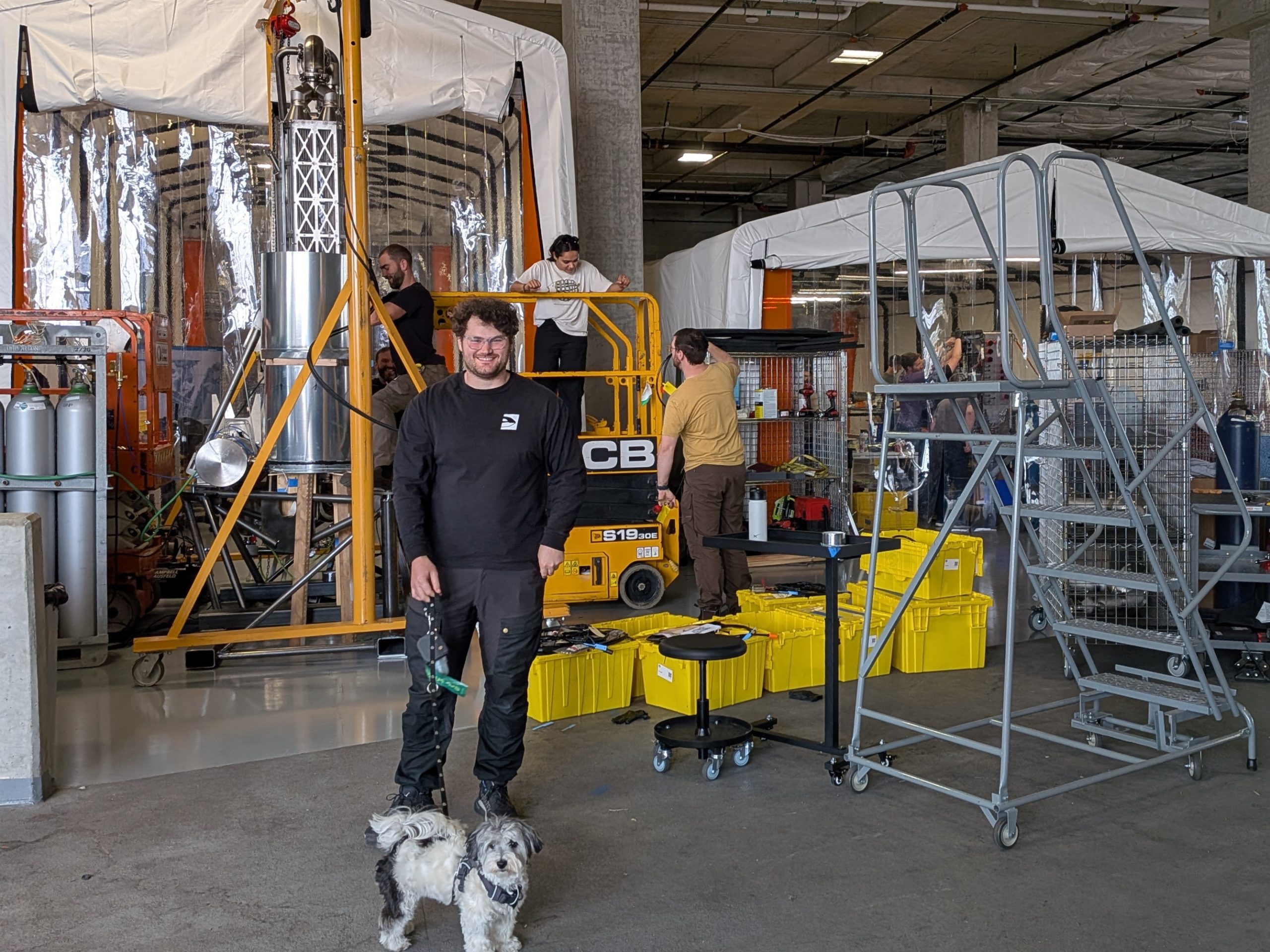
On a gray Seattle morning, inside a cavernous concrete warehouse near the shore of Lake Union, Andrew Redd stood watching his team swarm around a half-built machine the size of a small shipping container. At his feet, Maple, the company’s golden puppy, gnawed contentedly on a rope toy, oblivious to the fact that she was presiding over a pivotal moment in clean energy history. In just a few weeks, the machine—named Adélie, after a species of penguin—would be loaded onto a research vessel and carried hundreds of miles out into the Pacific Ocean. There, above an undersea volcano off the Oregon coast, it would be lowered through the water column and planted on the seafloor, where hydrothermal fluids can reach a blistering 750 degrees Fahrenheit. For Endurance Energy, the Seattle startup Redd founded in January 2025, this would be the fifth prototype deployment in less than two years—and the company’s boldest proof yet that the heat beneath the ocean floor could one day power entire cities. “Addressing the clean power problem is a way to make significant, scalable impact,” Redd said, his voice carrying over the hum of drills and the occasional bark of the office dog. “It’s a fundamental of human life—people need power.”
The scene inside Endurance’s headquarters captures the strange collision of industrial grit and high-tech ambition that defines the company. The original office, a modest space on the north shore of Lake Union, was once home to seafood processors; when chief operating officer Nate Rodland first walked in, he found a giant crab mounted on the wall and pinup pictures left behind by fishermen who had slept out back. That gritty, working-waterfront history feels fitting for a company trying to harvest energy from the deep ocean. This summer, Endurance expanded across the street into a 25,000-square-foot concrete facility that Redd describes, with a grin, as like a parking garage with ultrahigh ceilings. Inside, enormous white tents partition the space into distinct zones for research and manufacturing, and the polished floors are covered in cable trays, hydraulic lines, and the organized chaos of a startup moving at full speed. The team is a deliberately assembled mix of engineers, physicists, and builders—roughly three dozen people in all, including a dozen veterans from SpaceX, where Redd spent years working on rocket development, plus alums from fusion startup Helion Energy and Jeff Bezos’s space venture Blue Origin. They are, by nature, generalists. As Redd watched his thermal fluids analyst soldering electronics enclosures, he laughed and said, “Everyone is incredibly multidisciplinary. The challenge is incredibly multidisciplinary. That’s what makes it so fun and exciting.” That spirit is evident everywhere: people who design the thermodynamics of boiling refrigerants in titanium tubes are equally comfortable waterproofing control circuits with oil-filled, pressure-balanced chambers built to survive miles of ocean depth.
The technology itself is elegant in its simplicity, even if the engineering is brutally hard. Here’s how it works: first, the team drills a narrow borehole about 200 feet into the seafloor, carefully positioned a safe distance from active hydrothermal vent fields. Superheated, mineral-rich fluid rises from the Earth’s crust into the generator, where it flows around a closed loop of refrigerant inside titanium tubes. The heat causes the refrigerant to boil, creating vapor that spins a turbine and generates electricity. Then, using the natural cold of the deep ocean—just a few degrees above freezing—the refrigerant is condensed back into a liquid and the cycle begins again. The slightly warmed seawater is released harmlessly back onto the seafloor, and the electricity is sent either to shore via undersea cables or, in the case of next month’s pilot, transmitted as performance data through the University of Washington’s Regional Cabled Array, part of the Ocean Observatories Initiative. Aditi Bhatt, Endurance’s chief of staff, gestured to a row of earlier prototype devices housed in the original building—a graveyard of proof-of-concepts that look like something between torpedoes and steampunk water heaters. “We kind of joke that everything we do is just heating, cooling and pumping,” she said. But the joke belies the scale of their ambition. Each prototype is named for a sea creature, moving up the food chain as the generators grow in size and power: first krill, then silverfish, and eventually, they hope, an orca pod. Adélie, the current machine, is a 100-kilowatt system—modest, but enough to power a small neighborhood of homes. And because the system uses no combustion, no toxic chemicals, and releases no carbon, it offers the rare promise of baseload, around-the-clock renewable energy with a physical footprint no larger than a backyard shed.
Endurance has already come a remarkable distance in an incredibly short time. The company has completed four underwater prototype deployments, reaching depths of about two miles and temperatures up to 726 degrees Fahrenheit. Those missions have taken it to some of the most geologically active places on Earth: the Juan de Fuca Ridge off the Pacific Northwest, the Mariana Trough in the western Pacific, the East Pacific Rise off the coast of Mexico, and the Kingdom of Tonga in the South Pacific. Each deployment taught the team something new about surviving the deep ocean’s punishing conditions—the immense pressure that would crush an unprotected submarine, the corrosive chemistry of superheated seawater, the mineral scaling that can coat and clog internal components like plaque in an artery. The challenges are real and sometimes intimidating. Repairs to seafloor machinery require sending remotely operated vehicles down thousands of feet, and the cost of a single failure can be measured in millions of dollars. Even after the power is generated, it must travel through expensive subsea cables to reach population centers, and while many of the world’s cities sit near coastlines, the distances involved are often substantial. Still, the potential payoff is so immense that investors have poured $63 million into the company. The idea of tapping a limitless source of clean, carbon-free electricity that runs day and night, regardless of weather or time of day, is one of the most alluring prizes in the global fight against climate change. Unlike solar and wind, which depend on the sun shining or the wind blowing, geothermal energy from hydrothermal vents is always on. And unlike nuclear or fossil fuels, it produces no radioactive waste and no greenhouse gases. That combination—firm, dispatchable, clean power—is the holy grail of the energy transition, and Endurance is betting that the ocean floor is the best place to find it.
The next step in that bet is already in motion. As soon as Adélie is deployed and tested, work will begin immediately on a much larger, megawatt-scale device that will serve as Endurance’s first commercial pilot. The location for that pilot has already been secured: the Kingdom of Tonga, a South Pacific island nation whose volcanic geology makes it a natural laboratory for undersea geothermal power and whose residents currently depend on expensive, polluting diesel imports for much of their electricity. The company hopes to ship the megawatt-scale system next year, a staggeringly aggressive timeline that reflects Redd’s training at SpaceX, where the culture of iterative design, rapid prototyping, and relentless urgency is legendary. “I remember many times working on the next rocket before the previous one had actually launched,” Redd recalled, “just because of how much you learned from the process of building something.” That experience shaped his philosophy at Endurance: don’t wait for perfect, don’t rest on a successful test, and always keep moving because the mission matters too much to delay. “The sooner we can get clean, low-cost power on the grid, the more people we’re able to help,” he said. “So we’re really driving with intensity.” That intensity is visible in the faces of the employees as they tighten bolts and trace wires, in the whiteboards covered with schematics and countdowns, and even in the eager panting of Maple as she weaves between toolboxes and cable coils. For a company that measures its existence in months rather than decades, there is no time to waste.
Yet for all the breakneck speed, there is also a deeper narrative at work—one about human ingenuity and the ancient, almost primal relationship we have with heat. For most of history, geothermal energy meant hot springs and steam vents, places where the Earth’s interior warmth bubbled to the surface and ancient peoples gathered to cook, bathe, and heal. Now, a small group of engineers in Seattle is trying to do something far more ambitious: reach down into the planet’s crust, capture that same heat, and turn it into the electricity that powers hospitals, schools, factories, and homes. They are not alone in this quest. Companies like Fervo and Sage Geosystems are drilling into terrestrial geothermal reservoirs, and their progress has helped reignite interest in an energy source that was long dismissed as too expensive and too geographically limited. But Endurance is the first commercial venture to pursue the undersea frontier, and in doing so it has opened a new map of possibility. The ocean floor is a vast, mostly unexplored landscape of volcanic ridges and hydrothermal vents, and where there is volcanic heat, there is potential power. Adélie’s journey to the undersea volcano off Oregon is more than just another engineering test. It is a proof of concept for a radically different way of thinking about where energy comes from—not from the sun, not from the wind, not from burning something, but from the slow, patient, inexorable heat of the Earth itself, waiting beneath the waves. As Redd stood on the concrete floor of his facility, watching the Adélie generator take shape, he seemed less like a CEO and more like a mission commander preparing for launch. The puppy barked. The turbines spun in their housings. And somewhere far out in the Pacific, the volcano simmered, ready to meet its newest visitor.