

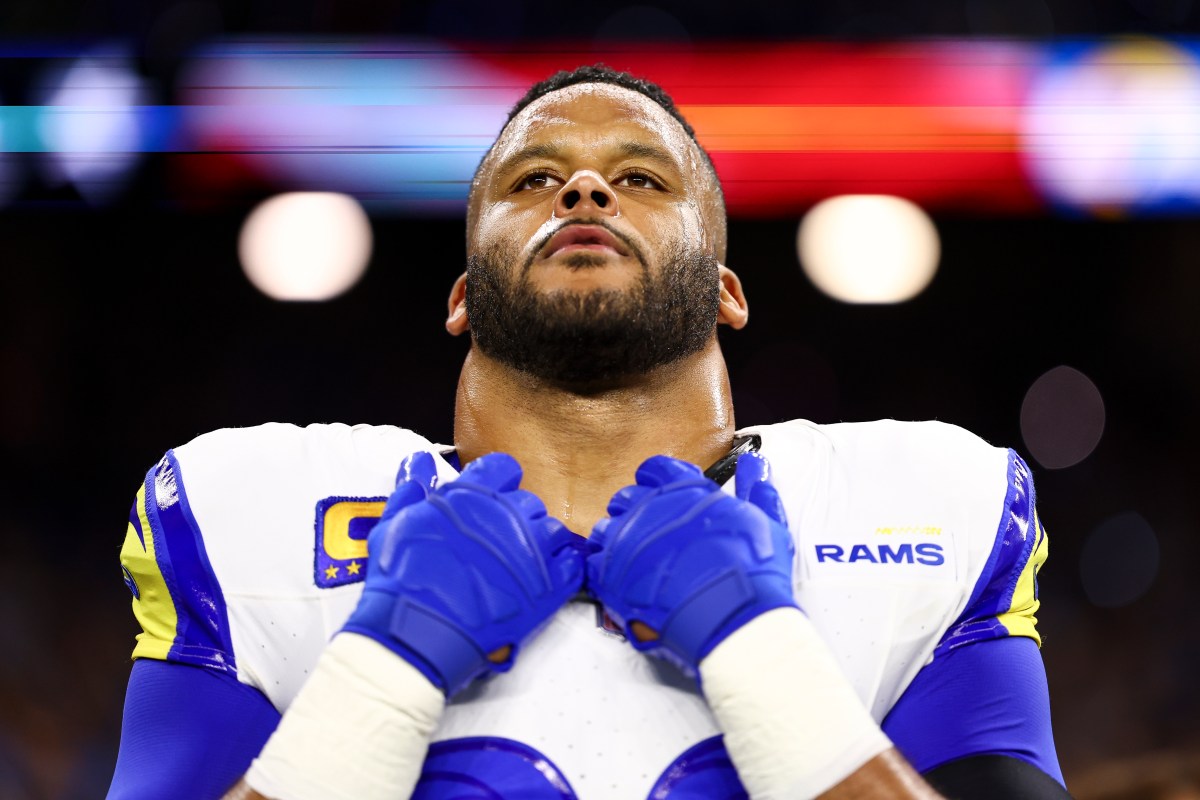
The Los Angeles sun beat down with an unforgiving intensity on the Rams’ training complex, baking the green fields and casting long shadows across the practice itinerary. As the team stumbled through the discombobulated rhythms of a preseason game against the Kansas City Chiefs, the casual observer might have mistaken the sloppy plays and experimental lineups for the only story of the day. But beneath the surface, far away from the rookie mistakes and the fleeting glimpses of untested potential, a much larger narrative was unfolding—one that held an entire franchise in a state of fragile, breathless anticipation. With less than a month standing between the Rams and their highly anticipated regular-season opener against the bitter rivals, the San Francisco 49ers, on September 10th, the unmistakable shadow of Aaron Donald loomed over every drill, every huddle, and every conversation. The three-time NFL Defensive Player of the Year, the man who terrorized offensive lines for over a decade before hanging up his cleats in 2024, suddenly finds himself caught in a gravitational pull between a peaceful retirement and the seductive call of the gridiron.
The rumors have intensified into a deafening crescendo in recent weeks, swirling around the football world with a life of their own, yet Donald himself remains frustratingly silent, leaving the sports world to dissect every cryptic Instagram post and every fleeting sighting at the facility. This is not a simple contractual negotiation or a strategic maneuver for leverage; this is the profound, deeply human struggle of a legend trying to determine if the fire still burns bright enough to justify walking back into the furnace. Last Sunday, he reportedly worked out with the Rams at training camp for the second time this summer, a clear indication that he is actively testing his physical limits against the brutal standards he has always held for himself. He even went as far as flying his personal speed trainer to Los Angeles, a committed investment of time and resources that suggests a genuine desire to reclaim the explosive athleticism that made him a nightmare for opposing quarterbacks. Yet, despite these deliberate steps toward a historic comeback, the ten-time Pro Bowler has not committed to anything, leaving the Rams organization and their fanbase suspended in a purgatory of hope and anxiety.
At the heart of this emotional vortex stands Sean McVay, the Rams’ head coach, whose own well-documented battles with the exhausting, all-consuming nature of coaching have forged him into a leader of rare empathy and emotional intelligence. When McVay faced the media following the preseason opener, his words were not the typical bristling, demanding rhetoric of a coach desperate for reinforcement. Instead, he offered a masterclass in patience and respect, speaking not as a coach trying to squeeze production from an aging asset, but as a friend and confidant walking alongside a man wrestling with existential questions. “We have some loose things where we’ve identified you know dates that we’d like to be able to hit,” McVay admitted, acknowledging the internal timeline running through the organization. However, he swiftly pivoted with a statement that revealed the core of his philosophy: “But what I don’t want to have is any sort of unnecessary pressure on him if there’s some unforeseen circumstances.” This is a monumental departure from the cutthroat, win-at-all-costs mentality that dominates the league, a conscious decision to prioritize the well-being of the human being over the pass-rushing demigod. McVay understands that Donald is not merely a defensive tackle but a man who now has a life beyond the stadium, filled with family obligations, personal wellness routines, and the simple, profound peace of uninterrupted mornings. By refusing to impose a rigid deadline, McVay is acknowledging that forcing Donald back before he is mentally and physically ready would not only destroy the magic of a potential return but could forever damage the sacred bond they share.
The internal debate raging within Donald is as complex as it is fascinating, a private war fought in the quiet moments between rigorous workout sessions. McVay offered a poignant glimpse into that psychological battlefield, explaining that the Rams have had multiple tentative discussions with the legendary lineman about his potential return this season. The coach elaborated on the nature of these conversations, revealing that Donald is essentially conducting an audit of his own abilities, meticulously evaluating whether he can still reach the stratospheric level of play that defined his career before he retired in 2024. “He knows himself in terms of, ‘Am I able to stack back-to-back days? Am I able to do some of the benchmarks that he’s set out for himself?'” McVay observed, painting a vivid picture of a perfectionist applying his legendary standards to his own comeback. For a player of Donald’s caliber, mere participation in the NFL is not a victory; absolute, soul-crushing domination is the only currency he has ever traded in. The fear that gnaws at him is not the fear of injury—he has never been cowed by physical pain—but the terrifying prospect of tarnishing a pristine legacy by returning as a mere shadow of his former self. September training camp is the crucible of truth, where heavy legs, burning lungs, and creeping doubt expose vulnerabilities, and Donald is putting himself through this grueling test to determine if the explosive first step, the violent hand-fighting, and the relentless pursuit of quarterbacks still reside within his body.
The tactical and strategic implications of his potential return cannot be overstated, as the Rams understand that simply adding Donald to the roster shifts the entire gravitational center of their defense. In the chess match that is the NFL, having a player who can single-handedly collapse a pocket and command double teams transforms game-planning overnight, giving defensive coordinators unprecedented flexibility and offensive coordinators sleepless nights. But stripped of all the X’s and O’s, this conflict is intensely emotional. Donald stepped away from football in 2024 not because of a failure or a falling out, but because he wanted to reclaim his life, to escape the relentless physical toll of a decade spent trading blows with three-hundred-pound behemoths. Retirement gave him something glorious: the chance to watch his children grow without the looming threat of injury, to enjoy a meal without checking a nutrition plan, and to let his battered joints heal under the warm sun of normalcy. Yet, the game has a way of haunting the greats, whispering its seductive promises through the quiet moments. The roar of seventy thousand fans, the primal joy of a crucial third-down sack, the euphoric adrenaline rush of bullying an offensive lineman into submission—these are the sirens that call to Donald even in his most peaceful moments. Returning would not be about money or accolades, as he has a bank account overflowing and a mantelpiece decorated with every award the sport can offer; it would be a purely romantic quest driven by the desire to prove to himself that the greatness is still there, waiting to be unleashed one final time.
As the calendar inexorably marches toward the September clash with the 49ers, the Rams organization finds itself in a unique position of extraordinary patience, a deliberate choice that speaks volumes about the connection between the player and the franchise. McVay and general manager Les Snead possess the luxury of time because they fundamentally understand that a fully committed, invested Donald is worth infinitely more than one who has been pressured into a decision. They know that the moment Donald walks through the door officially, he will bring with him not just his physical talents but a championship mentality that elevates every single player in the locker room. However, the broader football world watches with bated breath, eagerly refreshing their news feeds for any hint of a decision. The anxiety is palpable among the fanbase, who oscillate between euphoric hope and the dread of disappointment with every social media post. But perhaps the beauty of this situation lies precisely in its unresolved uncertainty, the raw demonstration that even sporting immortals must grapple with the universal human question of when to let go and when to hold on. Donald is not merely deciding whether to play football; he is deciding whether to voluntarily surrender his hard-won freedom once more to the unforgiving commitment of an NFL season. The answer remains tantalizingly out of reach, suspended between the comfort of what was and the alluring possibility of what could be. Whether he ultimately chooses to grace the field against the 49ers or confirms his retirement with graceful finality, his journey through this decision serves as a powerful, profoundly relatable reminder that the end of a career is never simple, and the greatest battles are often fought internally, far from the flash of cameras and the roar of the crowd.