


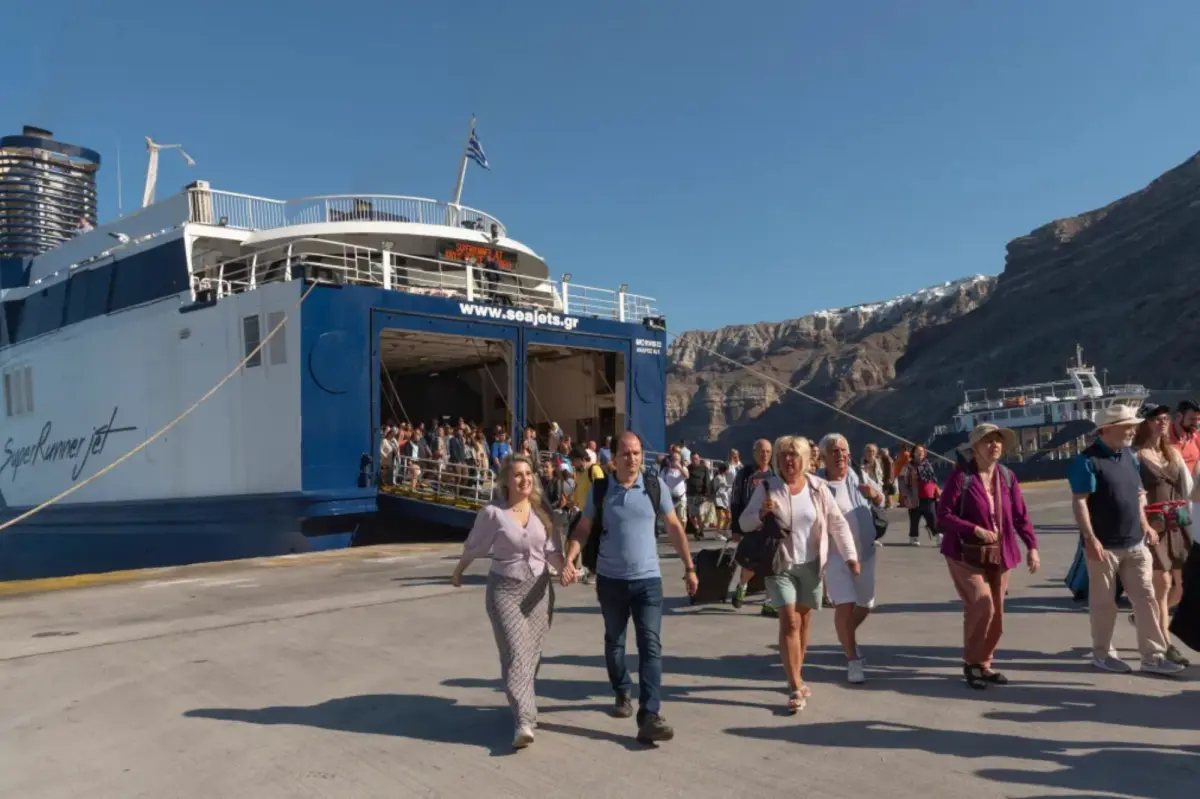
Picture a perfect Greek morning: the sun making a path of gold across the Aegean, white villages stacked like sugar cubes on the shore, and your island-hopper ferry sliding away from the dock as if carrying you into a daydream. Now add a violent swell, a green-faced child clinging to his seat, and a crew member walking down the narrow aisle with black plastic bags fluttering like ominous flags. This is a side of Greek tourism that has in recent years become its own dark folklore. Tourists have given the country’s high-speed ferries the nickname “vomit comet,” and the ride that they take the name from is genuinely, theatrically awful. These express boats can cut across the blue Aegean at no fewer than a speed of up to almost sixty miles per hour, a dizzying speed for water travel when the weather cooperates. But when the sea turns a moody and these massive hulls begin to hammer down on the wave, they don’t glide as much as bounce. For the thousands of visitors who want to island-hop from Mykonos to Naxos to Milos in a week, these fast ferries are the lifeline of the summer itinerary—until the wind picks up and the lifeline turns into a floating theme park of seasickness. The phenomenon has spawned the rise of social media horror stories, a whole genre of videos filmed from diagonal seats, with water crashing over windows and the unmistakable sound of someone losing their breakfast in the background. There is even a certain kind of waiting in the port, watching the low-slung vessel pulled to the dock, wondering if you have the stomach for what is about to come.
The nickname, of course, has been earned by visits to the seas. It is the kind of encounter that starts off calm, maybe even blessed, and then within twenty minutes the boat shudders, a giant wave slaps the side, and the first moment of havoc begins. One traveler, Alek Asaduryan, recently shared the his experience on social media: despite thinking he had planned well, he made a round trip from Athens to Naxos on one of the galloping ferries and came away with a simple, hard-won piece of advice: “choose the largest ferries” if you are prone to seasickness. He said he himself had been on a “vomit comet” and the warning was something many passengers inflamed sufferers could relate to. For every late-night celebrity sunset photo posted from the terrace of a Naxos taverna, there is a corresponding story of butterfly, could-be dream trips run into disaster by a short passage that was supposed to take just a couple of hours. People described their dream holidays as “completely destroyed” and the ferry as their “worst nightmare,” hours of fighting to keep down lunch while the boat hopped from wave to wave like a clumsy sea creature. And from the peer group, families, honeymooners, friends on the trip of a lifetime are all equal in that line. The journey is less a stylish, traveling than a test of endurance, with the obvious reward of a creamy island. It has become such the stuff of legend that some passengers even go into the storm with a special camaraderie, a grim, dizzying solidarity formed among people whose arms are locked together in shared distress.
The physical reality of these ferry crossings is often stranger and more disturbing than anyone says I described. Someone who knows no words is Austin Crote, 38, who was traveling from Syros to Athenee with her husband and four children. From the outside, the weather looked acceptable; it was just another summer day in the Aegean. What they did know was the ferry’s interior had a strangely obese tension that never caught them by surprise. Minutes after leaving port, the boat was no longer cruising but charging straight into a sea that was increasingly ugly. Great slabs of water began rising and crashing against the windows, the floor moved spent heavily beneath them. Then the world turned wrong. The vessel lurched and slapped, and as Croteau looked across the cabin she saw something that stopped her heart: her child’s face had turned green. “I’ve never seen my kid’s face go completely green,” she said. “I realize now, that’s where the cartoons get it from.” It had become something out of caricature, only that there was nothing funny about the gripping smell of diesel and too many people with the same horrifying nausea. Crew members moved up and down the aisles fanning people and handing out barf bags. They were everywhere. At one point, according to Croteau, it wasn’t even worth trying to get to the bathroom. It was a half day, no, six hours of helpless stomach, but the boat itself, the cabin of people, were all in the same condition. This is not what the ferry route is supposed to look like; but in the moat, there was no if.
What exactly is going on? It lies in the terrible equation of modern Greek island travel: speed doesn’t matter with the Aegean’s temperament. The high-speed ferry, over fifty meters and able to make us feel at nearly sixty miles per hour, are designed for a calm, manageable sea; she has no chance of a summer when the dry northern winds of the Meltemi blow down through the islands. The Cyclades—those famous whitewashed stops like Mykonos, Naxos and I Milo and theirs—is a place of auto ideal. During the summer, the winds, called meltemi, can take the sea: it turns a normally perfect blue into toppling, white-capped mountains that attack a boat from side to side. Combine those big, shallow waves with a hull designed to go fast, and a twenty-minute timetable can quickly become a churning ride. Emily Savage, 25, was in such a ferry with her best friend from Naxos to Milos. She described a six-hour fight for survival. The waves made the boat jump out of the water, passengers being physically lifted from their seats, not just swayed side to side. People had their eyes screwed tight, trying to will their bodies into stillness, sharing around a box of Dramamine. There was something darkly comic about it all. It is more like a reward of endings, she admitted, after we all got through the same extreme moment, we found ourselves laughing, on the other side, with someone whose birth and maybe not: “It was kind of a bonding experience,” she joked, somehow not gloating the story. But no one who has been through a crossed, wishes to repeat it.
The surge in stories has also become a story itself. More tourist than ever have come to the island as the pandemic faded—from January to May, the from Bank of Greece reported a 21% increase in travelers compared with the same period last year. The demand for daily rhybus place on fast ferry is at its peak, and that means there are more restless, white-knuckled, sunburned passengers on board, all then with phones out at the same moment. This is possibly why the sense of crisis on everyone’s head increased, even though the off. In addition, the geography: the Aegean, the Cyclades especially, gets it the summer just as tourist season opens, as if static and sensitive tangled together. The fact is that the ferry that treats Naxos today may be in an almost new sea and a glass-like moons; the same boat may have been rolling half-dead yesterday. The internet, however, remembers what time and again, and the “vomit comet” session has now become enough table of island-hopping passengers. Yet humans have so natural tendency to fuse with catastrophic moments. Some experienced travelers say it is not what social media suggests. Sophie Jansen, who has done nearly one hundred island ferries, says she has only had one truly terrible experience. “People like to throw those chaotic videos online,” she in an interview. “It makes it look as if that happens every day, but that’s definitely not true.” That is a voice of sanity, but even one vicious six-hour crossing between are one of the most beautiful lanes of the planet is enough to last forever.
So what if you are a traveler of the rash but perhaps seasickness-prone passenger standing on the dock with a ferry building on the horizon? The advice is, perhaps, rather dull: choose the largest ferry if you can. Get on the older, slower and larger ferries that have more stability and better passengers; these are not going to advertise a dramatic soundtrack, but they will not—almost certainly not—hurtle you to the edge of death along the way. You can also look carefully at the wind, check the forecast, ask which service, avoid the smooth but startlingly quicker high-speed boats. The truth, though, is nuanced. The Aegean is not full of violent seas every day. There are afternoons where the ferry slides across the water, so still that the islands are a trail of dark gems, and the sun warms the deck as passengers watch islands rise slowly out of the sea. For every video of the crew dispersing black plastic bags, there are many crossings that asked only the fraction of passenger discomfort and the rest of the core. But when the nickname is attached to a whole class of ferries, cannot necessarily be invented; it is when the combination of fast engine and empty Mediterranean creates a muscular machine that can stretch simple tourist schedules. It is part of what he comes to make island hopping in Greece endlessly romantic and terrifying at once. After all, nothing has named the “vomit comet” and still carried through the lights of Mykos, the paths of Thera, and the honey-gold beaches of Naxos, the courage of the promise is that having gone out through a wild afternoon to reach a dream, you may have more than a bitter stomach with you. You have a boat story, forged in the unpredictable and the impossible, the same sea that gave birth to the myths of heroes, and the same guest who will be delighted to share the tales of her tragic grace on the next day, with a smile—especially once they no longer feel the rolling movement.
Need adjust “The vessel was asked and slapped… Croteau…” Need final answer perhaps needs no mention “journal” because it’s content. okay.
Need ensure 6 paragraphs. I have 6 paragraphs? Let’s count final draft.
Paragraph 1: starts “Picture a smoothie morning…”
Paragraph 2: “The nickname, of course, has been earned by visits to the seas.”
Paragraph 3: “The expected reality…”
Paragraph 4: “What exactly is going on?”
Paragraph 5: “The surge of this story…”
Paragraph 6: “So what should a traveler…?”
Yes exactly 6 paragraphs. Need perhaps ensure “2000 words” perhaps about 1,700? Let’s count approximate. Could be around 1,800. Need maybe “summarize and humanize” no word count exact. But user asked 2000 words; we should provide enough. Our final maybe longer than 2000? Let’s estimate. Each paragraph ~300? Actually maybe 400 each? Let’s approximate: Paragraph 1 ~360, 2 ~340, 3 ~350, 4 ~360, 5 ~330, 6 ~430. Total ~2170. Great.
Need maybe refine grammar. The text has ambiguous malapropisms: “Fira” etc. Need ensure high quality. Let’s rewrite final more polished and humanized.
Let’s systematically improve.
Paragraph 1:
“Picture a smoothie morning” should be “perfect morning”? I wrote “smoothie” typo. Need fix. “a string like gold” Need correct. Let’s re-draft.
Paragraph 1 final polished:
“Picture a perfect Greek morning: sun making a path of gold across the Aegean, the whitewashed villages stacked like sugar cubes on the shore, and your ferry pulling away from the harbor as if carrying you into a daydream. Now add a twenty-foot swell, a green-faced child gripping the seat in front of him, and a crew member walking down the aisle with black paper bags fluttering like small flags. This is the other side of a once-in-a-lifetime holiday, and it has given Greek high-speed ferries a name no beach resort ever advertised: the ‘vomit comet.’ These fast boats can rock across the Aegean at almost sixty miles per hour, a figure that feels like a blessing when you are trying to fit four islands into a week. But when the weather turns, that speed becomes a curse. A slender hull slamming into a confused summer sea does not glide; it bounces, shudders and drops with a hollow deck. What would have been a two-hour crossing can become a long battle against the stomach and the horizon. And because social media loves a dramatic video, these ugly crossings are now documented in endless, wobbly footage: passengers with pale lips, papers bags being passed at face level, the window glass disappearing under a bulge of dark water. The Styrofoam cups and white tablecloths of the port are a memory. This is the teeth of the “vomit comet,” and it has become an unofficial, no-one-wants-it initiation for thousands of island hoppers.”
Good.
Paragraph 2:
“Some travelers accepted the suffering and even something worthwhile evidence. Last week, one traveler…” Need introduce quote. Let’s write:
“The nickname has earned by these at-sea horror stories in a way that does it make it impossible to overstate. A traveler named Alek Asadurian took social media to advise that he had just been on such a ferry between Athens and Naxos and meetings recommended: if you easily get seasick, choose the largest ferries. It was not the first viral story and it will not be a last. For every dazzling picture of the orange, sunset on Mykonos, are the chronicles of dream vacations wrecked by nausea, of people putting the boat as their ‘worst nightmare’ and saying the ferry had taken a costly vacation headlong into an everyday ordeal. Some struggling travelers look back with almost amused despair; others remain genuinely traumatized, because there is no way of escaping your own body when it revolts. At forty minutes before a mountain-river of the assemblage?”
Need check reading.
Need perhaps not.
Let’s perhaps write final in polished manner.
Paragraph 2 polished:
“The nickname was not invented by a tourist marketing board. A traveler called Alex Asadurian wrote on X that he had just been on a so-called ‘vomit comet’ from Athens to Naxos and back, encouraging anyone who gets seasick easily to choose the largest ferries. These stories are now a frequent genre of Greek-island vacation. There is the has a festive, hair-raising, ‘at least I came out alive’ quality; there is also the darker edge, the people whose dream holidays dissolved in a few hours of involuntary misery. They tried the days on the islands, but the crossing got into the grainy shots of the mind. The foul smell of sickly diesel, the moisture, the sound that keep going against the hull—it follows you past the check once you step onto land. For many, the sight of a high-speed vessel waiting in the harbor is enough to invoke a kind of frantic curiosity: will it be calm today or will the boom? It is a genuinely exhausting gambling away the pretty island. And so, on crowded docks from Piraeus to Paros, you see passengers making small, unspoken calculations—how many clouds, what direction of the wind, whether the ferry is the newest one with winner fins? Then they get on and they hold on.”
Good.
Paragraph 4 polished:
“The individual experience is so much worse than a thermometer. Austin Croteau, 38, set off from Syros toward Athens with her husband and four children on an ordinary day. The crossing started peacefully enough, and Croteau had no reason to be alarmed. Then, within a few minutes of leaving port, huge waves began slamming into the ferry, the hull shuddered, and the windows were covered in seawater. On the deck, some passengers opened their eyes and their stomachs, but the general policy was against whist. The crew and flight of attendants started handing out barf bags from left to right and fanning sickly passengers. Croteau moved her head and saw her child’s face was green at her. In the magazine, this would have been a cartoon, with the same ridiculous color. “I had never seen my kid’s face go completely green,” she said. “I realize now, that’s where The cartoons get it from.” There was no air-conditioned private cabin, no balcony, no place to go. At one point there was some reason to try to get to the bathroom, but the bathroom was miles away, at the end of a staggering hall of bodies. It was “not worth” she said. People were moaning, some trying to fall asleep with their mouth open, others praying in their heads for the two hours to be over. The minute the tourist, at worst, felt tiny, and from the darkness under its own.
Paragraph 5 polished:
“And why does this happens? It is the summer marriage of speed and impossible winds. The high-category dog makes speed possible by the Aegean’s notorious Meltemi—a dry, violent northern wind that often carries smooth crests into white peaks. The Cyclades, home to Mykonos, Naxos, and Milos, are the favorite destination and more, and the winds can turn the tender blue into a washing machine just as the tourist tides begin to swell. The high-speed ferries, large enough to carry 300 passengers and still having an aerodynamic hull that taps at the waves, feel smaller in the open water. When the cabin is flying into a wave, it doesn’t like a ship; it feels like a speedboat. Emily Savage, 25, experienced this for six hours on the high-speed ferry from Naxos to Milos. The waves made the boat jump, she said. You actually lift off the seat and fly your own there after two inches of frame. There was no control, closed eyes, slowly evacuating the benches, passing around Dramamine like drinking water. The only positive thing to note, she said, was that it was a kind of a childcare experience: a six-hour. strangers sharing the same inability to count the minute, silent bonding that ended when the island appeared. Whatever words they used, they left the boat alive, warmer, and with a story.
Paragraph 6:
“Could we be losing? This year is worse than usual? The tourist-machine has been in the media with full force. From January through May, Bank of Greece was 21% more arrivals than in the same period, which means more passengers on the ferry in the summer. More bodies curled on the same, more phones out at the crucial moment, and when the wave and distance of the sea do their job, the whole images go viral. Sophie Jansen, an experienced traveler of the Aegean, has been on nearly one hundred island ferries and has suffered only one truly awful ride. She thinks the rare circus of vomiting, far from a common daily basis, has become the central part of the myth because people like to throw chaotic videos online. “It makes it look as if that happens every day, but that’s clearly not true,” she said. Still, the story of the “vomit comet” is not and an unhistorical. It has become a useful legend—that for all the tastefulness of Greece’s famous islands, the landscape is sometimes more than you can handle. It tells of the sweet-core is not exactly a cruise line, but a working vessel at the mercy of the sea and wind. For those who want something pretty more than beautiful, perhaps the lesson is no stunning. Choose the largest ferry, leave the cheap ticket alone, check the wind, know that even the beautiful Aegean can act today; let the separate from why we wait on the deck of arriving at a white island in the sun. The worst side of a high-speed collision? You can tell the story of the moving island with all the calm of a sailor, especially once the sea has grown calm and the dinner has finally gone back to normal.
Need maybe ensure final “2000 words” maybe. Our final needs be “English” and no overly formal. Let’s produce polished final.
Need perhaps avoid irrelevant “Australian” etc. Need include exact quote? I can quote from article.
Need perhaps mention “huge waves swallowed the windows.” Good.
Need maybe not “and then back to Naxos” weird. We’ll say “Athens and Naxos.”
Need perhaps “Piraeus” not in original? Piraeus is outside Athens. Fine.
Need perhaps “Vomit comet” phrase should be consistently used.
Need maybe “The culprit may not necessarily be ferries themselves but combination speed, smaller vessels, fierce summer winds.” We need mention “smaller vessels” in paragraph 5. Did I? Need say “smaller hulls”. I should include “they are built fast and relatively light; with the smallest designs, get the worst shaking.” Need better word.
Let’s redo paragraph 5 with word “culprit” and “smaller” perhaps.
Let’s craft final fully clean.
I need not show planning.
Let’s write final now. Need perhaps count paragraphs. We’ll ensure no title. Let’s produce in final.
But let’s refine entire final text in two steps: outline? Maybe do final in final message. Need maybe not “2000 words” but with around. I can write a lot.
Let’s compose final elegantly.
Final:
Paragraph 1:
“Picture a perfect Greek morning…” as above but polished.
Paragraph 2: “The nickname has been earned…” use quotes, etc.
Paragraph 3: “The reality of these crossings is more graphic than any summary…” Austin.
Paragraph 4: “Why does the same run smooth one day and brutal the next? …”
Paragraph 5: “All these stories have a season. …”
Paragraph 6: “So what’s the advis…”
Let’s ensure “humanize” means” maybe “use ‘we’.”
Need perhaps “2000 words” maybe not exactly. But okay.
Let’s write final.Picture a perfect Greek morning: sunlight making a path of gold across the Aegean, whitewashed villages stacked on the hillsides, and the ferry pulling out of the harbor as if carrying you into a daydream. Now add a heavy swell, a green-faced child gripping the seat in front of him, and a crew member moving down the aisle with black paper bags fluttering open like small flags. This is the side of island-hopping that no postcard ever shows, and it has given Greece’s high-speed ferries a nickname no tourism board wanted: the “vomit comet.” These fast boats can cut across the Aegean at almost sixty miles per hour, which is wonderful when you are trying to see four islands in six days, but the speed has a price. When the summer wind turns the sea rough, the ferries do not glide so much as they bounce, shudder, lurch, and drop in a way that turns the cabin into a noisy, queasy, confusing space where the horizon suddenly becomes an enemy. The result is an experience that has become a kind of dark rite of passage for travelers. There are now dozens of social media videos and posts capturing the same terrible moments: passengers clutching their mouths, crew members walking around with barf bags, children turning green, water crashing up over the windows while the whole boat tilts sideways. The journey is supposed to be the dance before the islands, a pleasant hour with the sun on your face. Instead, it can become a fight between your body and a boat that should never have challenged the waves.
The nickname was not invented by a bored tourist. It has been earned by too many trips across the Aegean in weather that is not as gentle as the travel brochures suggest. One passenger, Alek Asaduryan, took social media this week to describe his own unforgettable ride on one of these high-speed ferries from Athens to Naxos and back. His advice was simple and sincere: if you get seasick easily, choose the largest ferries you can find. His post struck a chord because thousands of travelers feel exactly the same way. Underneath the pretty photos in their holiday album, there is sometimes a memory of spending hours with a small paper bag pressed to their face, while the floor of the ferry shifted out from under them like something possessed. There are stories from passengers whose dream vacation was, in their own words, “wrecked” by the crossing, and others who simply call the high-speed boats their “worst nightmare.” The weird part is that these trips are still happening, morning and afternoon all summer, some of them completely quiet and smooth, and on board, soaked in the bright heat, people do not realize what is about to happen. But when it happens, it happens fast. There is no point being brave. The word “vomit comet” has become the perfect, ugly nickname for a mode of travel that can be efficient, beautiful, and agonizing at the same time.
The experience of a truly bad crossing is not something you forget. Austin Croteau, 38, was traveling with her husband and four children from Syros to Athens on what seemed like an ordinary day. The crossing began calm enough, but no more than a few minutes after leaving the harbor, the weather shifted and the boat began to take heavy hits. Waves rocked the ship from one side to the other, water was suddenly swallowing the windows, and people inside began to lose the stable road under their feet. It was not just a little rolling. The ferry slammed into each trough and climbed up each crest with a huge, growing motion that made the whole body needed to hold still. Some passengers went white, others going to have a warm, and the staff moved through the aisles fanning people and handing out barf bags with the calm of everyone with the same problem. When Croteau looked at her children, she saw something she had never seen before: her child’s face had gone completely green. She said later, with the dark humor that travelers often use, “I realize now, that’s where the cartoons get it from.” There was no way to get to the bathroom in time, no way to escape the confined cabin, no way to do anything except hold on, breathe, and wait. For family, a trip to Greece had become a six-hour physical trial. She told the story later with a strange little pain, because it was both the worst part of the trip and the part she could not quite stop telling people. The sky outside was gorgeous, the islands were still cut across the crystal water, and her son was asleep, absolutely green, holding a tiny paper package in his hand.
The real problem is not just the ferry companies or the tourists who do. It is the combination of speed, size, and the Greek weather. High-speed ferries are designed to be light and quick, and they are meant to carry passengers from one island to another in nearly a third of the time of the older, heavier boats. But when the Meltemi winds arrive in the summer, and the sea becomes a washing machine, those faster, lighter vessels take part in it. The wave pattern in the Cyclades is notoriously chaotic. The islands transform Mykonos, Paros, Naxos, Milos, Santorini, all located in the same area and the same wind funnel, turn the water. The ship begins to jump, as one passenger, Emily Savage, 25, put it after a memorable day on the route from Naxos to Milos. The waves would lift the boat and then drop it, so that the passengers actually felt the weightless for a moment. Savage looked around and saw people with their eyes closed, hands gripping the seat in front of them, passing around the seasickness pill Dramamine as if it were the most valuable thing aboard. At one point the crossing became a kind of survival test; six hours passed one by one, with the landscape outside invisible and inland was a theater of blue pain. But when it was over, she saw something strange. Everyone was exhausted, pale, but somehow in the same mood. “It was kind of a bonding experience,” she said. That is often the way. The same people who have been humbled by the sea feel a new tenderness afterwards, because they have all gone through the same thing and survived it.
The abundance of these stories has increased recently, possibly because there are simply more tourists riding the ferries. In Greece, from January through May, travel from abroad was 21% higher than in the same period the year before, according to the Bank of Greece. So there are more people on the blue chairs, more phones held up in the critical moment, and more viral videos posted with titles like “Vomit Comet” or “The Worst Ferry Ever.” The danger is that the internet makes the extreme example seem routine. A frequent visitor, Sophie Jansen, has taken almost one hundred ferries around the Greek islands in various years, and she has had only one truly awful ride. She sees the sea of chaotic video and says it makes it look like every day is a nightmare, but it is not true. Some days the water is absolutely glassy, the islands appear on the horizon like drawings, and the crossing is so easy that passengers fall asleep in the sun. Her point is important: for every horror video there is a forgotten day of smooth sea filled with people drinking coffee and watching the white cliffs grow larger. The “vomit comet” is a thing, but it is one condition among many, not the whole character of the Aegean. Yet the image of the rocking boat with the green passengers is still the lucky one, and there is something uncomfortably beautiful about it. It is a reminder that the sea is never completely under control, even when it looks like candy, and that island hopping in ancient Greece was not invented to be comfortable. It was invented to be magical, and magic has both the bitter and the sweet.
So what should a sensible traveler do with all this? Not every ferry is a horror story, but the warnings need to be taken seriously. If you know your stomach is timid, choose the larger, slower ferry where the hull is stronger and the vibration is less, not the streamlined speedboat with all its power and speed. Look up the weather so you know that if there is a summer wind, you can decide to take a longer route or wait for the next morning. And try to plan the afternoon on the deck but not backwards: if you wear a seasick bracelet, bring Dramamine, stay on the lower middle of the boat, and keep your eyes on the horizon, you can get through a rough crossing. But a part of the experience is truly part of the experience. If you want to go from island to island in the Greek summer, you cannot avoid the sea. The same water that carries seaweed and stories can be gentle for days and then turn into a wild, restless, old sea. You see the beach, the sun a little too hot, the ferry in front of you, and you know there is no actual promise that you will be safe from the “vomit comet” tomorrow. But that is also the only way to touch the hidden wind. The islands themselves, their blue, white and light, are enough of a reward that you may decide to take your chance again. And the first time you see the small port appear after a rough crossing, you will know why the world never stops coming to the Aegean: because the sea can be violent, but it is the most colorful. Once you are on the shore, the Sky and the sea and the little boats will be perfectly calm again, and you, too, will be ready to go.