


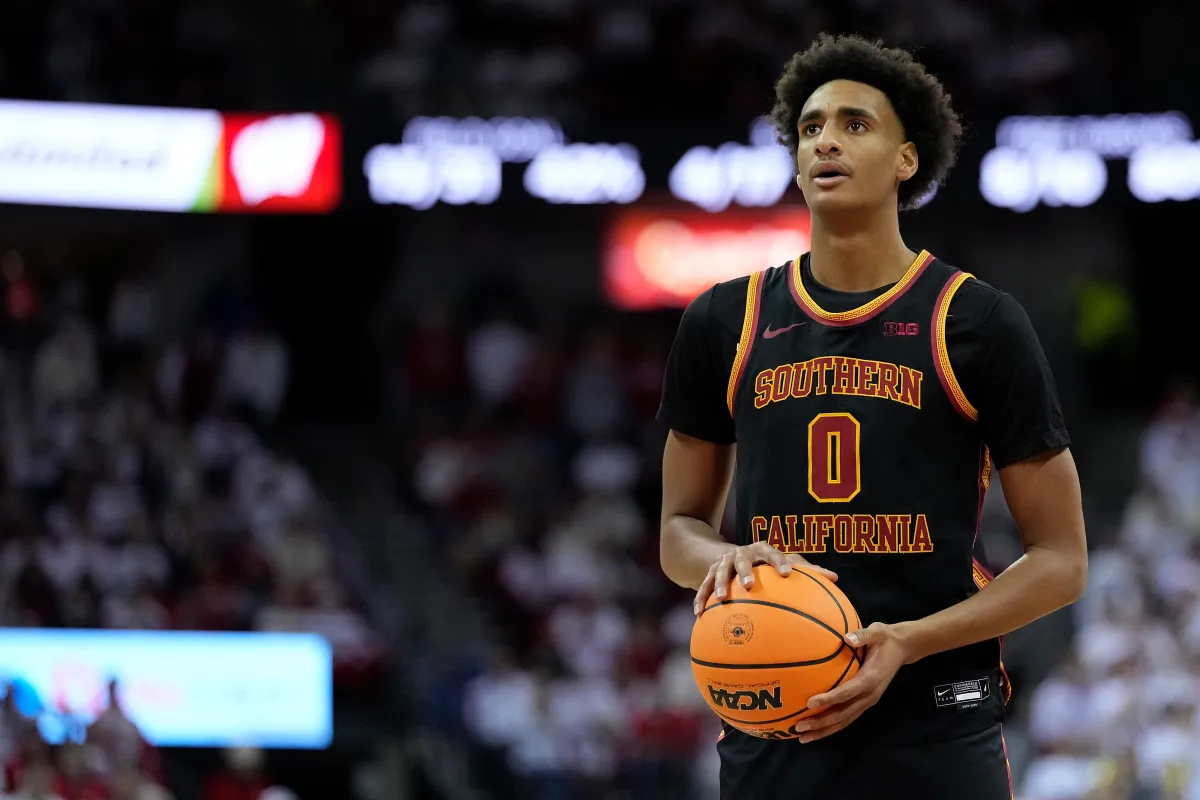
In the sprawling, sunbaked ecosystem of Los Angeles basketball, few names carry as much weight or as much history as “Arenas.” For Alijah Arenas, the son of three-time NBA All-Star Gilbert Arenas, the path to the professional ranks was never a question of if, but when—and, more importantly, how. The spotlight in Southern California is relentless, magnifying every crossover, every deep three-pointer, and every mistake. Yet, as he stands on the precipice of his sophomore season at USC, the young guard’s voice has lost the impatient edge of a hot-shot recruit. Instead, there is a clarity that feels almost startling for a 20-year-old. He has traded the seductive allure of individual stardom for a far more pragmatic, and perhaps more terrifying, metric for success: the scoreboard. After a frustrating, injury-riddled freshman year that denied him the stage he craved, Alijah has resurfaced with a singular obsession. He doesn’t talk about his jump shot, his handles, or his scoring averages. He talks about victory. It is a mature pivot, a realization that in the brutal, unforgiving ecosystem of NBA scouting, statistics without context are just expensive decorations. His journey back to the Trojans is not a retreat; it is a calculated, strategic repositioning, born from the realization that the only currency that translates seamlessly to the professional stage is winning.
“Win.” That’s the word Alijah unequivocally uses when asked what it will take to elevate his draft stock for the 2027 NBA Draft. It is a rehearsed yet sincere mantra, stripped of elaborate excuses or complex basketball jargon. “I don’t have any other words. If we win, we all can make it. That’s the biggest thing that I have my eyes set on right now. How do I get to that next level?” This isn’t just coach-speak; it is a recent, painful lesson extracted from the cold data of the last few years. Arenas points directly at the correlation between team success and individual recognition. “All the guys in the first round of the draft from last year were on winning teams. Your individual stats can help you, but winning can help you go even farther.” He isn’t wrong. When the 2026 NBA Draft lottery was announced, the correlation was glaring—six of the top twelve picks came from the four No. 1 seeds in the NCAA Tournament: Michigan, Duke, Arizona, and Houston. These were players who had been battle-tested in March, who had endured the pressure of a deep tournament run, and who had proven they could impact victory when the stakes were astronomically high. For NBA general managers, those moments are the ultimate audition. It is a stark shift from the previous decade of scouting, where raw athleticism and stat-sheet stuffing could mask a losing culture. Now, scouts look for the intangible glue that holds a locker room together, the player who makes everyone else better. Alijah knows that a 25-point performance in a 15-point loss to a mid-tier Pac-12 team will never hold the same weight as a 15-point performance in the Elite Eight. He is repositioning his entire value proposition, betting that his sacrifice for the team’s collective goal will yield a greater individual return.
The pain that drove this epiphany was visceral. Alijah had initially planned to declare for the 2026 NBA Draft after just a single season at USC, riding the hype that followed him out of high school. But fate, as it often does, had a different, humbling script. A knee injury requiring surgery cast a dark shadow over his collegiate debut, delaying it until January 21st. When he finally stepped onto the floor, the rust and physical apprehension were palpable. He managed to appear in 14 games, posting respectable averages of 14.1 points, 2.9 rebounds, and 2.1 assists per game. On paper, those numbers are solid, but in the context of his lofty goals, they felt hollow. He was playing catch-up, fighting against his own body, and dreaming of a March Madness run that never materialized for the Trojans. He spent months in the training room, watching on the sidelines as his teammates battled without him, feeling the clock tick down on his draft ambitions. The quiet frustration gnawed at him. He had come to college to prove he was a transcendent talent, a superstar in waiting. Instead, he was just a promising prospect on a team that missed the NCAA Tournament. The season ended with a whimper, leaving Alijah unpicked and unproven. The withdrawal from the 2026 draft wasn’t just about needing more polish; it was about needing a redemption arc. It was about repairing the narrative that had been abruptly fractured by that unlucky twist of the knee.
His father, Gilbert, understands that hunger for redemption intimately. Back in March, during a candid appearance on the “Hoopin’ N Hollerin” podcast, the elder Arenas peeled back the layers of their private conversations. Gilbert revealed that he had pressed his son on the decision to return, questioning the logic of delaying his payday. The response he received wasn’t from the polished media-trained athlete; it was from the raw, competitive son who grew up watching his dad battle Kobe Bryant. “I want to lead college in scoring,” Alijah told him. “I don’t think these people know what I could do.” It is a declaration filled with swagger, a direct inheritance from his father’s unapologetic confidence. However, there is a fascinating tension here. The father’s instinct is to tell his son to dominate, to average 30 points a game and silence the doubters with sheer offensive firepower. The son, however, is beginning to reconcile that primal urge with the modern realities of the NBA draft. He wants to lead the nation in scoring—that primal, personal fire still burns—but he now realizes that the number next to his name in the win column is the ultimate tie-breaker. He is learning to balance his father’s aggressive DNA with the wisdom of a player who recognizes that the league values winners over volume scorers. It is a delicate dance between the ghost of his father’s era and the demands of his own.
The weight of that balancing act now rests directly on his shoulders in a way it hasn’t before. As one of just three returners on a USC roster that has been gutted by the transfer portal and early departures, Alijah has been thrust into a leadership position by default. The veteran core that surrounded him last year is gone, replaced by a wave of freshmen and newcomers who will look to him for guidance. The shift is significant. Last season, he could defer to upperclassmen, focusing purely on his own offensive rhythm. Now, the offense will flow through him, and the defense will key on him. He must be the emotional engine as well as the scoring engine. The goal is stark: get USC back to the NCAA Tournament for the first time since 2023. It is a lofty ambition for a team that is essentially being rebuilt in Alijah’s image. The pressure to succeed is immense, but Arenas seems to be embracing it rather than shying away from it. He knows that a deep tournament run in the gauntlet of the Big Ten would be the ultimate statement to the 2027 draft board. He is no longer just a talented kid trying to get his; he is the captain charged with steering the proverbial ship through rough waters.
Ultimately, Alijah Arenas’s story for the 2026-2027 season is one of synthesis—merging the fiery competitive spirit of his lineage with the cold, analytical demands of the modern NBA. He is no longer just “Gilbert’s son” hunting for validation, nor is he a stat-padder desperate for a scoring title. He is crafting a new identity as a leader, a winner, and a commodity. The 2027 NBA Draft is the distant finish line, but the path to get there runs through the unglamorous grind of team practices, the sharing of the basketball, and the resilience required to lead a young squad through the wilderness of a rebuilding season. Alijah knows that the mock drafts will fluctuate, but the character forged in a playoff run cannot be simulated. He wants that feeling—the one his father experienced in the NBA playoffs—the gnawing pressure, the electric atmosphere, and the ultimate relief of victory. He wants to prove that he wasn’t just a high-scoring prospect who couldn’t stay healthy, but a winning basketball player who elevated an entire program. If he can achieve that—if he can turn the Trojans into a bracket-busting contender—the stats will take care of themselves, and the lottery ticket will be punched. Until then, he focuses on the only number that truly matters: the one on the scoreboard when the clock hits zero.