



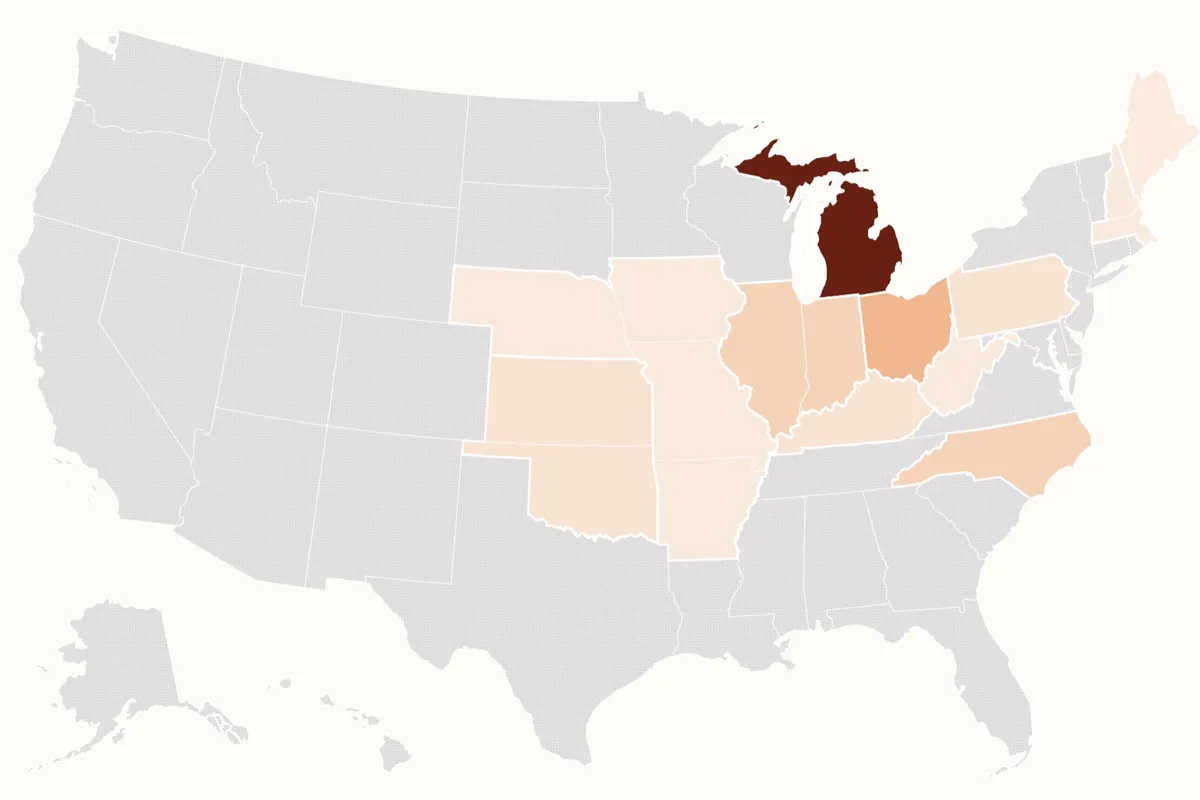
It starts with something as ordinary as a salad — crisp, cold iceberg lettuce, maybe tucked into a taco or served on the side of a plate. But for thousands of Americans this summer, that simple bite has led to weeks of stomach cramps, relentless diarrhea, and in some cases, hospital beds. The United States is now in the middle of its largest cyclosporiasis outbreak ever recorded, and health officials have traced the culprit to iceberg lettuce grown in central Mexico and distributed through one of the country’s biggest produce suppliers. As of Thursday, seventeen states are officially connected to the outbreak, with Maine and Massachusetts the latest to join the list. That’s a jump from the fifteen states reported just last week, and it’s a deeply unsettling moment for anyone who has eaten at Taco Bell, bought bagged lettuce, or simply trusted that a leafy green from the store was safe to eat. The numbers are staggering: the CDC reports at least 9,481 confirmed cases tied to this specific outbreak, including at least 398 people who have needed hospitalization. And Michigan has reported the first two deaths. Behind each one of those statistics is someone who never expected that a meal could change their life so quickly.
The investigation points to a familiar name in the produce aisle. The FDA has linked shredded iceberg lettuce served at Taco Bell to the outbreak, and investigators have focused their attention on Taylor Farms, a massive produce company that supplies lettuce to restaurants and grocery stores across the country. In July, the company issued a recall of iceberg lettuce grown in central Mexico, after health officials began asking questions about the source of the contamination. Taylor Farms says it moved quickly, pulling potentially affected products from shelves and going beyond the initial request by recalling all iceberg lettuce sourced from that region. The company has also voluntarily suspended all iceberg lettuce sourcing and production from central Mexico, at least for now. In a public statement, Taylor Farms stressed that no product tests have confirmed the presence of Cyclospora as of August 13, but it took these steps out of “an abundance of caution.” Taco Bell, whose restaurants became a focal point of the investigation, also said it completed removal of the affected lettuce from its locations nationwide. The fast-food chain said it acted swiftly, not only to take the lettuce out of its kitchens but to remove the ingredient from its entire supply chain, because the company wanted its guests to enjoy their meals safely. It’s a story of a food system trying to catch up with a silent, microscopic threat — and of companies scrambling to protect their customers before the cause is even fully confirmed.
But the outbreak tied to Taylor Farms and Taco Bell is only part of a much larger, more troubling pattern. Federal health officials say that since May 1, at least 13,895 laboratory-confirmed cases of cyclosporiasis have been reported across 47 states, plus the District of Columbia and Puerto Rico. That’s an enormous number compared to a year ago — between May 1 and August 31 of last year, only 1,180 cases were reported in the entire United States. And even those 13,895 confirmed cases don’t tell the whole story. The CDC says it is aware of at least 10,455 additional cases that have not been laboratory-confirmed or still require investigation to determine whether the infection was acquired domestically. Many of those are concentrated in Michigan, which seems to be experiencing a particularly heavy toll. The agency warns that the true number of illnesses is likely much higher still. People with mild symptoms may never see a doctor; people without insurance may avoid a test; people who recover quickly may just assume they had a stomach bug. All of those infections remain invisible in official tallies, which means the real human suffering is certainly greater than even these alarming numbers suggest. For every person in a hospital bed, there may be many more at home with a fever, chugging water, and wondering if they should have skipped the salad bar. The outbreak is not just a public health issue; it’s a reminder of how vulnerable we all are when something goes wrong in a complex global food supply chain.
If you’ve never heard of Cyclospora, you’re not alone. Among foodborne pathogens, it is not as famous as salmonella or E. coli, but it can be just as miserable. Cyclospora is a microscopic parasite that lives in contaminated water and soil. It typically reaches food through water used to irrigate crops or wash produce — water that has somehow come into contact with human feces. When a person eats contaminated food, the parasite settles in the small intestine and causes an illness called cyclosporiasis. The symptoms are not subtle. The CDC describes “frequent and sometimes explosive bowel movements,” along with cramping, bloating, nausea, fatigue, and sometimes vomiting. It sounds unpleasant because it is. The illness does not hit right away; symptoms generally appear about a week after exposure, though they can start anywhere from two days to two weeks later. That delay makes it incredibly hard to trace. By the time someone gets sick, they may have eaten dozens of different foods from dozens of different places. They might have been to Taco Bell, but also had a salad at home, a sandwich at a friend’s barbecue, or a smoothie made with fresh greens. It’s a detective puzzle where the evidence disappears as quickly as the meal did.
For those who are diagnosed, the road back to health can be a long one. Without treatment, the illness can last a month or more, and — cruelly — symptoms can fade, seem to get better, and then return. Diagnosing cyclosporiasis requires specialized stool tests, and even then, it may take several samples over multiple days to find the parasite. Standard tests don’t always catch it, which means many cases are likely missed or mistaken for a terrible stomach flu. The good news is that there is an effective treatment: an antibiotic combination known as trimethoprim-sulfamethoxazole, commonly sold under the brand names Bactrim or Septra. For most people, that medication can clear the infection and bring relief, though rest and fluids are just as important, especially when diarrhea has been severe. People with weakened immune systems, chronic health conditions, or poor overall health are more likely to suffer severe or prolonged illness, and for them, an infection like this is not just an inconvenience — it can be dangerous. The two deaths in Michigan are a heartbreaking reminder that even a parasite associated with fresh vegetables can have fatal consequences. It’s not a reason to panic, but it is a reason to take symptoms seriously, especially if you’ve eaten lettuce or produce from affected areas and then developed diarrhea that just won’t go away.
So what should a person do with all of this information? First, if you experience watery diarrhea, cramping, nausea, or fatigue that lasts more than a few days, especially if you’ve eaten at Taco Bell or consumed iceberg lettuce recently, talk to a healthcare provider. Ask specifically about cyclosporiasis testing, because it’s not part of a routine stool exam. Mention the outbreak; doctors are more likely to consider the parasite if they know it’s circulating in the community. For everyone else, this moment is a chance to remember that food safety is a shared responsibility. Wash your hands, wash your produce, and pay attention to recalls even when they seem distant. The FDA and the CDC are still investigating, and more cases are likely to be identified in the coming weeks. Taylor Farms has suspended production from central Mexico, and Taco Bell has removed the affected lettuce from its supply chain, but the investigation is far from over. For thousands of families, this summer has already left them sick, frightened, or grieving. The least the rest of us can do is stay informed, stay compassionate, and understand that when we say food is a necessity, we also mean that it must be safe. The lettuce has been pulled, the numbers are being counted, and scientists are chasing every clue. But behind the investigation is something we all share: a simple desire to sit down, take a bite, and trust that what we eat will nourish us, not harm us.