



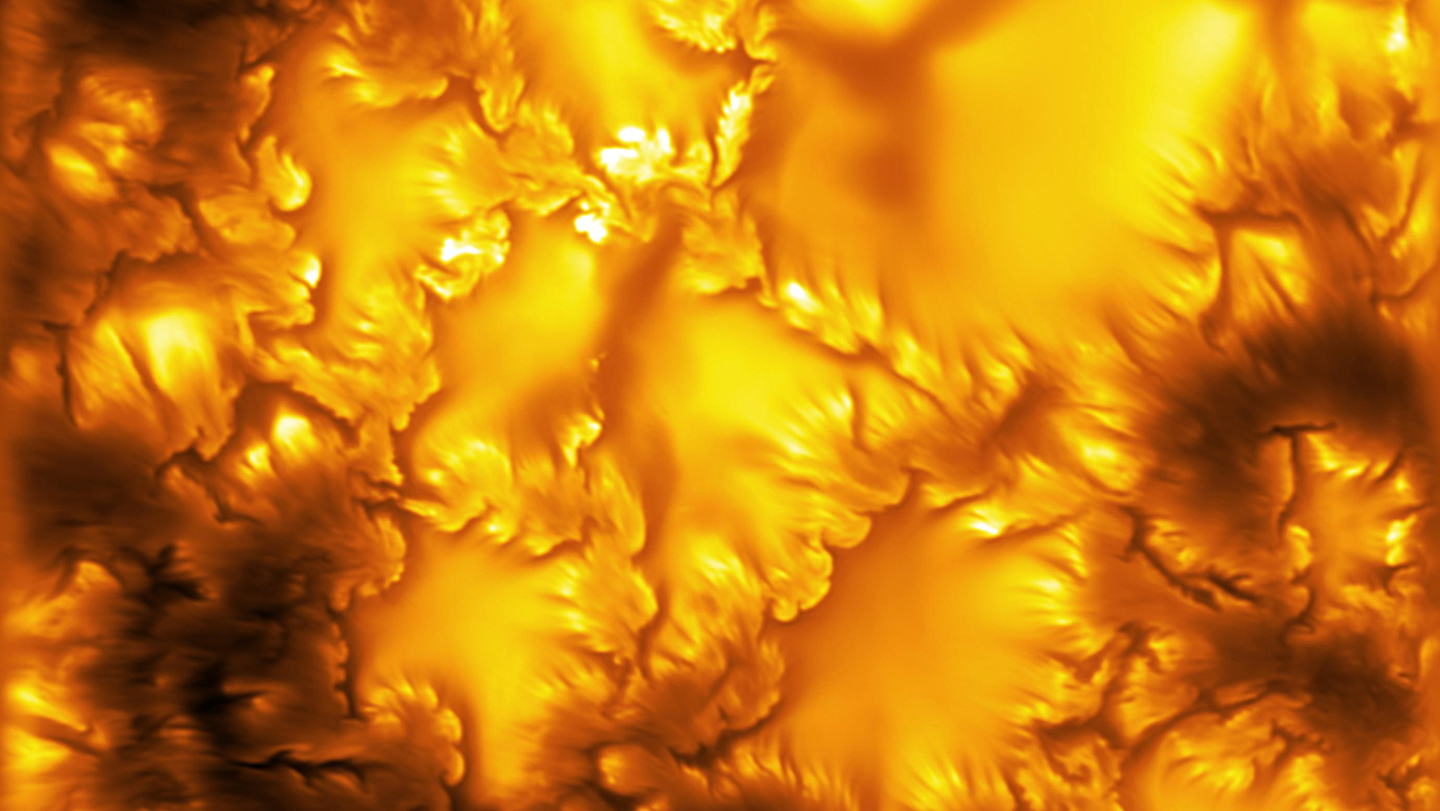
Our host star, the sun, has long been viewed from Earth as a relatively uniform, blazing golden orb, but beneath its brilliant facade lies a chaotic, ultra-fine canvas of violent structures and constant, turbulent movement. In a groundbreaking leap forward for solar physics, astronomers have recently captured breathtaking, high-energy whirlpools dancing across a miniscule 19-kilometer-wide patch of the solar surface. These mesmerizing, highly detailed images, published in a landmark study in the journal Nature, represent the highest-resolution observations of the sun ever recorded by humankind, revealing a level of detail that was previously unimaginable. For centuries, stargazers and solar scientists alike have peered through increasingly powerful telescopes, yet the fine-scale mechanics of the solar surface remained tantalizingly out of focus, obscured by the vastness of space and the thick, churning atmosphere of our own planet. Now, with these unprecedentedly crisp images, researchers have captured the first direct, visual evidence of a specific type of fluid instability occurring at the boundary lines of the sun’s magnetic fields. These churning, magnetized plasma swirls are far more than just a beautiful cosmic curiosity; they represent a fundamental breakthrough in our understanding of the sun’s dynamic nature, offering a crucial missing piece of the puzzle regarding how solar energy propagates, concentrates, and eventually explodes into the solar system. By revealing these microscopic details, the images have forever transformed our perspective on the star that sustains life on Earth, proving that even the most colossal solar phenomena are driven by intricate, small-scale processes that we are only now beginning to truly see.
To appreciate the physics behind these newly discovered solar whirlpools, we must turn to a fascinating fluid dynamics phenomenon known as the Kelvin-Helmholtz instability, or KHI. Named after the brilliant nineteenth-century physicists Lord Kelvin and Hermann von Helmholtz, this instability naturally manifests whenever two adjacent, fluid-like layers of matter slide past one another at different velocities, creating friction at their boundary. When the speed difference between these layers reaches a critical threshold, any minor disturbance at their interface escalates into a series of elegant, curling waves that roll up into distinctive, spiral-shaped structures. On Earth, we encounter this beautiful physical process in several familiar ways, such as when warm and cold air masses collide in the atmosphere to paint wave-like cloud patterns across the sky, or when wind shears the surface of the ocean to create rhythmic, breaking waves. On a grander scale, the Kelvin-Helmholtz instability is responsible for sculpting the colossal, colorful cloud bands that encircle the turbulent atmosphere of Jupiter. However, directly observing this delicate, chaotic dance on the surface of our sun—a hostile, scorching environment dominated by intense gravitational forces and powerful electromagnetic fields—has historically been an impossible dream for astrophysicists. “This instability occurs everywhere at the boundaries of solar magnetic elements,” explains astrophysicist David Kuridze of the National Solar Observatory, highlighting that while scientists knew the KHI must exist there because the sun’s surface behaves like a superheated fluid of charged particles, capturing a visual signature of this process required a level of imaging detail that lay far beyond our technological capabilities until this historic breakthrough.
The true stars of this cosmic show are the millions of “solar magnetic elements” that speckle the sun’s outer layer like a vibrant, invisible patchwork of magnetic energy. The sun is not a solid object, but rather a roiling cauldron of plasma—a state of matter so incredibly hot that its constituent atoms are stripped of their electrons, leaving behind a highly conductive soup of charged particles. When this plasma moves, it behaves like a fluid, dragging the sun’s intense magnetic field lines along with it in a complex, beautifully synchronized dance where fluid dynamics and electromagnetism become completely inseparable. As these millions of magnetic elements jostle, rub, and shear against one another on the solar surface, the massive velocity differences at their boundaries inevitably trigger the Kelvin-Helmholtz instability. The resulting KHI whirlpools act like cosmic generators, twisting and coiling the local magnetic field lines into highly tense, tightly wound configurations, much like a person winding up a rubber band tighter and tighter. This intricate process of converting the kinetic energy of swirling plasma into raw magnetic tension is a primary mechanism for energy transfer, stabilization, and transformation across the solar surface. It provides scientists with a vivid, real-time map of how localized turbulence can store vast reservoirs of latent energy, laying the groundwork for some of the most spectacular and violent outbursts in the known universe.
This monumental scientific triumph was made possible by the state-of-the-art Daniel K. Inouye Solar Telescope, an engineering marvel situated near the majestic summit of the Haleakalā volcano on the Hawaiian island of Maui. Operating as the largest and most powerful solar observatory in the world, this cutting-edge facility boasts a massive primary mirror measuring four meters in diameter, designed specifically to capture the faint, fine details of our local star with unparalleled light-gathering ability. However, constructing a massive mirror is only half the battle when trying to photograph a target located 93 million miles away through the constantly shifting, turbulent lens of Earth’s atmosphere. To overcome the shimmering, blurry distortions that would otherwise ruin such delicate photographs—the very same atmospheric thermal movements that make distant stars appear to twinkle to the naked eye—engineers equipped the Inouye telescope with an incredibly sophisticated, real-time adaptive optics system. This revolutionary system utilizes ultra-fast sensors and deformable mirrors that adjust their physical shapes thousands of times per second, perfectly counteracting the atmospheric turbulence in real time. As Leon Ofman, an astrophysicist at the Catholic University of America, points out, this advanced adaptive system was absolutely crucial for correcting the distortions that would have otherwise completely destroyed the fine resolution of these images, which require resolving structures down to a mere 20-kilometer scale.
The profound excitement surrounding the direct observation of these microscopic solar whirlpools lies in their direct connection to the sun’s most gargantuan and dangerous outbursts, such as solar flares and coronal mass ejections. For decades, heliophysicists have struggled to pinpoint the precise trigger mechanisms behind these explosive events, which have the capacity to release the energy of billions of atomic bombs in a matter of minutes. The discovery of the Kelvin-Helmholtz instability at the boundaries of solar magnetic elements offers a compelling, elegant solution to this long-standing mystery. As these localized KHI whirlpools continuously twist and deform the magnetic field lines, they build up immense, unsustainable levels of magnetic tension within the plasma. Eventually, this built-up magnetic stress reaches a breaking point where the warped field lines snap, break, and violently reconnect in a process known as magnetic reconnection. This sudden snap of the magnetic rubber band explosively unleashes massive reservoirs of stored energy outward into the solar system, driving the spectacular flares and plasma eruptions that we observe from Earth. By examining these tiny, 19-kilometer-wide whirlpools, researchers are effectively peering into the tiny spark plugs that ignite the sun’s massive engine, finally allowing us to witness the birth of solar storms at their very source and understand how micro-scale fluctuations drive macro-scale space weather.
Ultimately, deciphering the fine-scale fluid dynamics of the sun is not merely an exercise in academic curiosity; it is an essential endeavor for protecting our increasingly technology-dependent modern world. When the sun experiences a massive flare or coronal mass ejection triggered by these localized magnetic instabilities, it hurls a torrent of high-energy radiation and charged particles directly toward Earth, creating severe space weather events. These geomagnetic storms have the potential to cripple communication satellites, disrupt global GPS navigation systems, endanger astronauts living aboard the International Space Station, and even induce massive electrical currents in power grids on Earth, risking catastrophic, long-term blackouts. By learning to decipher the subtle physical warning signs of energy transfer on the sun’s surface, scientists can dramatically improve the accuracy and lead time of our space weather forecasts, giving utility companies and space agencies precious time to shield vulnerable infrastructure. As Leon Ofman eloquently summarizes, we must study this energy transfer process from the very interior of the sun to its surface to truly comprehend how solar activity develops and ultimately affects us on Earth and beyond. This research marks the dawn of a new era in space science, allowing us to trace the journey of energy from the thermonuclear furnace of the sun’s deep core, up through its turbulent surface convective zones, and ultimately across the vast gulf of space to our home planet, bridging the gap between microscopic solar turbulence and our daily lives.